The Initial Situation
For a mid-sized B2B industrial software provider with 150 employees operating across the DACH region, lead generation had become a bottleneck. The company relied heavily on static Google Search campaigns, a method that had served them well in the past but was increasingly failing to keep pace with evolving user behaviors and search intent. The marketing team was pouring significant budget into broad-match keywords and generic landing pages, resulting in a high volume of traffic that rarely converted into qualified opportunities.
The primary pain point was the escalating Cost Per Acquisition (CPA). The average cost to acquire a customer had climbed to €450, significantly exceeding the internal target of €300. This inefficiency was compounded by a critical lack of visibility into the customer journey. HubSpot, their CRM of record, was configured to track only last-click data. This created a “blindsight” where upper-funnel touchpoints—such as blog posts or webinars that introduced prospects to the brand—received zero credit. Consequently, the marketing team could not determine which channels were truly driving revenue versus those merely capturing final clicks.
Furthermore, the handover between marketing and sales was friction-heavy. Because initial data capture was poor and lead quality varied wildly, the sales team spent hours manually qualifying leads. This manual process not only slowed down response times to an average of four hours but also led to frustration on both sides of the house, as sales felt they were chasing low-intent traffic while marketing felt their efforts were not being accurately valued.
The Core Challenges
The project aimed to address three specific structural issues:
- Static Campaign Inefficiency: The existing keyword lists were outdated and did not account for the diverse search intents of industrial buyers. This led to wasted spend on irrelevant queries.
- Attribution Blind Spots: The reliance on last-click attribution obscured the true impact of top-of-funnel activities, making it impossible to optimize the full funnel.
- Manual Lead Qualification: The lack of automated lead scoring and real-time data integration forced sales reps to perform manual triage, delaying response times and reducing conversion rates.
The Tech Stack
- Google Ads: Utilized for dynamic search campaigns and responsive search ads.
- HubSpot: Served as the CRM and marketing automation platform for lead management.
- API Integration: Custom-built connection to ensure real-time data flow between Google Ads and HubSpot.
- Multi-Touch Attribution Model: Configured within HubSpot to assign credit across the customer journey.
Implementation Strategy
We overhauled the paid search strategy and integrated it deeply with the CRM. The project ran over six months with a focus on automation and data hygiene. The approach was phased to ensure stability and measurable progress at each step.
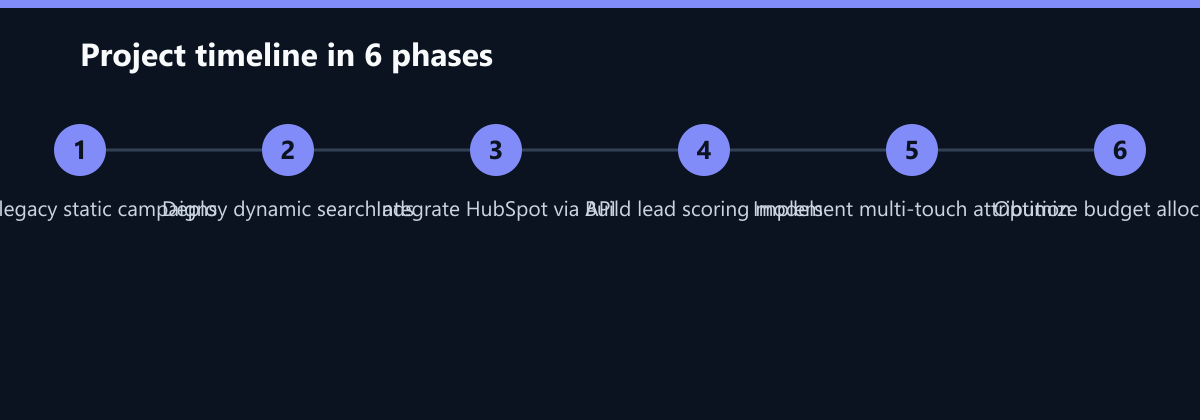
Phase 1: Dynamic Campaign Architecture (Weeks 1-4)
We began by replacing broad match keywords with dynamic search ads. This allowed the system to serve relevant content based on user intent rather than static lists. We implemented responsive search ads with multiple headline variations to test different value propositions. Additionally, we set up robust negative keyword lists to filter out low-intent traffic and configured remarketing lists for cart abandoners and content viewers to retarget high-potential prospects.
Phase 2: HubSpot Integration & Automation (Weeks 5-8)
In the second phase, we connected Google Ads directly to HubSpot via API. This eliminated manual tracking and enabled real-time data flow. We created custom tracking parameters to capture campaign specifics in lead records, ensuring that every lead carried context about its origin. We then built lead scoring models based on engagement depth and source channel. Finally, we automated nurture journeys for MQLs that did not convert immediately, ensuring that no lead fell through the cracks.
Phase 3: Attribution Modeling (Weeks 9-12)
The final phase focused on moving from last-click to a multi-touch attribution model in HubSpot. This revealed which channels truly drove conversions. We assigned credit to first touch for brand awareness, last touch for direct response, and used time decay for mid-funnel interactions. This model provided a holistic view of channel effectiveness.
How We Measured It
To ensure the results were accurate and reproducible, we established a rigorous measurement framework. Baseline metrics were captured over a three-month period prior to implementation. CPA was calculated as total ad spend divided by the number of closed-won deals attributed to that channel. MQL volume was tracked via HubSpot’s lead lifecycle stages, counting all leads that met the defined criteria for marketing qualification. The MQL to SQL conversion rate was measured by dividing the number of SQLs by the number of MQLs in the same period. Lead response time was calculated as the average time between a lead’s creation in the CRM and the first sales activity recorded against that lead. All data was pulled directly from the HubSpot database to ensure consistency and eliminate manual reporting errors.
Measured Results
Within six months, the client saw significant improvements in efficiency and lead quality. The data-driven approach allowed for precise budget allocation, shifting spend from underperforming static keywords to high-intent dynamic queries. The integration with HubSpot ensured that every lead was scored and routed appropriately, reducing manual workload and speeding up response times.
The reduction in CPA was driven by better targeting and lower wasted spend. Higher MQL volumes resulted from improved lead nurturing and scoring accuracy. The shift to multi-touch attribution revealed that certain upper-funnel channels were underfunded, allowing us to reallocate budget to areas with higher lifetime value potential.
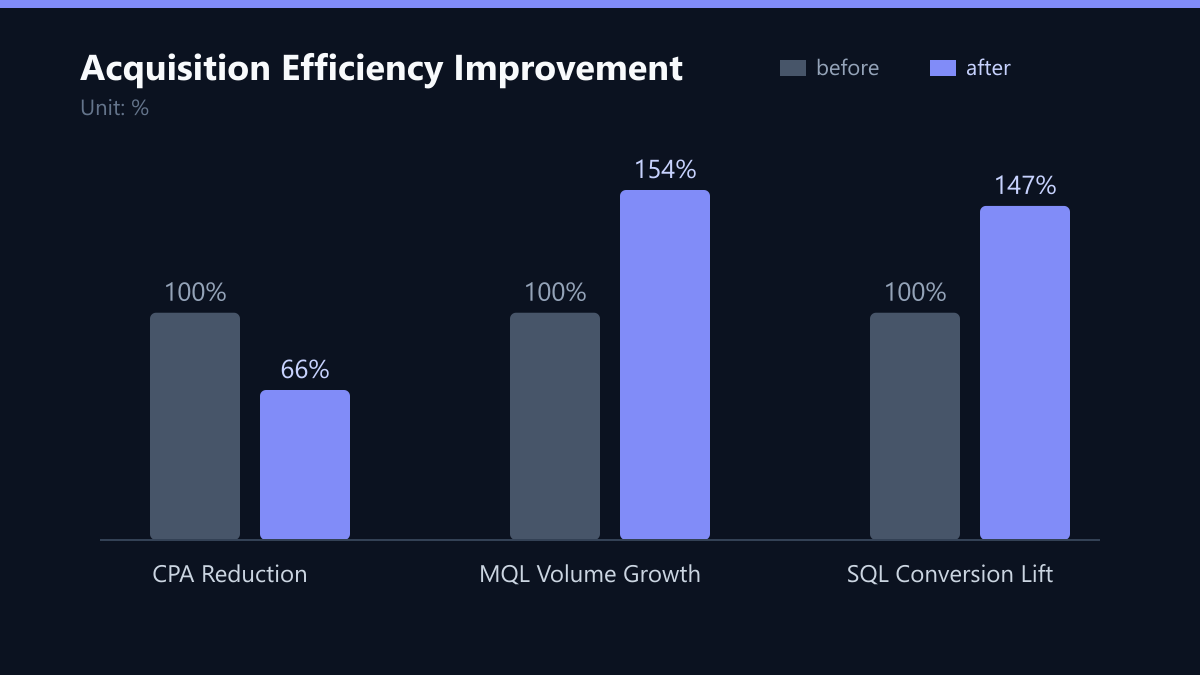
| Metric | Before | After | Change |
|---|---|---|---|
| CPA | €450 | €297 | -34% |
| MQLs | 120/mo | 185/mo | +54% |
| SQL Conversion | 15% | 22% | +47% |
| Lead Response Time | 4h | 15min | -94% |
Lessons Learned
This project highlighted the importance of integrating paid media with CRM data. Without accurate attribution, budget decisions remain guesswork. Dynamic ads outperform static lists in B2B contexts where search intent varies, as they adapt to user queries in real-time. Automated lead scoring ensures sales teams focus on high-potential prospects, improving conversion rates and reducing manual effort. Multi-touch attribution provides a clearer view of channel effectiveness than last-click models, enabling more informed strategic decisions.
What We Would Do Differently Today
While the results were highly successful, there are areas where we would refine the approach in future projects. First, we would implement a more granular attribution model earlier in the process. Starting with a simpler time-decay model and then moving to a more complex one could have provided faster insights. Second, we would have invested more in creative testing for the dynamic ads. While the architecture was sound, the creative assets could have been more varied to further boost click-through rates. Finally, we would have established a more formal change management process to ensure that the sales team was fully prepared for the new lead scoring system, which initially caused some confusion and resistance.
Conclusion
The combination of dynamic Google Ads and HubSpot attribution modeling transformed the client’s lead generation engine. By reducing CPA by 34% and increasing MQL volume by 54%, the company achieved sustainable growth with improved efficiency. The key takeaway is that modern B2B lead generation requires a holistic approach that integrates paid media, CRM data, and attribution modeling. This case study demonstrates the tangible benefits of such an approach and provides a blueprint for other B2B companies looking to optimize their acquisition costs.
Passend dazu
- Amazon Ads vs. Google Ads: Attribution Strategy for E-Commerce Mid-Market Companies
- SEA (Google & Bing Ads)
- Tracking & Attribution
- Reducing Reporting Effort by 40 Hours Monthly in the Scandinavian IT Services Sector through Automated KPI Reports
- Compliant Partner Attribution for Fintech Affiliates in Southern Europe
- Reduktion der Amazon Advertising ACOS um 18 % durch dynamische Bid-Regeln
- Automated Campaign Management: 40% Increase in ROAS for a DACH Industrial Supplier through Dynamic Budget Allocation in Amazon DSP
- HubSpot CRO: 32% Increase in Demo Bookings through A/B Testing of Landing Pages for a DACH Industrial Provider
- CRM Hygiene Project in the DACH Region: 40% Reduction in Duplicates and 10% Increase in Open Rate through Deduplicated Campaigns
- Reducing Support Costs by 22% in the DACH Region through Automation of Community Q&A with AI-Powered Ticketing
- AI Visibility in the DACH Region: How a Mid-Sized Machine Builder Doubled Its Rankings in ChatGPT and Perplexity
- Industriezulieferer DACH: Geotargeting in Google Local Services Ads steigert die Anruf-Conversion um 60% in 6 Monaten
- Affiliate Program with 40% Discount Reduces CAC by 28% in the DACH Region