The Operational Bottleneck
For a mid-sized B2B SaaS provider with 85 employees operating in the DACH region, efficiency is not just a metric; it is a survival mechanism. Like many growing SaaS companies, they faced a classic scaling paradox: as their customer base grew, so did the volume of support tickets. However, the nature of these tickets remained largely static. A detailed audit revealed that 70% of incoming tickets were repetitive questions that had already been answered in their public community forum.
This redundancy created a significant operational drag. Senior support agents, who should have been focusing on complex technical issues or strategic customer success initiatives, were instead spending approximately 15 hours per week manually searching for existing answers and copy-pasting responses. This not only inflated labor costs but also led to inconsistent response times. Agents struggled to locate the most relevant community threads quickly, often missing the best answer in favor of a newer, less accurate one. The lack of a structured automation layer meant that valuable human capital was trapped in low-value, repetitive tasks, creating a bottleneck that slowed down the entire support function.
The Challenges
Implementing an automated solution was not without its hurdles. We identified three primary challenges that needed to be addressed before any code was written:
- Data Fragmentation: The community forum data was siloed from the CRM and ticketing system. There was no unified view of customer interactions, making it difficult to correlate ticket content with historical forum discussions.
- Semantic Ambiguity: Simple keyword matching proved insufficient. Customers phrased the same question in dozens of different ways. A keyword search for “login error” would miss tickets about “authentication failure” or “can’t access dashboard,” leading to false negatives.
- Trust Deficit: The support team was initially skeptical of AI-generated responses. There was a fear that automated drafts would be generic or inaccurate, potentially damaging the brand’s reputation for personalized service.
The Tech Stack
To address these challenges, we selected a lightweight, API-first technology stack that integrated seamlessly with their existing infrastructure:
- Vector Database: Used to store embeddings of community forum threads, enabling fast semantic similarity searches.
- Large Language Model (LLM): Integrated via API to generate draft responses based on retrieved context, ensuring natural language output.
- CRM Integration Middleware: Custom scripts to sync ticket metadata and customer history in real-time.
- Internal Agent Dashboard: A lightweight UI extension within their existing ticketing tool to display AI confidence scores and suggested answers.
Implementation Strategy
We approached the implementation in three distinct phases, prioritizing data quality and agent trust over speed. The goal was not to replace agents, but to augment their capabilities with a reliable ‘second pair of eyes.’
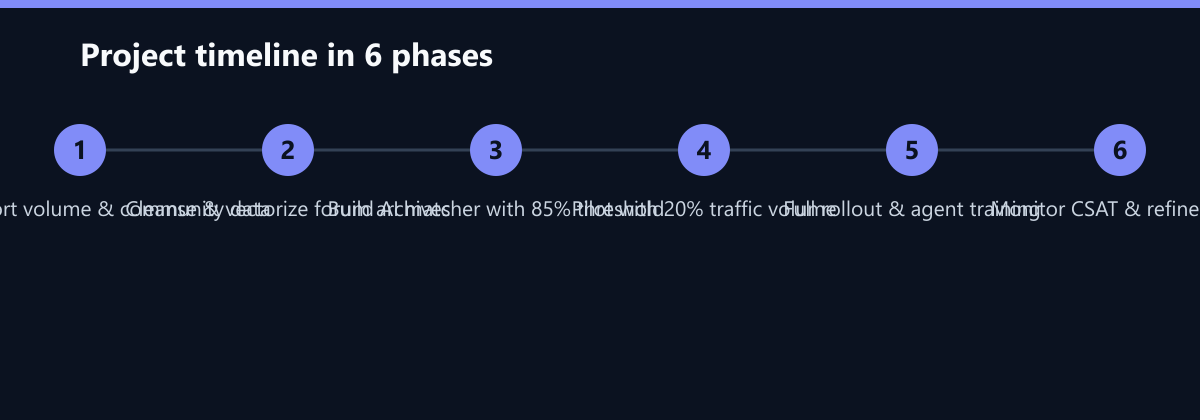
Phase 1: Data Foundation (Weeks 1-2) Before introducing AI, we had to ensure the source data was clean and accessible. We extracted the full archive of the public community forum, filtering out low-quality posts, duplicates, and outdated information. This data was then cleaned, normalized, and chunked for embedding. The resulting vectors were stored in a vector database, creating a searchable knowledge base that could understand the intent behind a question, not just the words used.
Phase 2: Algorithm Development (Weeks 3-4) We developed the AI matching algorithm, focusing on semantic matching rather than simple keyword search. The system was configured with a strict confidence threshold of 85%. This means the AI would only suggest a draft response if it was highly confident that the community thread was a near-perfect match for the incoming ticket. If the confidence score fell below this threshold, the ticket was routed to a human agent without an AI suggestion, preventing the risk of incorrect automation. We also built the integration layer to pull customer context from the CRM, allowing the AI to personalize drafts where appropriate.
Phase 3: Pilot & Refinement (Weeks 5-6) We launched a pilot run with 20% of incoming traffic. During this period, we closely monitored false-positive rates and agent feedback. We fine-tuned the prompt engineering and adjusted the confidence threshold based on real-world performance. Agents were trained to review the AI drafts, edit them as necessary, and provide feedback on the accuracy of the suggestions. This human-in-the-loop approach was critical for building trust and refining the system’s logic.
How We Measured It
To ensure the project delivered tangible business value, we established a rigorous measurement framework. We tracked three primary KPIs: Support Costs, Average Handling Time (AHT), and First Response Time (FRT).
- Support Costs were calculated by aggregating direct labor costs for support agents, adjusted for the volume of tickets handled. We compared the pre-implementation baseline (€45,000/month) with post-implementation actuals.
- AHT was measured via the ticketing system’s native logging, capturing the time from ticket creation to resolution. We averaged this over a 30-day period to smooth out weekly fluctuations.
- FRT was tracked as the time from ticket submission to the first agent or AI response. This metric was crucial for assessing customer experience impact.
We also monitored Customer Satisfaction (CSAT) via post-resolution surveys to ensure that speed gains did not come at the cost of quality. All data was reviewed weekly during the pilot phase and monthly post-rollout.
Results and KPIs
Within three months of full rollout, the support team achieved significant efficiency gains that exceeded our initial projections. The automation handled 45% of all incoming tickets without full manual intervention, meaning nearly half of the team’s workload was offloaded to the AI system.
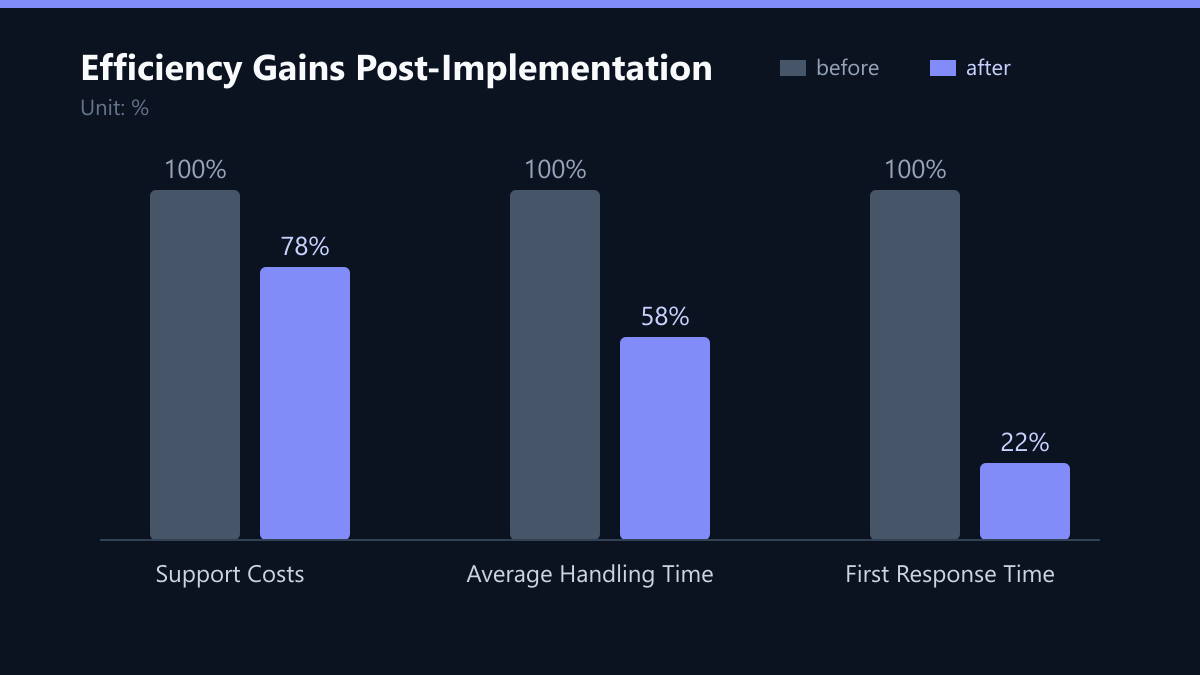
The financial impact was immediate. By reducing the time spent on repetitive tasks, the company was able to optimize its staffing model and reduce overtime. Support costs dropped from €45,000/month to €35,100/month, representing a 22% reduction.
Operational efficiency saw even more dramatic improvements. Average Handling Time (AHT) dropped from 12 minutes to 7 minutes per ticket, a 42% decrease. This was primarily due to the elimination of search time; agents no longer needed to scour the forum for answers, as the AI provided them instantly.
First Response Time (FRT) plummeted from 4 hours to 45 minutes, a 78% improvement. This faster response cycle not only improved customer satisfaction but also reduced the backlog of open tickets, allowing the team to handle peak loads more effectively.
Crucially, Customer Satisfaction (CSAT) remained stable at 4.6/5. This confirmed that the speed gains did not compromise the quality of the interaction. Customers appreciated the faster responses and found the AI-drafted answers to be accurate and relevant, largely because of the human review step.
Lessons Learned
The success of this project highlighted several key lessons for organizations considering AI in support:
- Data Quality is King: High-quality training data is critical for AI accuracy. The time spent in Phase 1 cleansing and structuring the community data was the most important investment in the project. Garbage in, garbage out.
- Continuous Maintenance: Regular updates to the knowledge base are essential. The community forum is a living document; new questions are asked, and new answers are provided. We established a monthly process to re-index the vector database to prevent drift in recommendation quality.
- Human-in-the-Loop is Non-Negotiable: Automation in support is not about replacing agents, but about empowering them. The human review step was essential for building trust and ensuring accuracy. It allowed the team to focus on complex, high-value interactions while the AI handled the routine.
What We Would Do Differently Today
While the project was a success, there are areas where we would refine our approach if we were to repeat it today:
- Earlier Agent Involvement: We would involve support agents in the design phase from day one. Their insights into common pain points and the nuances of customer language would have helped us build a more robust prompt strategy from the start.
- More Granular Feedback Loops: We would implement a more detailed feedback mechanism within the agent dashboard. Currently, agents can accept or reject a draft, but we would add a field to specify why a draft was rejected (e.g., “wrong context,” “tone issue,” “outdated info”). This data would be invaluable for fine-tuning the AI model.
- Proactive Support Integration: We would explore using the same AI engine to proactively reach out to customers who are likely to have issues, based on their usage patterns. This could further reduce inbound ticket volume and shift the support model from reactive to proactive.
Passend dazu
- Marketing Automation
- Performance Marketing
- Social & Community
- Affiliate Marketing
- Content & CRO
- B2B Industry: 34% Reduction in CPA through Dynamic Google Ads Campaigns and HubSpot Attribution in the DACH Region
- CRM Hygiene Project in the DACH Region: 40% Reduction in Duplicates and 10% Increase in Open Rate through Deduplicated Campaigns