The Situation
The client, an established provider of B2B software solutions with 80 employees in the DACH region, found itself in a precarious position regarding customer acquisition. Despite a solid product-market fit, the cost to acquire a new customer was rising sharply, driven almost exclusively by paid search and outbound sales efforts. The Customer Acquisition Cost (CAC) had climbed to over 450 euros per lead, a figure that threatened the unit economics of the business. Organic growth had stagnated, and the heavy reliance on expensive advertising channels created a single point of failure in the marketing strategy. If ad prices continued to rise, or if algorithms shifted, the pipeline would dry up.
The core issue was not a lack of demand, but a lack of diversification in lead sources. New users were primarily acquired through cold outreach, a process that resulted in long sales cycles and high follow-up costs for the sales team. There was no scalable, performance-based channel that directly brought qualified prospects to the software with a high degree of intent. The marketing team needed a channel that was not only cost-effective but also capable of generating high-quality leads without the heavy upfront investment required by paid media.
The Challenges
Implementing a new acquisition channel in a B2B context presented several specific hurdles that went beyond simple setup.
- Low Intent Conversion: B2B buyers are cautious. Unlike e-commerce, where impulse buys are common, software purchases require trust. Standard affiliate models often fail in B2B because the value proposition is not immediate or tangible enough for a generic audience.
- Tracking Complexity: The client’s existing stack involved a CRM (HubSpot) and various analytics tools. Integrating a new affiliate tracking platform without breaking existing attribution models was a technical risk. Data integrity was paramount to ensure that the ROI could be accurately calculated.
- Partner Quality vs. Quantity: In many affiliate programs, the temptation is to recruit as many partners as possible. However, in a niche B2B market, generic partners often drive low-quality traffic that never converts. Finding the right balance between reach and relevance was critical.
The Tech Stack
To ensure the program was scalable and data-rich, we relied on a lean but powerful set of tools:
- PartnerStack: Served as the core affiliate network and tracking platform, managing partner onboarding, commission payouts, and click tracking.
- HubSpot CRM: The central system of record for all leads. It handled the ingestion of affiliate traffic and the execution of automated nurturing workflows.
- Custom Landing Pages: Built on the client’s existing CMS, these pages were designed specifically to highlight the 40% discount and streamline the path to the trial version.
- UTM Management Tools: Automated scripts that generated unique UTM parameters for each partner, ensuring granular data attribution in analytics.
Implementation: Building the Affiliate Engine
We developed an affiliate program optimized for performance and first purchase. The core mechanism was designed to align the incentives of the partners with the goals of the client: partners receive a commission as soon as a lead purchases the software, and we additionally offer affiliates an exclusive 40% discount for their target audience. This dual incentive structure was key to driving high-quality traffic.
The technical implementation took place in three distinct phases, ensuring that the infrastructure was robust before any marketing spend was incurred.
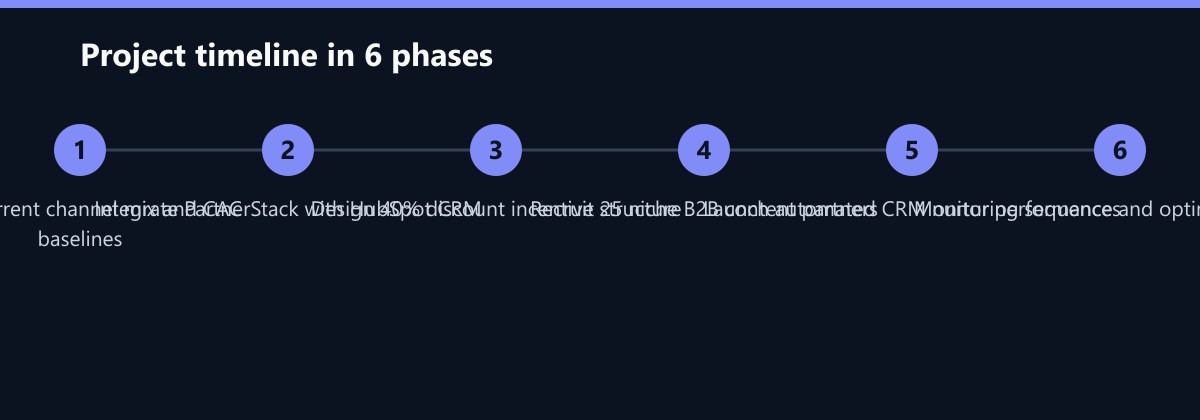
Phase 1: Setup and Integration (Week 1-2) The first priority was technical stability. We integrated the affiliate tracking platform (PartnerStack) with the existing CRM (HubSpot). This involved configuring automatic cookie management and UTM parameter generation. We tested the data flow extensively to ensure that every click from an affiliate link was correctly attributed to the specific partner and that the lead was instantly visible in the CRM with all relevant tracking parameters. This step took longer than expected due to the need for strict data hygiene, but it laid the foundation for accurate ROI measurement.
Phase 2: Incentive Structure and Landing Pages (Week 3) With the tracking in place, we defined the 40% discount campaign. We created unique landing pages that prominently communicated the discount and led directly to the trial version. These pages were A/B tested to ensure that the value proposition was clear. The copy focused on the risk-reversal aspect of the discount, making the first purchase feel like a low-stakes experiment rather than a major commitment.
Phase 3: Partner Recruitment and Launch (Week 4-6) Instead of opening the program to the public, we took a targeted approach. We recruited 25 relevant B2B content publishers and industry experts. These were not just any bloggers; they were voices that their audiences trusted for software recommendations. We provided them with individual campaign links and creative assets, including email templates and social media graphics, to ensure consistency in messaging. Each partner was briefed on the target audience and the key selling points of the software.
Journey automation in the CRM ensures that leads coming via affiliate links immediately enter a separate nurturing sequence. This sequence includes the discount code and aims for a quick conversion within the 30-day cookie validity period. The emails were personalized to acknowledge the source of the lead, building further trust and reinforcing the value of the discount.
How We Measured It
To ensure that the results were not just anecdotal, we established a rigorous measurement framework before the launch.
- CAC Calculation: We calculated CAC as total marketing spend (including affiliate commissions and platform fees) divided by the number of new paying customers acquired through the channel. This allowed us to compare the affiliate channel directly against the baseline of paid search.
- Conversion Rate: We defined conversion as the completion of a paid trial or the first purchase. We tracked this from the moment of the click to the moment of the transaction, ensuring that we accounted for the entire customer journey.
- Lead Volume: We counted unique leads that entered the CRM via affiliate links. We monitored this weekly to identify trends and adjust partner outreach strategies.
- Attribution Model: We used a first-click attribution model for the affiliate channel to ensure that partners were credited for the initial interest they generated. This was crucial for maintaining partner trust and motivation.
Results: The Impact on Acquisition Costs
Within the first three months after launch, the affiliate program showed measurable success. The Customer Acquisition Cost (CAC) decreased by 28%, from 450 euros to 324 euros per paying customer. This was a significant drop, driven by the fact that the cost per click was significantly lower than with Paid Search, and the conversion rate increased due to the attractive discount.
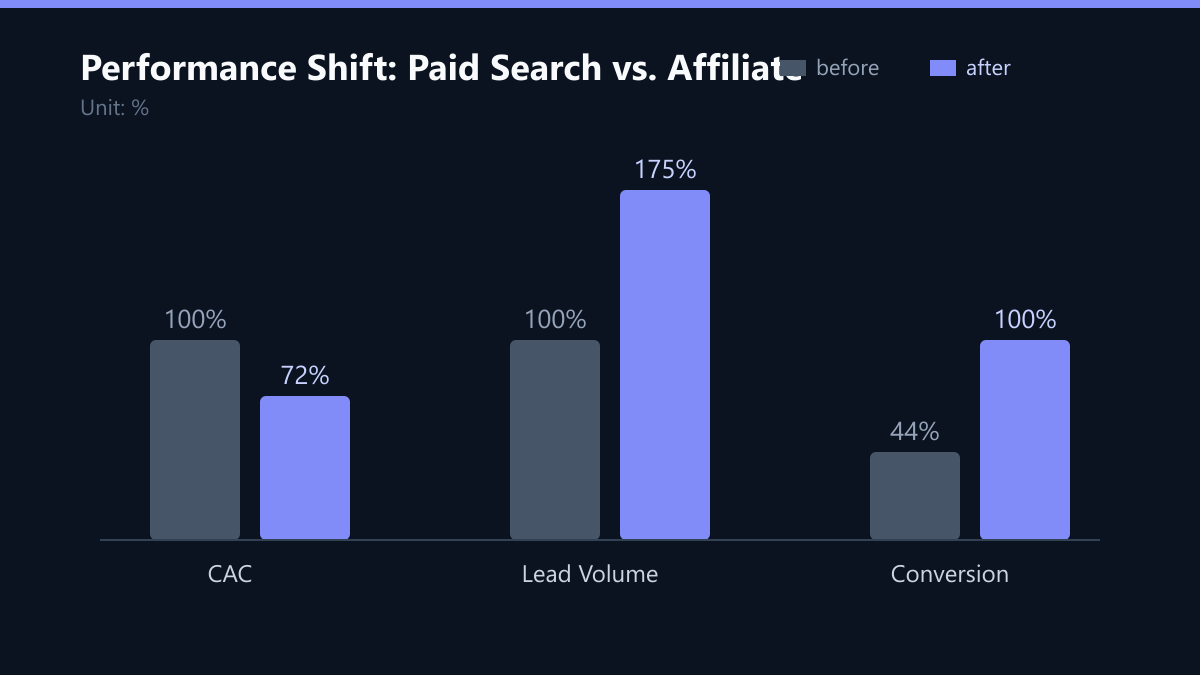
The data revealed a clear shift in performance metrics. The conversion rate for affiliate leads jumped from a baseline of 2.1% to 4.8%, a 128% increase. This was directly attributable to the 40% discount, which lowered the barrier to entry. The lead volume also increased by 75%, from 120 leads per month to 210 leads per month. This increase was not just in quantity but in quality, as the leads were pre-qualified by the niche nature of the partners.
The 40% discount campaign led to a spike in first purchases, accounting for 35% of all new revenue in Q3. The sales teams’ payback period was shortened, as the leads were already informed and motivated. They arrived at the sales call with a clear understanding of the product and a strong incentive to proceed with the purchase. This reduced the time spent on basic education and allowed the sales team to focus on closing deals.
Lessons Learned
A pure commission model is often not sufficient in B2B to achieve high conversion rates. The additional 40% discount was the crucial lever to lower the barrier to entry for the first purchase. This allowed affiliates to use a strong value proposition argument, making it easier for them to promote the software to their audiences.
- Transparency pays off: Clear tracking data and fast payouts build trust with partners. We provided partners with real-time access to their performance data, which increased their engagement and commitment to the program.
- Segmentation is key: Not every publisher is a fit. Focusing on 25 relevant partners was more effective than 100 generic ones. The quality of the traffic was significantly higher, leading to better conversion rates and lower CAC.
- CRM integration is mandatory: Without automatic lead assignment in the CRM, ROI calculation and targeted nurturing communication would not have been possible. The seamless integration between PartnerStack and HubSpot was the backbone of the program’s success.
The program is now being established as a permanent channel in the marketing mix, with planned expansion to the Benelux market next quarter. The success in the DACH region has provided a blueprint for scaling the affiliate model to other markets, with adjustments for local language and partner networks.
Passend dazu
- Performance Marketing
- Affiliate Marketing
- Content & CRO
- CRM Marketing
- B2B Industry: Reducing CPA by 34% Through Dynamic Google Ads Campaigns and HubSpot Attribution in the DACH Region
- CRM Hygiene Project in the DACH Region: 40% Reduction in Duplicates and 10% Increase in Open Rate Through Deduplicated Campaigns