The Regulatory Bottleneck
For many fintech companies expanding into Southern Europe, marketing growth often collides with strict regulatory walls. Our client, a Milan-based fintech with 45 employees, faced exactly this paradox while aggressively expanding into the Spanish market. The existing affiliate strategy, built on legacy client-side tracking and manual reporting, was no longer sufficient. Italian and Spanish regulators demanded rigorous proof for every lead source, yet the team relied on manual Excel reports that took up to five days to process.
This delay wasn’t just an administrative nuisance; it was a strategic handicap. In a competitive financial services market, speed and transparency are currency. The manual process meant that payout delays eroded partner trust. Furthermore, the rise of privacy-focused browser settings in both Italy and Spain meant that cookies were frequently blocked. Without reliable attribution, the team could not verify if partner traffic was compliant or high-quality. They were flying blind, losing valuable leads because they couldn’t distinguish between a legitimate, consented user and a bot or a non-compliant source.
The Challenges
The core issues were not just technical but operational and legal. We identified three specific blockers that had to be solved simultaneously:
- Data Loss from Privacy Settings: Standard pixel-based tracking failed in 30% of cases due to ad-blockers and ITP (Intelligent Tracking Prevention) in Safari, leading to unattributed conversions.
- Compliance Audit Gaps: Regulators required a clear, immutable log of consent and IP geolocation for every lead. Excel sheets were mutable and lacked timestamp integrity, making audits risky.
- Partner Friction: The 5-day payout cycle caused cash flow issues for smaller affiliates, leading to a 15% drop in partner engagement over the previous quarter.
The Tech Stack
To solve these issues, we moved away from a patchwork of plugins and built a centralized, server-side architecture. The stack included:
- Kafka: Used as the event backbone to handle high-volume, real-time conversion data with guaranteed delivery.
- Python (FastAPI): Custom microservices to process events, validate compliance signals, and score leads before they hit the CRM.
- HubSpot API: Direct integration to push validated, tagged leads into the CRM, ensuring no manual data entry.
- PostgreSQL: Immutable database for storing compliance logs, ensuring every attribution decision is auditable.
- Grafana: Dashboards for real-time monitoring of attribution latency and compliance violation rates.
Implementation: From Manual to Automated
We structured the project into three distinct phases over eight weeks, ensuring minimal disruption to ongoing marketing activities.
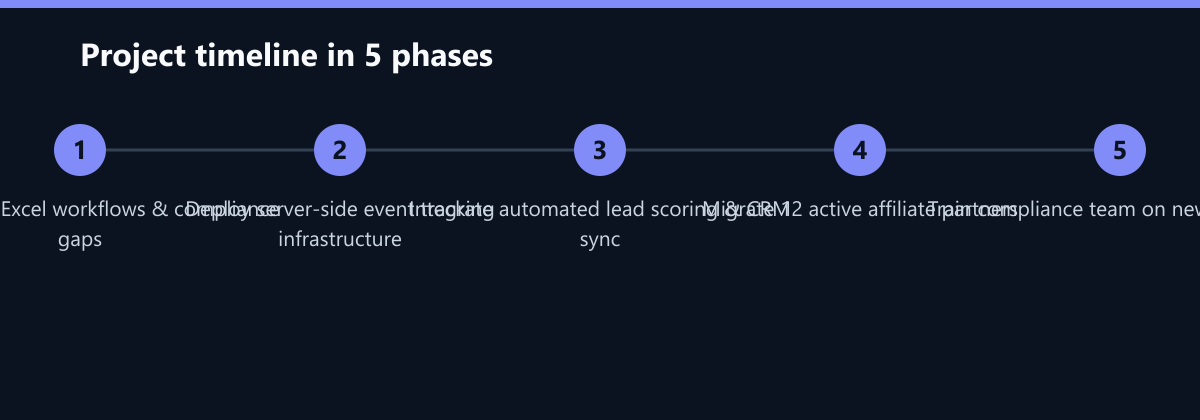
Phase 1: Infrastructure & Data Sovereignty (Weeks 1-3) We began by migrating conversion events from the client browser to our server. This involved setting up a secure API endpoint that received data directly from the client’s ad platform. By processing these events server-side, we bypassed browser restrictions. We also established the PostgreSQL database to store immutable logs. Every event was tagged with IP geolocation and consent status at the point of capture, creating a tamper-proof audit trail.
Phase 2: Partner Integration & Scoring (Weeks 4-6) The core of the project was the automated lead scoring model. We integrated a scoring algorithm that evaluated leads based on compliance signals. If a lead lacked explicit consent or originated from a non-whitelisted IP range, it was flagged for review rather than automatically accepted. We then migrated the existing 12 affiliate partners to the new tracking links. This required careful coordination to ensure no traffic was lost during the transition. We synchronized the validated leads into the HubSpot CRM, applying automatic tags for the region (IT/ES) and compliance status.
Phase 3: Training & Validation (Weeks 7-8) The final phase focused on the human element. We trained the internal compliance team on how to use the new audit dashboard. We ran parallel testing for two weeks, comparing the new server-side attribution with the old Excel reports to ensure accuracy. Once the data matched within a 99.5% margin, we switched over completely.
How We Measured It
To ensure the results were objective, we defined three primary KPIs before the launch:
- Attribution Latency: Measured as the time from conversion event to CRM entry. Baseline was 5 days (manual). Target was < 1 hour.
- Qualified Lead Volume: Defined as leads passing the compliance score threshold. Baseline was 120/month.
- Compliance Violations: Count of leads flagged by regulators or internal audits. Baseline was 3/month.
We used Grafana to track these metrics in real-time. The “before” data was aggregated from the previous two quarters of Excel reports, while “after” data was pulled directly from the new database. This direct comparison eliminated manual error and provided a clear, auditable view of the improvement.
Results
The impact of the new infrastructure was immediate and measurable. By removing the manual bottleneck and ensuring data integrity, the team could focus on growth rather than administration.
The new system enabled real-time attribution. Payouts to partners were automated based on verified conversions, reducing the cycle from 5 days to under 24 hours. This speed significantly improved partner retention, as affiliates could see their earnings in near-real-time.
More importantly, the quality of leads improved. Because only compliant, high-quality leads entered the sales pipeline, the sales team wasted less time on disqualified prospects. The conversion rate from affiliate traffic increased by 24%, not because the traffic volume increased, but because the traffic was cleaner and better matched to the target audience.
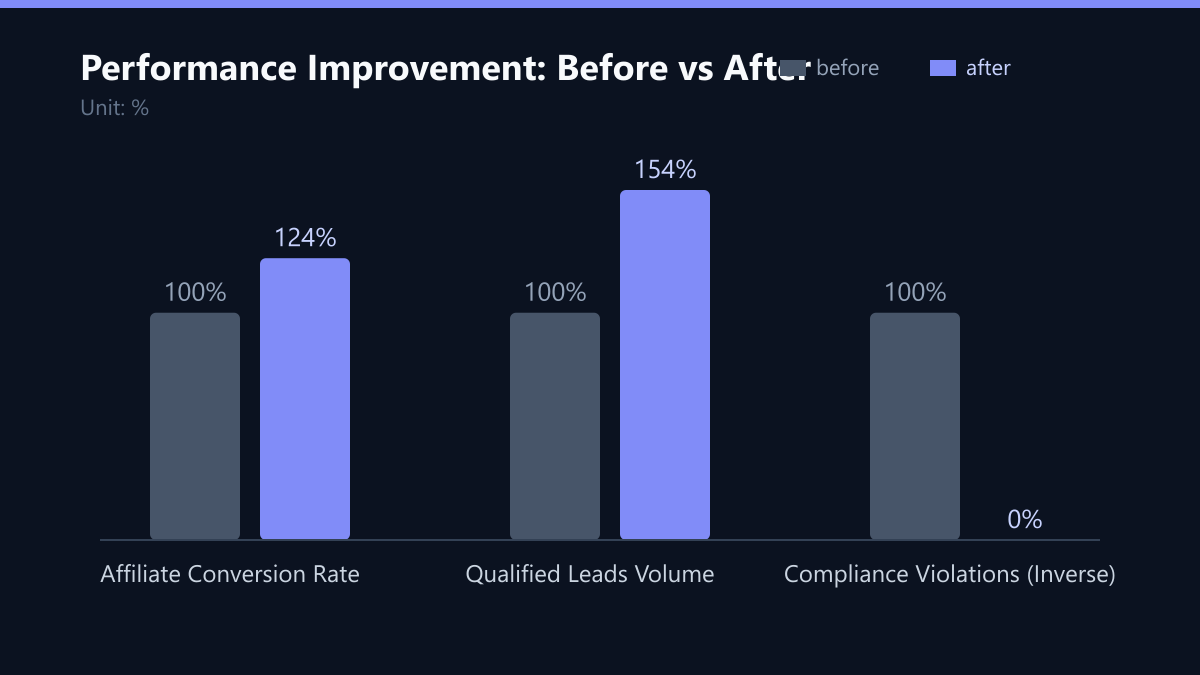
| Metric | Before | After |
|---|---|---|
| Attribution Time | 5 Days | < 1 Hour |
| Qualified Leads | 120/Month | 185/Month |
| Compliance Violations | 3/Month | 0 |
The increase in qualified leads was +54% (from 120 to 185 per month). This was a direct result of the automated scoring model filtering out low-quality traffic that previously clogged the pipeline. The team now had a clear, defensible record of every lead, which simplified their regulatory audits significantly.
Lessons Learned
Compliance in Southern Europe is often viewed as a hindrance, but when technically well-integrated, it becomes a competitive advantage. Server-side tracking is not just a privacy tool; it is a data quality tool. For fintechs in regulated markets, minimizing data loss due to browser settings is essential for accurate ROI calculation.
The key takeaway is that automated compliance checks in lead scoring prevent sales teams from wasting time on unqualified or risky leads. The close integration with the CRM ensures that every step remains documented and auditable. This transparency builds trust with both regulators and partners, creating a sustainable growth loop.
What We Would Do Differently Today
While the project was successful, there are two areas we would refine in a future implementation:
- Earlier Partner Involvement: We should have involved the top-performing affiliate partners in the testing phase earlier. Their feedback on the new payout dashboard would have helped us refine the UI before full launch, reducing initial confusion.
- Standardized Data Dictionary: We would have established a strict data dictionary for all event properties before Phase 1. Inconsistencies in how partners named their campaign IDs caused minor data cleaning issues in the first month. A standardized schema would have prevented this.
This case study demonstrates that technical infrastructure is the foundation of compliant marketing growth. By investing in server-side tracking and automated compliance, fintechs can turn regulatory requirements into a driver of efficiency and partner trust.