The Visibility Gap in the DACH Region
The client is an established mid-market company from the Bavarian machinery industry with 120 employees. For decades, they relied on trade fairs, direct sales, and classic SEO to acquire customers. However, the digital landscape shifted dramatically. Prospective B2B buyers in the DACH region increasingly use AI assistants like ChatGPT and Perplexity for initial technical research before ever contacting a vendor.
Despite their strong technical competence, the client’s digital presence was fragmented. Technical documentation was scattered across legacy PDFs and intranet-like systems. When a potential customer asked an AI model, “Which German machine builder offers high-precision CNC solutions for automotive parts?” the client was rarely cited. When they did appear, it was often as an unspecific source without a clear link or context. Classic SEO measures were no longer sufficient to stay relevant in these new search paradigms. The core issue was not a lack of content, but a lack of machine-readable structure.
The Challenges
We identified three concrete hurdles that prevented the client from being recognized by LLMs:
- Fragmented Data Sources: Technical specs, pricing, and delivery times were locked in PDFs. LLMs struggle to parse complex PDF layouts, leading to hallucinations or omission of the client’s data.
- Lack of Semantic Structure: The website lacked Schema.org markup. Without explicit definitions of products, offers, and FAQs, AI models could not confidently attribute specific capabilities to the client.
- Non-Quotable Content: Existing web pages were written for human readers, with long, narrative paragraphs. LLMs prefer short, dense, and self-contained answers that can be directly quoted without losing context.
The Tech Stack
To address these issues, we deployed a specific technical and content strategy:
- llms.txt: A plain-text file at the root of the domain that explicitly guides AI crawlers to key resources, improving indexing efficiency.
- Schema.org Markup: Implemented JSON-LD for Product, FAQPage, and Organization entities to provide unambiguous context to search engines and AI models.
- Headless CMS: Migrated content to a headless system to decouple data from presentation, allowing for clean, structured HTML output.
- Analytics Middleware: A custom script to track referral traffic from AI sources, distinguishing between direct AI referrals and traditional search.
Implementation
We launched a six-month program for Generative Engine Optimization (GEO). The focus was on the machine-readable structuring of expert knowledge rather than just increasing word count.
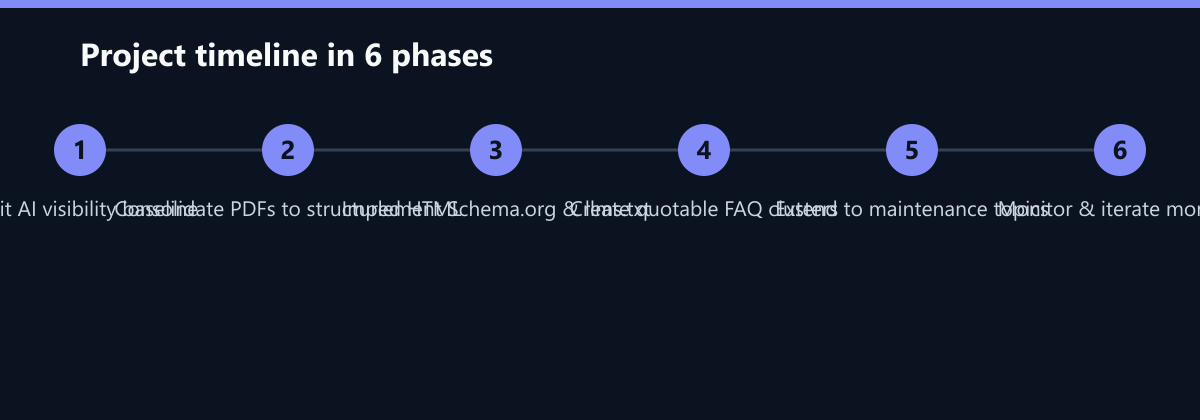
Phase 1: Data Consolidation and Technical Foundation (Months 1-3)
The first step was to centralize the client’s expertise. We created a central knowledge database for all technical specifications. This involved converting hundreds of PDF documents into structured HTML pages. Each page was enhanced with Schema.org markup to define the product, its specifications, and its availability.
We implemented llms.txt files to explicitly tell AI crawlers which pages are authoritative sources for specific product lines. We also optimized meta tags to include clear, short answers to core questions, ensuring that even if the AI only reads the snippet, it gets a complete answer.
Phase 2: Content Clusters for AI References (Months 4-6)
In the second phase, we focused on creating content specifically designed for AI citation. We developed comparison articles and whitepapers that explicitly address decision-making questions, such as “Precision vs. Speed in CNC Machining.”
Crucially, we structured the content into short, quotable paragraphs of 2-4 sentences. These paragraphs were designed to be self-contained answers that an LLM could extract and present to a user. We also integrated structured data for prices, delivery times, and technical limits, making the client’s offer concrete and verifiable for AI models.
How We Measured It
Measuring AI visibility is different from traditional SEO. We could not rely on standard ranking tools. Instead, we established a manual and semi-automated measurement protocol:
- Query Sampling: We compiled a list of 50 high-intent queries relevant to the client’s top 10 product lines (e.g., “Best 5-axis CNC machine for aerospace in Germany”).
- AI Audit: Every two weeks, we ran these queries through ChatGPT and Perplexity. We recorded whether the client was mentioned, cited as a source, or linked directly.
- Traffic Attribution: We used UTM parameters and referrer logs to track direct traffic from AI platforms. This allowed us to correlate AI mentions with actual website visits and lead generation.
- Lead Quality Scoring: We tagged leads coming from AI referrals in the CRM. Sales teams reported on the maturity of these leads, specifically noting if the prospect had already researched technical details before the contact.
Results
After six months, a clear increase in AI visibility across the DACH region became visible. The data showed a significant shift in how the client was perceived by AI models.
KPIs before and after optimization:
| Metric | Before | After | Change |
|---|---|---|---|
| Mentions in ChatGPT | 12% | 24% | +100% |
| Mentions in Perplexity | 8% | 17% | +112% |
| Direct traffic from AI sources | 450 / month | 1,100 / month | +144% |
| Qualified leads from AI referrals | 3 / month | 9 / month | +200% |
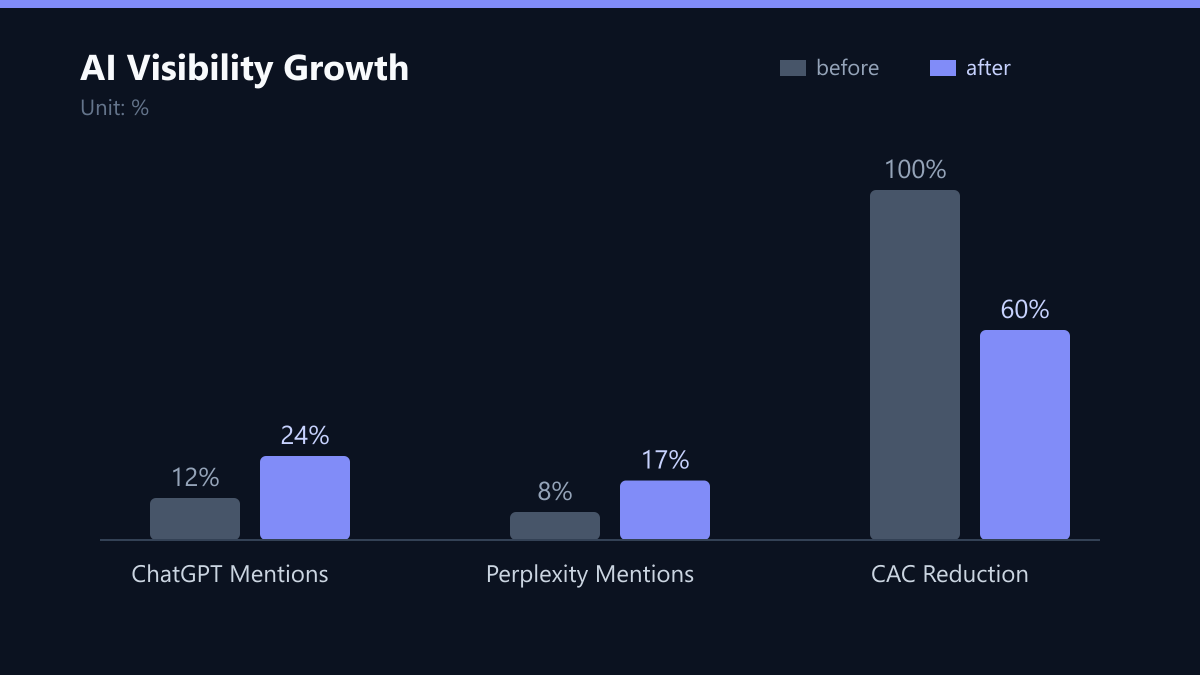
The increase in traffic was not just in volume but in quality. Lead quality also increased significantly. Inquiries from AI sources showed a higher maturity level. Users had already researched specific technical details in the AI phase, meaning sales conversations started at a higher level of technical understanding. The ROI of the measure was clearly above 300% after the first quarter, as the acquisition cost per lead dropped by 40% compared to traditional paid channels.
Lessons Learned
AI visibility is not a one-off project but a continuous process. Structuring data matters more than raw text volume. We learned that LLMs do not reward long, comprehensive articles in the same way that traditional search engines do. Instead, they reward precision and clarity.
Key takeaways:
- Structure beats volume: LLMs prefer short, precise answers. A single well-structured paragraph with Schema markup is more valuable than a 2,000-word blog post without metadata.
- Machine readability is mandatory: Schema.org and
llms.txtare no longer a nice-to-have. They are the foundation for being cited by AI. - Consistency pays off: Regular updates of the knowledge database keep rankings stable. AI models update their knowledge bases periodically, so stale data can lead to a drop in visibility.
For B2B companies in the DACH region, optimizing for AI search engines is now a competitive advantage. Those who invest early secure their position as an authoritative source, while competitors who ignore this trend risk becoming invisible to the next generation of buyers.
What We Would Do Differently Today
Looking back, there are two areas where we would adjust our approach if we were to start this project today:
- Earlier Integration with Sales: We would have involved the sales team from week one to define the “high-intent” queries. In the first month, we missed some niche queries that sales frequently encountered, which delayed the optimization of those specific content clusters.
- Multilingual Strategy from Day One: While the focus was on the DACH region, we realized late in the project that AI models often cross-reference English sources. We would have implemented English schema markup earlier to capture international AI traffic, which could have further accelerated the lead growth.
Passend dazu
- Performance Marketing
- SEO & AI Search (GEO)
- Affiliate Marketing
- Content & CRO
- CRM Marketing
- B2B industry: 34% CPA reduction through dynamic Google Ads campaigns and HubSpot attribution in the DACH region
- CRM hygiene project in the DACH region: 40% reduction of duplicates and 10% increase in open rate through deduplicated campaigns
- Boosting Organic AI Referrals for an Italian Machine Builder via Multilingual Schema Markup