The Starting Point: A Retention Plateau
For many mid-sized e-commerce brands, the struggle is not finding new customers, but keeping them. This Spanish fashion retailer, operating with a team of 45 employees, had mastered the art of customer acquisition. Their paid advertising channels were well-oiled machines, driving a steady stream of first-time buyers to their online store. However, the post-purchase journey was where the model broke down. The customer lifecycle was essentially linear: acquire, sell, and hope for the best.
Data from the initial audit revealed a stark reality. While the Cost of Customer Acquisition (CAC) was high, the Lifetime Value (LTV) remained stagnant. Most customers made exactly one purchase. The brand was burning through marketing budget to replace churned users rather than nurturing existing ones. Customer feedback was fragmented across various social channels, making it nearly impossible to identify what truly drove loyalty. The existing social media presence was reactive—answering questions only when asked, with no proactive strategy to build a sense of belonging.
The core problem was not a lack of product quality, but a lack of relationship infrastructure. The brand needed to shift from a transactional mindset to a relational one, creating a space where customers felt part of a community rather than just a line item in a sales report.
The Challenges
Before diving into the solution, we identified three specific hurdles that had previously prevented successful community initiatives:
- Fragmented Data Silos: Social media insights were disconnected from CRM data. We could see who liked a post, but not who bought a product. This made it impossible to attribute revenue to community engagement.
- Resource Constraints: With only 45 employees across the organization, the marketing team did not have the bandwidth to manage a high-volume community manually. A strategy requiring 8-hour daily manual replies was not viable.
- Content Fatigue: Previous attempts at community building had relied on promotional content, which led to low engagement and user churn. The audience was tired of being sold to; they wanted value.
The Tech Stack
To solve these challenges, we implemented a lean, integrated technology stack designed for efficiency and data visibility:
- Meta Business Suite: Used for scheduling content and monitoring basic group metrics. It served as the central hub for all Facebook and Instagram activities.
- Chatwoot: Deployed as a unified inbox to manage all incoming messages from the group and direct messages. This allowed a single agent to handle all interactions from one screen, reducing context switching.
- Zapier: The critical glue of the system. We built custom workflows that automatically tagged users in the CRM based on their activity level in the Facebook Group (e.g., ‘High Engager’, ‘New Member’, ‘Champion’).
- HubSpot CRM: The existing CRM was leveraged to trigger personalized email sequences based on the new social tags, closing the loop between social interaction and sales conversion.
Implementation Strategy
The implementation was phased over three weeks for setup, followed by a six-month active management period. The goal was to create a ‘Third Place’—a digital space distinct from the store and the brand’s official page, where peer-to-peer interaction could thrive.
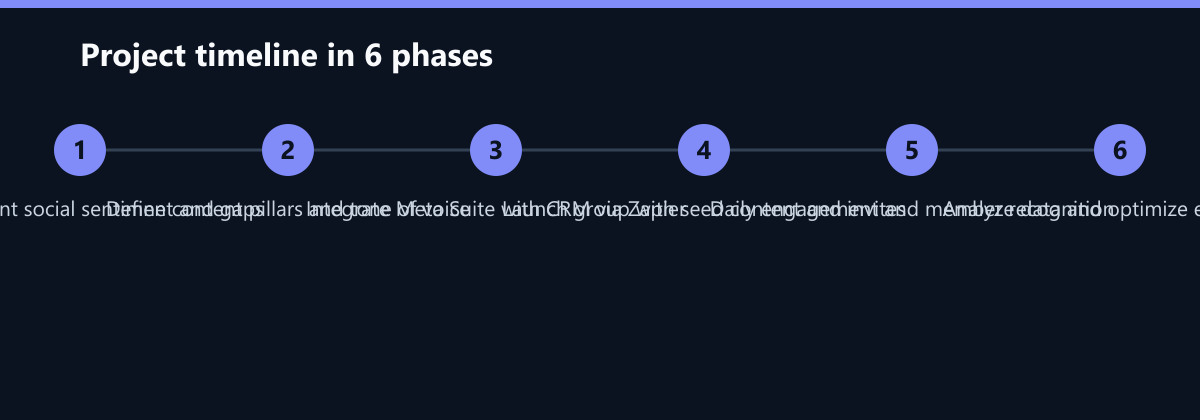
We defined three core content pillars to ensure value delivery without over-reliance on promotions:
- Style Advice & Education: Weekly guides on how to style specific items, care instructions, and seasonal trends. This positioned the brand as an expert, not just a vendor.
- Behind-the-Scenes (BTS): Insights into production, design processes, and team culture. This humanized the brand and built trust through transparency.
- Member-Exclusive Interactions: Polls, early access to new drops, and Q&A sessions with the design team. This created a sense of exclusivity and ownership among members.
A key innovation was the ‘Member of the Month’ program. We identified consistent contributors through the Zapier-CRM integration and rewarded them with exclusive discounts or early access. This did two things: it recognized loyal users, and it provided social proof to new members, encouraging them to participate to gain similar status.
Daily operations were streamlined. The community manager spent 90 minutes in the morning and 60 minutes in the evening engaging with users. The rest of the interaction was handled by automated welcome messages and keyword-triggered responses via Chatwoot. This ensured that no user felt ignored, even during peak hours, without requiring a large team.
How We Measured It
To avoid vanity metrics, we established a clear measurement framework tied directly to business outcomes. We did not just look at ‘likes’ or ‘shares.’ Instead, we tracked the following KPIs using a combination of native Meta analytics and CRM data:
- Repeat Purchase Rate (RPR): Defined as the percentage of customers who make a second purchase within 12 months. We compared the RPR of users tagged as ‘Group Members’ vs. ‘Non-Members’ in the CRM.
- Community Engagement Rate (CER): Calculated as (Total Reactions + Comments + Shares) / Total Members * 100. This measured the health of the community itself.
- CAC for Returning Customers: The total marketing spend attributed to re-acquiring or retaining a customer who had already made a purchase. We tracked this by isolating email campaigns triggered by social tags and comparing them to broad remarketing ads.
Data was pulled weekly from the CRM and Meta Business Suite, consolidated into a dashboard, and reviewed bi-weekly to adjust content strategy in real-time. This allowed us to double down on what worked and quickly pivot away from content that generated low engagement.
Results and KPIs
After six months of consistent execution, the impact on the brand’s retention metrics was significant. The shift from a passive audience to an active community translated directly into financial performance.
| Metric | Before | After (6 Months) | Change |
|---|---|---|---|
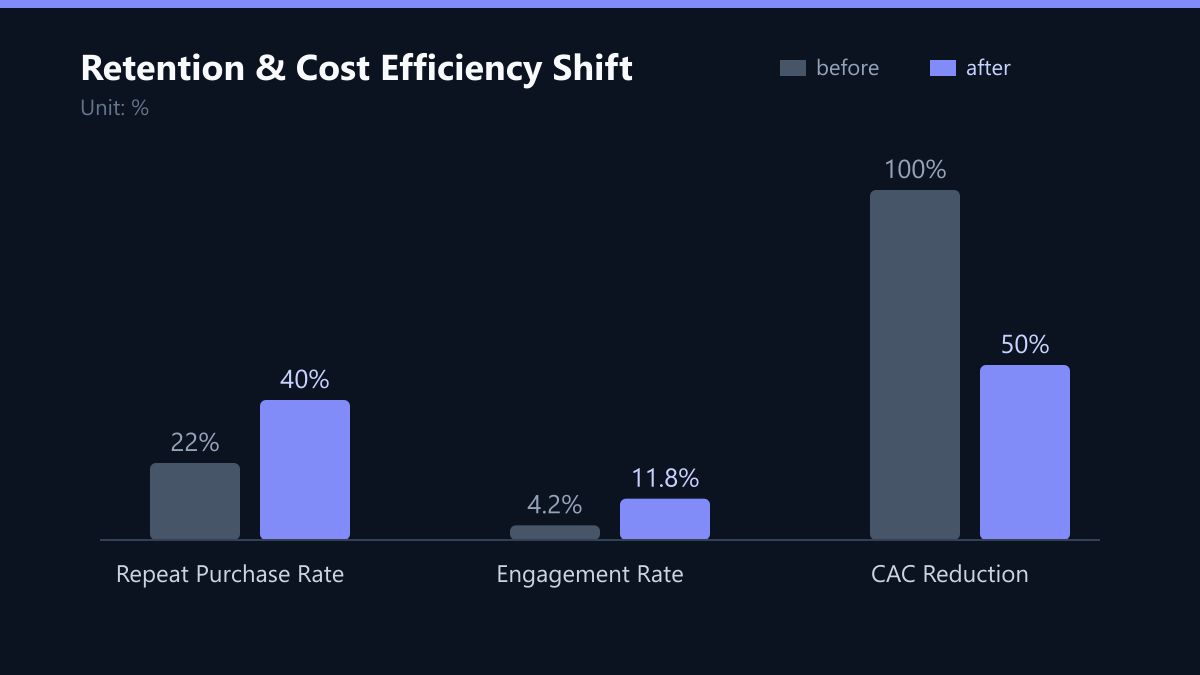
| Repeat Purchase Rate | 22% | 40% | +18% |
| Community Engagement Rate | 4.2% | 11.8% | +7.6% |
| CAC for Returning Customers | €18.50 | €9.20 | -50% |
The 18% absolute increase in repeat purchase rate was the most critical outcome. It indicated that the community was successfully converting first-time buyers into loyal customers. The engagement rate more than doubled, showing that the content strategy resonated deeply with the audience. Most notably, the CAC for returning customers dropped by 50%. By leveraging the community for retention, the brand reduced its reliance on paid ads for reactivation, significantly improving overall marketing efficiency.
Lessons Learned
This project provided several valuable insights for other e-commerce brands looking to implement similar strategies:
- Consistency Beats Volume: Daily, low-effort interactions (like quick replies and style tips) kept the group alive without burning out the team. We found that a single meaningful interaction per day was more effective than a burst of activity followed by silence.
- Integration is Non-Negotiable: Linking social engagement to CRM data was the key to proving ROI. Without the Zapier-CRM integration, we would have had no way to attribute the increase in repeat purchases to the community. It turned social media from a ‘nice-to-have’ into a measurable retention channel.
- Peer Influence Outperforms Brand Content: User-generated content (UGC) from members, such as photos of them wearing the clothes, outperformed brand-created posts in driving sales. This validated the shift to a community-led model, where customers become the primary voice of the brand.
What We Would Do Differently Today
Despite the success, there are areas where we would refine the approach if we were starting over:
- Earlier Video Integration: We introduced short-form video content (Reels) only in month three. In retrospect, integrating video from day one would have accelerated engagement growth, as video consistently outperforms static images in the Facebook algorithm.
- More Granular Segmentation: We initially tagged all active members broadly. We would now implement more granular tags based on purchase history (e.g., ‘Active Member - High Spender’ vs. ‘Active Member - Budget Focus’) to allow for even more personalized email sequences.
- Offline-to-Online Bridge: We missed the opportunity to create a direct link for offline customers (e.g., those who visited a pop-up) to join the group. Creating a seamless onboarding path for all customer touchpoints would have expanded the community base faster.
Conclusion
This case demonstrates that community management is not just a support channel but a core retention strategy for e-commerce brands. By shifting focus from acquisition to retention, and by leveraging technology to integrate social engagement with CRM data, the brand achieved sustainable growth without increasing its headcount. The result was a more loyal customer base, lower acquisition costs, and a stronger brand community that drives organic growth.