The Plateau: High Spend, Stagnant Growth
The client, a B2B SaaS provider based in Stockholm with a team of 120 employees, had reached a frustrating performance ceiling. Despite maintaining a high level of digital ad spend, the website conversion rate remained stagnant. The marketing team was pouring resources into paid channels, yet the return on investment (ROI) was not scaling proportionally. The core issue was not a lack of traffic, but a lack of relevance. All prospects, regardless of their source or intent level, were funneled into a single, static landing page. This ‘one-size-fits-all’ approach failed to address the specific pain points of different buyer segments, leading to high bounce rates and low engagement.
Compounding the frontend inefficiency was a significant bottleneck in the backend sales process. Valuable time was being lost as sales staff manually searched for new leads in the CRM and drafted individual emails from scratch. This manual effort led to long response times, often exceeding 48 hours for initial contact. In the competitive B2B SaaS landscape, speed is critical; leads contacted within the first hour are significantly more likely to convert. The combination of generic landing pages and slow manual follow-up created a leaky bucket where high-value opportunities were slipping through the cracks.
The Challenges
To address these issues, we identified three specific challenges that needed to be solved simultaneously:
- Lack of Personalization: The current single landing page could not cater to the different motivations of users coming from Paid Search, Organic Search, or Industry Events. Each channel attracts users at different stages of the buyer’s journey, requiring tailored messaging.
- Manual Lead Handling: The sales team was spending approximately 30% of their time on administrative tasks, specifically lead qualification and initial outreach. This not only reduced their selling time but also introduced human error and inconsistency in follow-up speed.
- Data Fragmentation: Marketing and Sales data were not fully integrated. Marketing could not easily see which landing page variants led to the highest quality leads, and Sales could not see the full history of a lead’s interactions before contacting them.
The Tech Stack
We selected a lean, integrated stack to ensure seamless data flow and minimal maintenance overhead:
- HubSpot CRM: The central hub for lead management, scoring, and automated email journeys. It provided the necessary triggers for dynamic content and workflow automation.
- Google Analytics 4 (GA4): Used for precise tracking of user behavior, source attribution, and conversion events. It served as the source of truth for A/B test data.
- Google Optimize: Integrated with GA4 to run systematic A/B tests on landing page elements such as headlines, CTAs, and social proof.
- WordPress (Headless/CMS): The frontend platform where the segmented landing pages were built and tested. We ensured fast load times to prevent user drop-off.
Implementation: A Two-Pronged Strategy
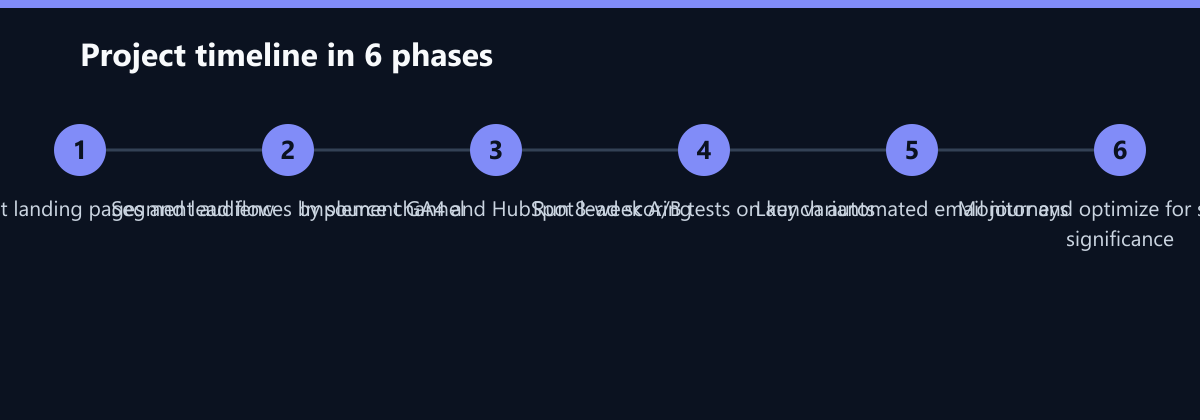
We implemented a dual strategy focusing on frontend optimization (Landing Page Optimization) and backend efficiency (Sales Automation). The total project duration was twelve weeks, covering setup, the testing phase, and workflow fine-tuning.
1. Landing Page Optimization (LPO)
We began by segmenting the audience based on source channels. We created three distinct landing page variants:
- Paid Search Variant: Focused on immediate pain points and direct value propositions, with a strong, urgent CTA.
- Organic Search Variant: Emphasized educational content and thought leadership, guiding users deeper into the funnel with softer CTAs.
- Events Variant: Tailored for attendees of industry events, featuring event-specific content and a direct link to book a personalized demo.
Over a period of eight weeks, we ran systematic A/B tests on these variants. We tested headlines, CTA button colors and copy, and the placement of social proof elements. The technical setup involved integrating Google Optimize and GA4 to track micro-conversions (e.g., form starts) and macro-conversions (e.g., demo bookings). This allowed us to identify which elements drove the most engagement without relying on guesswork.
2. Automated Follow-up Emails
While the frontend was being optimized, we restructured the backend lead handling process in HubSpot CRM. We implemented a robust lead scoring system that assigned points based on user behavior (e.g., page views, email opens, content downloads) and firmographic data. This allowed us to prioritize leads effectively.
Based on the score, we developed three parallel email journeys:
- Cold Leads: A nurture sequence focused on education and brand awareness, sending 3-4 emails over 2 weeks.
- Warm Leads: A sequence highlighting case studies and product features, designed to move them to the next stage.
- Hot Leads: An immediate, personalized email from a sales representative, triggered within minutes of the lead reaching a high score threshold.
The content was dynamic, adapting to the specific product or feature the lead had viewed on the website. This ensured that the email follow-up was highly relevant to the user’s current interest.
How We Measured It
To ensure the KPIs were accurate and actionable, we established a clear measurement framework before the project began. We used GA4 to track conversion rates per landing page variant, ensuring that the A/B tests had statistical significance. We set a minimum threshold of 1,000 sessions per variant before making any decisions. For response time, we used HubSpot’s activity tracking to measure the time delta between lead creation and the first sales touchpoint. We compared the average response time of the manual process (baseline) with the automated process. MQL volume was tracked by counting the number of leads that met the agreed-upon qualification criteria (score + intent) per month. This rigorous approach allowed us to attribute the improvements directly to the implemented changes rather than external factors.
Results: Measurable Growth
The combination of optimized landing pages and automated follow-up processes led to significant and sustainable improvements. After six months of running the new system, the results were clear.
The conversion rate increased from 2.1% to 3.5%, representing a relative increase of 66% and an absolute gain of 1.4 percentage points. This meant that for the same amount of traffic, the company was generating significantly more opportunities. The response time for initial contact dropped dramatically from an average of 48 hours to under 4 hours, a reduction of 91%. This speed gave the sales team a crucial advantage in the early stages of the sales cycle. Furthermore, the volume of qualified leads (MQLs) increased by 22%, rising from 150 to 183 per month, despite a constant marketing budget. The sales team also reported a 30% reduction in manual administrative work, allowing them to focus more on closing deals.
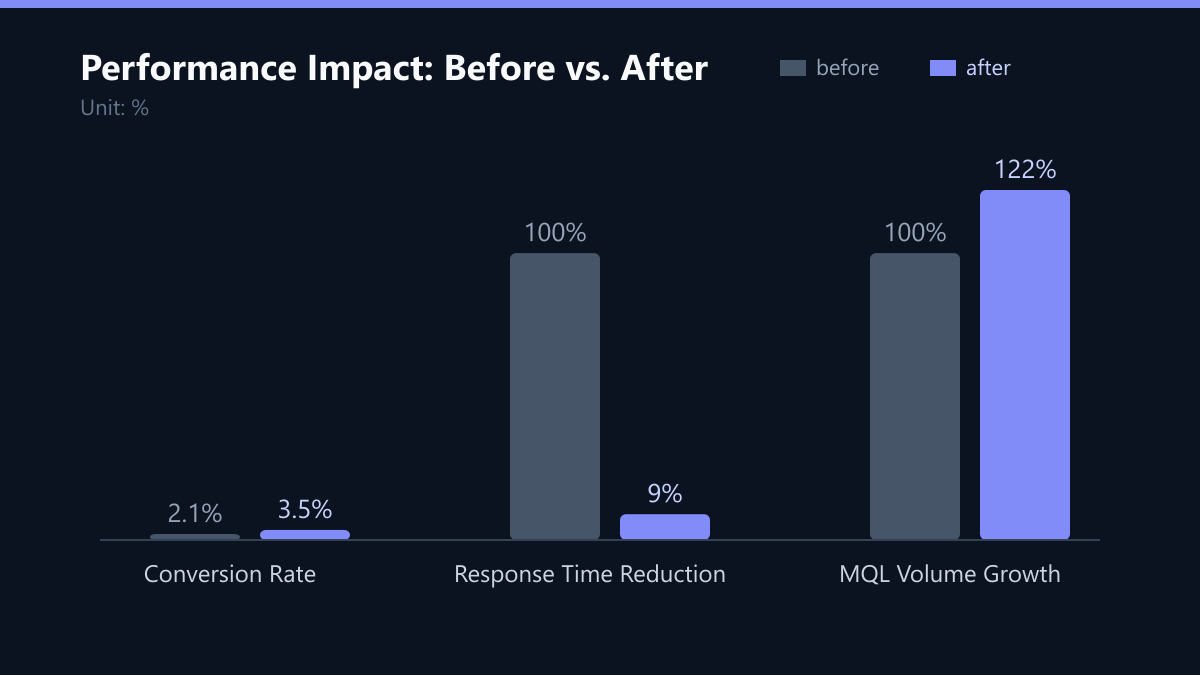
| Metric | Before | After | Change |
|---|---|---|---|
| Conversion-Rate | 2,1 % | 3,5 % | +66 % |
| Reaktionszeit | 48 h | < 4 h | -91 % |
| MQLs | 150 / Monat | 183 / Monat | +22 % |
Lessons Learned
This project highlighted several key takeaways for B2B companies looking to improve their marketing efficiency. First, segmentation is critical. Generic landing pages consistently underperform compared to segmented variants that speak directly to the user’s specific context. Second, speed beats perfection. An automated, slightly less perfect email sent within hours is far more effective than a perfectly crafted email sent two days later. Finally, data-driven decisions are essential. A/B tests must run long enough to achieve statistical significance; stopping tests too early can lead to misleading conclusions. We recommend a minimum of 1,000 sessions per variant to ensure reliability.
What We Would Do Differently Today
Looking back, there are a few areas where we would refine the approach. First, we would have integrated the lead scoring model more closely with the landing page design from the start. By understanding which page elements led to higher scores, we could have optimized the tests more efficiently. Second, we would have explored more advanced dynamic content options in the email journeys. While the current setup was effective, using more granular data points to personalize the email body could have further improved engagement. Lastly, we would have established a more formal feedback loop between Sales and Marketing earlier in the project. Regular syncs to discuss lead quality and feedback on the automated emails would have allowed for faster iteration and improvement of the workflows.
Passend dazu
- Performance Marketing
- SEO & AI Search (GEO)
- Affiliate Marketing
- Content & CRO
- CRM Marketing
- Automated Campaign Management: 40% Increase in ROAS for a DACH Industrial Supplier through Dynamic Budget Allocation in Amazon DSP
- Reduction of Reporting Effort by 40 Hours Monthly in the Scandinavian IT Services Sector through Automated KPI Reports
- Social Ad Fatigue Prevention in Scandinavia: CPC Stabilization over 6 Months through Creative Rotation