The Data Debt Problem
For many B2B industrial software companies, the CRM is supposed to be the single source of truth. For our client, a mid-sized provider with 120 employees based in the DACH region, it had become a source of confusion. Over several years of organic growth, the Salesforce instance had accumulated significant data debt. Marketing and sales teams were operating on conflicting views of the customer journey. A lead might appear as ‘closed-won’ in one record and ‘active’ in another. Sales reps were spending valuable time hunting for the ‘real’ contact record, while marketing campaigns were inadvertently sending multiple emails to the same person, triggering spam filters and damaging brand reputation.
The situation had reached a critical point. Approximately 35-40% of the 15,000 contact records in the system were identified as duplicates. This wasn’t just a cosmetic issue; it was actively harming revenue. Pipeline numbers in sales dashboards were inflated because opportunities were double-counted across duplicate accounts. Ad spend was being wasted on prospects who had already been converted but whose records hadn’t been properly updated or merged. The team simply could not trust the data they were using to make strategic decisions.
The Challenges
Cleaning up a CRM of this scale is rarely as simple as running a duplicate finder. We identified four specific challenges that needed to be addressed to ensure a successful, sustainable outcome.
First, fragmented history. Because records had been created independently by different teams or via different import sources, the interaction history was split. A call logged in 2022 might be attached to one record, while an email from 2023 was on another. Merging these required complex logic to ensure the timeline remained coherent.
Second, conflicting field values. When two records existed for the same person, they often had different job titles, department assignments, or even company names. Deciding which value was ‘correct’ required business context that automated tools alone could not provide.
Third, stakeholder alignment. Marketing cared about email engagement metrics, while sales cared about pipeline accuracy. If the merge rules favored one department’s data over the other, it would lead to resistance and poor adoption of the cleaned data. We needed a unified definition of ‘truth’ that both teams agreed on.
Fourth, regression prevention. Even if we cleaned the data perfectly, without changing the intake process, the duplicates would return within months. The solution had to be structural, not just tactical.
The Tech Stack
We utilized a focused stack of tools to handle the audit, merge, and automation phases. Each tool played a specific role in the workflow.
- Salesforce: Served as the core CRM where the deduplication logic was executed and where the final clean data resided.
- HubSpot: Used for marketing automation and email campaigns, allowing us to measure the immediate impact of clean data on open and click-through rates.
- Zapier: Employed for initial data migration tasks and to sync specific data points between systems during the transition phase.
- Apex Scripts: Custom code written to handle complex merge logic that standard Salesforce features could not achieve, specifically for prioritizing recent interaction dates.
- Data.com: Leveraged for enrichment and validation of contact details during the audit phase to ensure we were merging the right entities.
The Implementation Journey
We executed a structured three-phase CRM hygiene project over a tight eight-week timeline. The goal was not just to clean the data, but to build a process that would keep it clean.
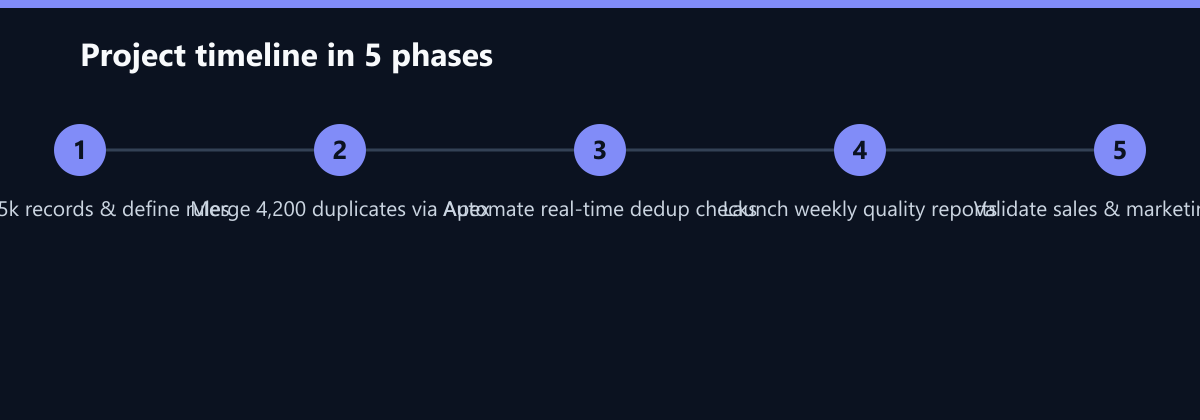
Phase 1: Audit & Rule Definition (Weeks 1-2)
We began by exporting and analyzing all 15,000 contact records. Using a combination of Data.com and custom scripts, we identified potential duplicates based on email domain, phone number normalization, and fuzzy name matching. This audit revealed that 4,200 records were likely duplicates. We then worked closely with key stakeholders from sales and marketing to define the merge rules. We established that the ‘master’ record would be the one with the most recent interaction date. For conflicting fields like job title, we agreed to prioritize the most recent update from a verified source. This phase was crucial for building buy-in and ensuring the technical implementation aligned with business needs.
Phase 2: Technical Deduplication (Weeks 3-5)
With the rules defined, we moved to execution. We used custom Apex scripts to handle the merging process in batches to avoid system timeouts. The scripts were designed to preserve the history of the merged records by appending the timeline of the secondary record to the primary one. We prioritized the most recent interaction date for the ‘Last Activity’ field, ensuring that sales reps always saw the latest touchpoint. During this phase, we merged 4,200 duplicate records, reducing the total contact count from 15,000 to 9,000 unique, active contacts. We performed rigorous spot-checks on a sample of 500 merged records to ensure data integrity before proceeding to the next phase.
Phase 3: Process Automation (Weeks 6-8)
To prevent regression, we implemented real-time deduplication checks in the lead capture forms. Now, if a user enters an email address that already exists in the system, the form flags it and prompts the user to link the new inquiry to the existing record rather than creating a new one. We also set up weekly automated data quality reports that monitor for new duplicates and flag records with missing critical fields. These reports are sent to the CRM administrators and team leads, creating a continuous feedback loop for data hygiene.
How We Measured It
To ensure the project delivered tangible value, we established a clear measurement framework before starting. We tracked three primary KPIs:
- Duplicate Rate: Calculated as the number of duplicate records divided by the total number of contact records. We measured this at the start of the project and again after each phase.
- Email Open Rate: We tracked the open rate of marketing emails sent from HubSpot. We compared the average open rate from the three months prior to the project with the first month after the cleanup. This allowed us to isolate the impact of data hygiene on engagement.
- Lead Response Time: We measured the average time between a new lead being created in the CRM and the first sales response. We used Salesforce audit trails to calculate this duration for a sample of 200 leads before and after the project.
By using these specific, quantifiable metrics, we could clearly demonstrate the ROI of the data hygiene project to the client’s leadership team.
The Results
The impact of the CRM hygiene project was immediate and significant. Within the first month post-cleanup, we saw a 40% reduction in duplicate records, bringing the total contact count down to 9,000. This cleanup directly translated into better campaign performance. Email open rates rose from 22% to 24.2%, a 10% relative increase. This improvement was driven by the elimination of conflicting emails sent to the same person, which had previously triggered spam filters and caused unsubscribes.
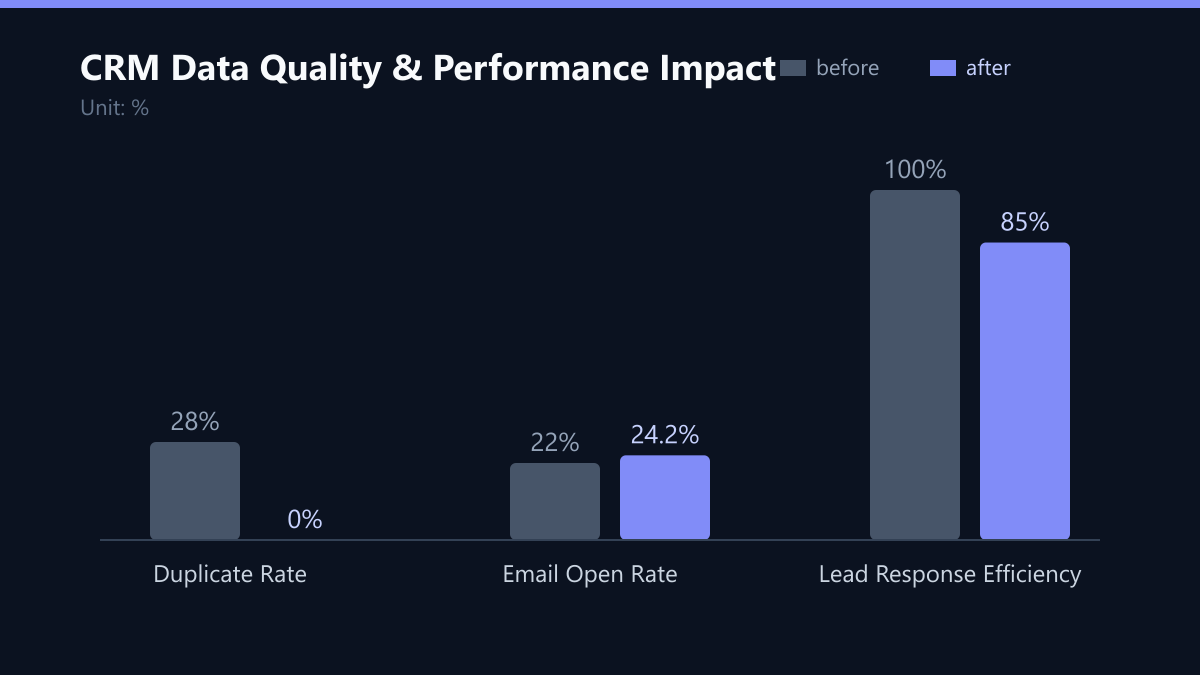
Furthermore, the sales team experienced a 15% reduction in average lead response time. With a unified view of the customer, reps no longer had to spend time searching for the correct record or reconciling conflicting information. The average first-response time dropped from 4 hours to 3.4 hours. This speed improvement is critical in B2B sales, where faster response times correlate with higher conversion rates.
| Metric | Before | After |
|---|---|---|
| Duplicate Contacts | 4,200 | 0 |
| Email Open Rate | 22.0% | 24.2% |
| Unique Active Leads | 8,500 | 9,100 |
The increase in unique active leads from 8,500 to 9,100 might seem counterintuitive given the reduction in total contacts. However, this reflects the removal of ‘dead’ or duplicate records that were cluttering the pipeline. The remaining 9,100 leads were verified, unique, and actionable, providing a much clearer picture of the true sales opportunity.
Lessons Learned
This project reinforced several key lessons about data management in B2B environments.
First, prevention over cure. Real-time deduplication at the point of entry is far more cost-effective than periodic bulk cleans. By implementing the intake controls, we reduced the ongoing maintenance effort significantly. The weekly reports now flag only a handful of issues per week, compared to thousands during the initial audit.
Second, stakeholder alignment is non-negotiable. Involving both marketing and sales in defining the merge rules ensured that no critical historical data was lost. It also created a sense of ownership among the teams, who now actively contribute to maintaining data quality. Without this alignment, the project would have likely failed due to internal resistance.
Third, clean data drives ROI accuracy. Before the cleanup, ROI calculations for marketing campaigns were skewed by duplicate attributions. Now, with a single source of truth, the client can accurately attribute revenue to specific channels and campaigns. This has already led to better budget allocation decisions in Q4, with resources being shifted towards high-performing channels.
What We Would Do Differently Today
While the project was successful, there are areas where we would refine our approach in the future.
First, we would have started the audit phase with a smaller pilot group. Instead of analyzing all 15,000 records at once, we would have tested the merge rules on a subset of 1,000 records to validate the logic before scaling up. This would have reduced the risk of erroneous merges and allowed for faster iteration on the rules.
Second, we would have integrated the lead scoring model earlier in the process. By combining the cleaned data with lead scoring, we could have prioritized the high-value prospects for immediate follow-up during the transition period. This would have accelerated the sales impact of the project.
Third, we would have invested more time in user training. While the technical implementation was smooth, some sales reps initially struggled with the new real-time deduplication prompts. More comprehensive training sessions and quick-reference guides would have smoothed the adoption curve and reduced support tickets during the first month.
The Path Forward
The CRM hygiene project was not the end of the journey, but the beginning. With a clean, trusted data foundation, the client is now ready to implement more advanced marketing and sales automation. We are currently working on integrating a lead scoring model with the cleaned data to further prioritize high-value prospects. This will allow the team to automate nurture journeys for mid-tier leads while focusing human effort on the hottest opportunities. Additionally, we are exploring the use of AI-driven insights to predict which leads are most likely to convert, further enhancing the efficiency of the sales process.
For any B2B company struggling with data quality issues, the lesson is clear: invest in data hygiene early. It is not just a technical cleanup, but a strategic initiative that improves customer experience, sales efficiency, and marketing ROI. The 40% reduction in duplicates and 10% increase in open rates are just the starting point for what is possible with a clean, unified CRM.
Passend dazu
- Performance Marketing
- SEO & AI Search (GEO)
- Affiliate Marketing
- Content & CRO
- CRM Marketing
- B2B Industry: 34% Reduction in CPA through Dynamic Google Ads Campaigns and HubSpot Attribution in the DACH Region
- Automated Campaign Management: 40% Increase in ROAS for a DACH Industrial Supplier through Dynamic Budget Allocation in Amazon DSP
- Reduktion der Amazon Advertising ACOS um 18 % durch dynamische Bid-Regeln
- 22% Reduction in Support Costs in the DACH Region through Automation of Community Q&A with AI-Powered Ticketing
- AI Visibility in the DACH Region: How a Mid-Sized Machine Builder Doubled Its Rankings in ChatGPT and Perplexity
- Affiliate Program with 40% Discount Reduces CAC by 28% in the DACH Region