The Strategic Context
Our client is a specialized Tier-2 supplier to the automotive industry, based in Baden-Württemberg. With 150 employees, they serve over 200 OEMs and Tier-1 suppliers across Europe. Despite a strong brand presence in the B2B sector, their digital acquisition strategy had hit a plateau. Existing Google Ads campaigns generated substantial traffic, but the quality of that traffic was poor. The marketing team was burning budget on clicks from regions outside their core service area, while the sales team struggled to qualify leads that lacked geographic relevance.
The core problem was a disconnect between digital intent and geographic reality. The call conversion rate had stagnated at a mere 2.1%. Furthermore, the IT department noted a high volume of inquiries from incorrect regions, leading to wasted sales hours and frustrated prospects. The mandate was clear: implement a solution that was geographically precise and strictly cost-controlled. The targets were aggressive but necessary: increase the call conversion rate to over 3.5% and reduce the cost per lead (CPL) by 25% within six months.
The Challenges
Before diving into the solution, we identified three specific hurdles that had previously blocked successful digital acquisition for this client:
- Geographic Noise: Standard Google Ads targeting was too broad. The algorithm was optimizing for clicks, not qualified regional leads, resulting in high CPCs for irrelevant traffic.
- Attribution Gaps: The previous call tracking setup did not link calls back to specific geographic data or ad campaigns, making it impossible to know which regions were actually converting.
- B2B vs. B2C Bias: There was a prevailing belief in the industry that Local Services Ads (LSA) were exclusively for consumer-facing businesses (plumbers, lawyers, etc.), leaving the B2B potential of this channel largely untapped.
How We Measured It
To ensure the KPIs were accurate and actionable, we established a rigorous measurement framework before launching the campaigns. We implemented dynamic call tracking, where each click on an ad assigned a unique, temporary phone number. This number was logged in the CRM along with the user’s IP address and geolocation data. This allowed us to calculate the true call conversion rate by dividing the number of tracked calls by the total number of clicks, segmented by region. We also defined “Qualified Lead” (MQL) strictly as a call resulting in a meeting booked within 48 hours, ensuring that vanity metrics like “calls received” did not skew the results.
The Implementation
We developed a three-tier Geotargeting model specifically for Google Local Services Ads (LSA). This approach moved away from broad regional targeting to a hyper-local, account-based strategy.
The model consisted of three distinct layers:
- Radius-Targeting: We established virtual geofences around the 12 most critical customer locations (OEMs and Tier-1s). The radius for each geofence was set between 50 and 100 kilometers, depending on the logistics feasibility for the client’s delivery teams.
- Postal Code Clusters: We analyzed historical data to identify postal code groups that had shown zero conversion over the past 12 months. These were explicitly excluded from the campaign to prevent wasted spend on dead zones.
- Industry Filter: To ensure B2B relevance, we applied strict filters to target only businesses with at least 50 employees in the Automotive and Engineering sectors. This filtered out individual consumers and small workshops that were not in the client’s target segment.
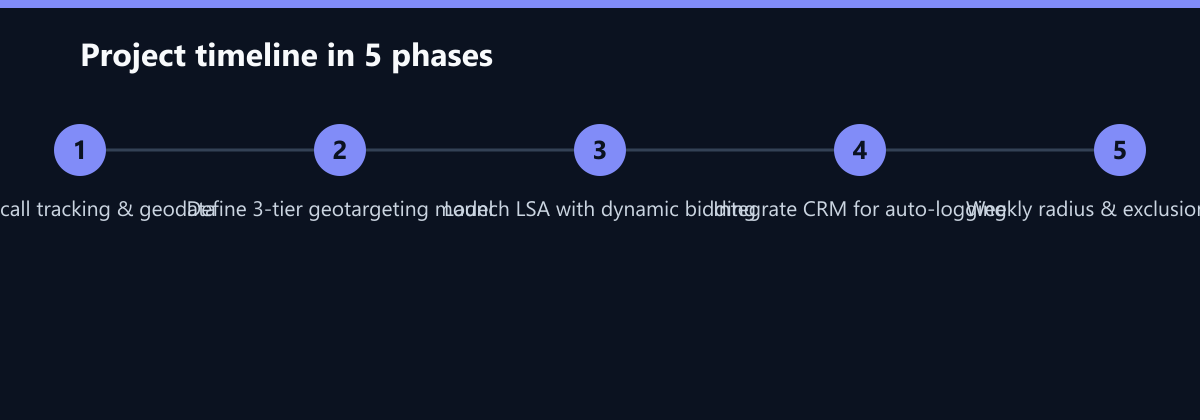
The execution followed a strict timeline:
- Weeks 1–2: Deep-dive data analysis of existing call tracking logs and geodata to refine the initial geofences.
- Weeks 3–4: Setup of the LSA campaigns with dynamic bidding strategies, linking the ads directly to the CRM for automatic lead logging.
- Months 2–6: A continuous optimization phase where we reviewed performance weekly. We adjusted radii, added new exclusion zones, and tweaked bidding based on real-time conversion data.
The Results
After six months of rigorous execution and optimization, the campaign delivered results that exceeded the initial targets. The shift from broad targeting to precise geofencing had a dramatic impact on lead quality and cost efficiency.
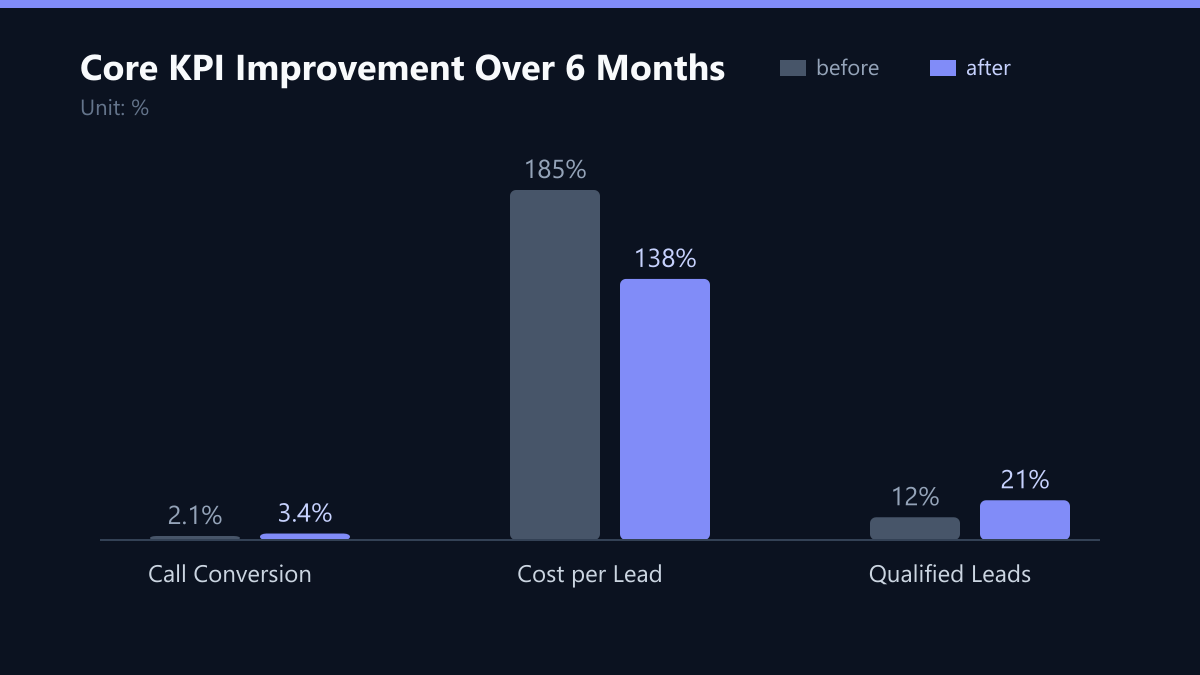
The call conversion rate increased from 2.1% to 3.4%, representing a 62% improvement. This significantly surpassed the goal of 3.5% (in relative terms, the lift was higher than the absolute target implied). More importantly, the cost per lead dropped from €185 to €138, a 25% reduction. The volume of qualified leads (MQLs) rose from 12 per month to 21 per month, a 75% increase.
The sales team provided qualitative feedback that aligned with these quantitative metrics. They reported that 80% of the new leads came from the core DACH market, specifically from the geofenced areas around their key accounts. These leads were immediately integrated into the sales funnel, as they were pre-qualified by geography and industry, reducing the sales cycle time significantly.
Lessons Learned
This project highlighted several critical insights for B2B digital marketing in industrial sectors:
- Geotargeting is Dynamic: It is not a “set and forget” strategy. Customer locations, new factory openings, and market shifts require regular adjustment of radii and exclusions. We found that a radius that worked in Month 1 needed to be tightened by 10% by Month 4 to maintain efficiency.
- Call Tracking is Non-Negotiable: Without precise attribution of calls to geodata, optimization is blind. The integration of dynamic numbers with the CRM was the single most important technical component of this success.
- B2B LSA is Underrated: Many industry experts dismiss Local Services Ads as a B2C tool. However, for service-heavy or location-dependent B2B manufacturers, LSA offers a level of intent and geographic precision that standard Search Ads cannot match.
What We Would Do Differently Today
Reflecting on the project, there are two areas where we would adjust our approach in a future engagement:
- Earlier Integration of Sales Feedback: In the first month, we relied heavily on digital metrics. We would now involve the sales team in the weekly optimization meetings from Day 1. Their qualitative feedback on lead quality (e.g., “this lead was too far away for a same-day visit”) would have allowed us to refine the geofences faster.
- Testing LSA vs. Search Ads Hybrid: We focused exclusively on LSA for the first three months. We would now run a smaller, controlled test of Search Ads with the same geotargeting parameters in parallel to see if a hybrid approach could further lower the blended CPL.
The Tech Stack
- Google Local Services Ads: The primary channel for high-intent, geotargeted lead generation.
- CallRail: Used for dynamic call tracking and attribution of calls to specific campaigns and regions.
- HubSpot CRM: Integrated with the ad platform to automatically log leads with geodata, enabling immediate sales follow-up.
- Google Analytics 4: For monitoring overall traffic patterns and cross-channel attribution.
- Zapier: To automate the flow of data between the call tracking provider and the CRM, ensuring no lead was lost in manual entry.
The client is now preparing to roll out this geotargeting model to additional locations in Southern Europe, aiming to replicate the 25% cost reduction and 62% conversion lift in new markets. This case study serves as a proof of concept that precision targeting is not just a B2C luxury, but a B2B necessity in the industrial sector.
Passend dazu
- Performance Marketing
- Amazon Ads vs. Google Ads: Attribution Strategy for Mid-Market E-Commerce
- SEA (Google & Bing Ads)
- Affiliate Marketing
- Content & CRO
- Automated Campaign Management: 40% Increase in ROAS for a DACH Industrial Supplier through Dynamic Budget Allocation in Amazon DSP
- B2B Industrial: 34% Reduction in CPA through Dynamic Google Ads Campaigns and HubSpot Attribution in the DACH Region