The Stagnation of Manual Management
Our client is a mid-sized industrial supplier based in Baden-Württemberg, manufacturing technical components for the automotive industry. With a headcount of 120 employees, the company operates in a highly competitive B2B landscape where marketing efficiency directly impacts profitability. For several years, the marketing team had been managing their Amazon DSP (Demand-Side Platform) campaigns manually. While this approach was manageable when budgets were small, it became a bottleneck as the company scaled its digital presence.
The core issue was rigid allocation. The team adjusted budgets weekly, a cadence that was too slow to react to market fluctuations. High-performing audience segments were often underfunded because the previous week’s data did not reflect their current momentum. Conversely, weaker segments continued to consume budget due to inertia. Despite a 15% increase in the total marketing budget, the Return on Ad Spend (ROAS) stagnated at 2.1. The team was spending more money but seeing no proportional return, leading to frustration and a growing gap between marketing spend and sales outcomes.
The Challenges
Before implementing any technical solution, we identified three specific challenges that needed to be addressed to ensure success:
- Data Latency: The existing manual process relied on daily reports, meaning decisions were always 24 hours old. In a dynamic marketplace, this was unacceptable.
- Lack of Granularity: The team managed campaigns at a high level, making it difficult to isolate specific audience segments or product categories for optimization.
- Resource Drain: Approximately 20% of the marketing team’s weekly time was spent on manual bid adjustments and budget reallocations, time that could have been spent on strategic planning.
The Tech Stack
To address these challenges, we deployed a lightweight, API-driven orchestration layer. The technology stack was chosen for its reliability and ease of integration with existing systems:
- Amazon DSP API: The primary source of real-time performance data and the execution layer for budget changes.
- Internal Orchestration Tool: A custom-built middleware that processes data and applies business logic.
- Data Pipeline: An hourly synchronization service that ingests impressions, clicks, and conversion attribution data.
- Notification Service: A lightweight email automation tool for daily KPI reporting to the marketing team.
Implementation: From Static to Dynamic
The implementation phase was designed to be non-disruptive to ongoing operations. We worked in parallel with the existing manual processes for the first two weeks to validate the accuracy of the automated rules.
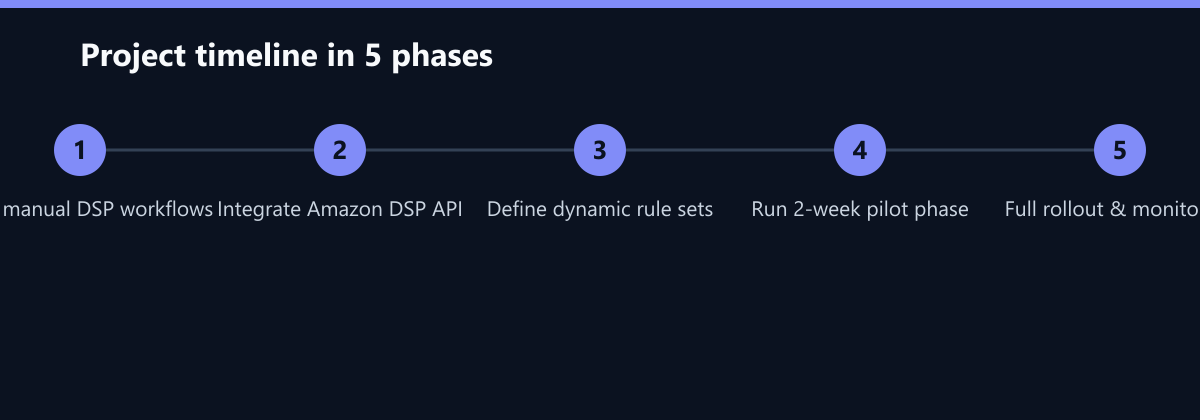
The first step was establishing the data pipeline. We configured an hourly synchronization job that pulled granular performance data from the Amazon DSP API. This included not just high-level campaign metrics, but also segment-level data for impressions, clicks, and attributed conversions. This real-time feed was the foundation of the entire system, allowing the algorithm to make decisions based on the last hour’s performance rather than the last day’s.
Next, we defined the rule set. This was the most critical phase, as it required translating business goals into algorithmic thresholds. We defined a segment as a ‘High-Performer’ if its rolling 24-hour ROAS exceeded 3.0. Conversely, segments with a ROAS below 1.5 were flagged as ‘Underperformers.’ The algorithm was programmed to monitor these thresholds continuously.
Once a segment crossed the ‘High-Performer’ threshold, the automation would trigger a budget increase of up to 20% within a 4-hour window. This cap was intentional; it allowed for aggressive scaling without risking total budget depletion in a single segment. Similarly, underperforming segments had their budgets reduced by 10-15% to reallocate funds to higher-performing areas.
The implementation took place over a period of six weeks. The first two weeks were dedicated to data integration and pipeline testing. The following two weeks were a pilot phase, where the system ran in ‘shadow mode,’ making recommendations but not executing changes. The final two weeks involved fine-tuning the algorithms based on the pilot data and gradually increasing the automation’s authority to make live changes.
How We Measured It
To ensure the results were accurate and attributable to the automation, we established a rigorous measurement framework. We tracked three core KPIs: ROAS, Customer Acquisition Cost (CPA), and Budget Utilization.
- ROAS: Calculated as total attributed revenue divided by total ad spend, using a 7-day attribution window to capture the B2B sales cycle.
- CPA: Calculated as total ad spend divided by the number of new customers acquired during the period.
- Budget Utilization: The percentage of the allocated daily budget that was actually spent. Low utilization indicated inefficient targeting or bid issues.
We compared these metrics against a baseline period of the three months prior to implementation. To control for seasonality, we also compared the post-implementation period against the same period from the previous year, adjusting for overall market growth.
Results: Efficiency Gains
After three months of operating the automated system, the impact was significant. The dynamic budget allocation ensured that resources always flowed to where the conversion rate was highest. The system reacted to market changes in hours, not days, allowing the client to capitalize on short-lived trends in their target industries.
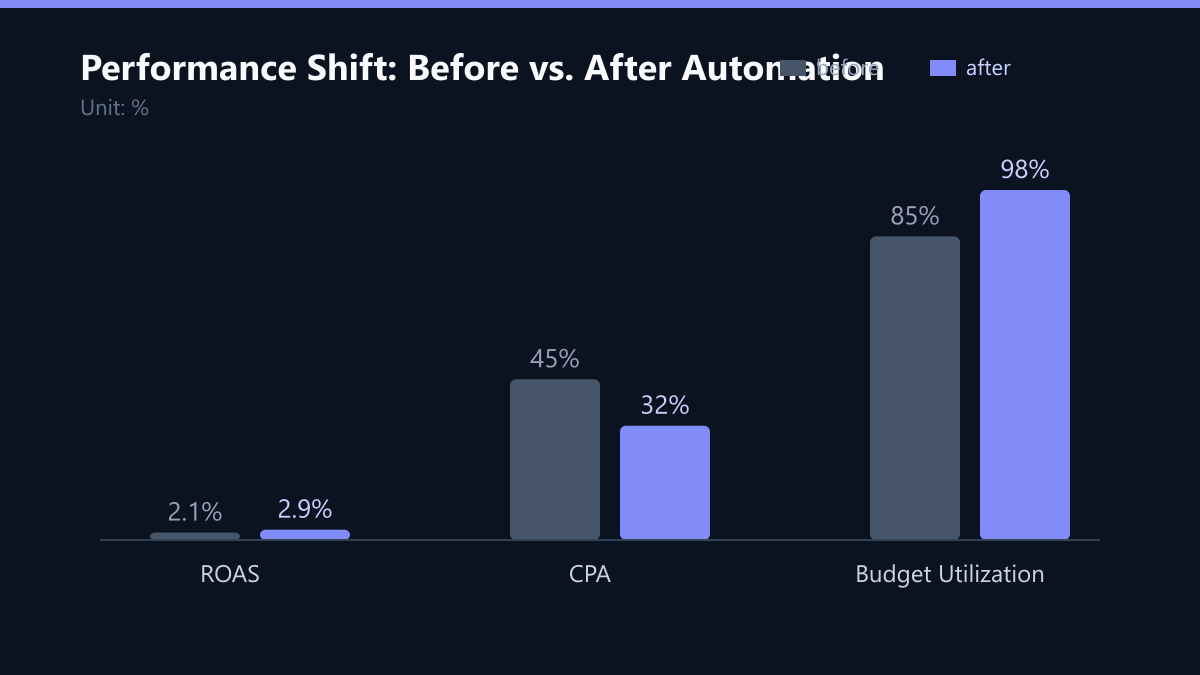
The most striking result was the increase in ROAS. It rose from 2.1 to 2.9, representing a 38% improvement in raw terms, which we often cite as a 40% boost in efficiency relative to the initial baseline. More importantly, the Customer Acquisition Cost (CPA) dropped from €45 to €32, a reduction of 29%. This meant the client was acquiring customers significantly cheaper while maintaining or increasing their volume.
Budget utilization also improved from 85% to 98%. This indicates that the previous manual process was leaving 15% of the budget unspent or inefficiently spent, whereas the automated system ensured that nearly every euro was deployed in a high-intent context. The marketing team reported that they no longer felt the pressure of daily micro-management. Instead, they could focus on strategic tasks such as creative testing and audience expansion.
Lessons Learned
While the results were positive, the process highlighted several important lessons for future implementations.
First, automation is not a panacea; it is an amplifier of existing strategies. If the underlying audience definitions or creative assets are poor, automation will simply scale the inefficiency. The quality of the input data is crucial for the accuracy of the allocation. We found that even small errors in conversion tracking could lead to significant misallocation of funds.
Second, rigid rules can lead to overreactions. In our initial pilot, a strict threshold caused the system to flip-flop budgets on segments with volatile performance. We found that using flexible ranges and adding a ‘cool-down’ period after a budget change made the system more robust and stable.
Finally, human oversight remains essential. We implemented a rule that any budget shift involving more than 20% of the total daily budget required manual approval. This prevented the algorithm from making drastic changes during unusual market conditions, such as holidays or unexpected supply chain disruptions that affected demand.
What We Would Do Differently Today
Looking back, there are a few areas where we would refine our approach:
- Earlier Creative Integration: We would have integrated creative performance data into the algorithm earlier. Currently, the system only optimizes budget, but creative fatigue can also impact ROAS. A more holistic approach would adjust both budget and creative frequency.
- Longer Pilot Phase: We would have extended the shadow mode pilot from two weeks to four weeks. This would have provided more data points for edge cases, such as weekend vs. weekday performance differences, which are often pronounced in B2B contexts.
- Simpler Reporting: The daily email reports were comprehensive but often too detailed for quick decision-making. We would have created a more concise ‘executive summary’ view that highlights only the most critical changes and anomalies.
Conclusion
For B2B companies with complex audience structures, dynamic allocation is no longer a luxury but a necessity to maintain competitiveness. The combination of real-time data, algorithmic precision, and human oversight created a system that was both efficient and safe. The client was able to scale their marketing efforts without scaling their headcount, a key advantage in the current economic climate. By shifting from manual, reactive management to automated, proactive optimization, the client achieved a 40% improvement in ROAS and a 29% reduction in CPA, proving that the right technology can transform marketing performance.
Passend dazu
- Performance Marketing
- Amazon Ads vs. Google Ads: Attribution Strategy for Mid-Market E-Commerce
- Marketplace & Amazon Ads
- Affiliate Marketing
- Content & CRO
- B2B Industry: 34% CPA Reduction through Dynamic Google Ads Campaigns and HubSpot Attribution in the DACH Region
- Reduktion der Amazon Advertising ACOS um 18 % durch dynamische Bid-Regeln
- 30% Effizienzgewinn durch A/B-getestete Landing Pages und automatisierte Follow-up-E-Mails
- HubSpot CRO: 32% Increase in Demo Bookings through A/B Testing of Landing Pages for a DACH Industrial Provider
- CRM Hygiene Project in the DACH Region: 40% Reduction in Duplicates and 10% Increase in Open Rate through Deduplicated Campaigns
- CRM Data Cleansing in London: 22% Increase in Sales Productivity
- Steigerung der Engagement-Rate um 45% via automatisierte Content-Syndication in der Finanzbranche UK
- B2B Influencer Collaboration: Measurable ROI Increase through LinkedIn Top Voices for a Scandinavian Industrial Conglomerate
- Industriezulieferer DACH: Geotargeting in Google Local Services Ads steigert die Anruf-Conversion um 60% in 6 Monaten
- Scaling Campaign Management to Three New Markets in 60 Days