The Starting Point: Manual Bottlenecks in a High-Volume Account
The client is a mid-sized fashion e-commerce brand based in the DACH region with 45 employees. Despite a robust marketing budget, the company struggled with inefficient ad spend. The core issue was a reliance on manual management for over 50 active Amazon Advertising campaigns. In a fast-moving sector like fashion, where trends and inventory levels shift weekly, this manual approach created a significant scalability bottleneck.
The team spent approximately four hours daily adjusting bids, pausing keywords, and reviewing performance reports. This labor-intensive process led to inconsistent optimization. By the time a manager reviewed a underperforming keyword, the budget for that day was often already exhausted. Consequently, the Advertising Cost of Sales (ACOS) remained stubbornly high at 32 %, significantly above the market average of 25 % for the fashion category. This inefficiency directly threatened profit margins, especially with the Q4 peak season approaching.
A deep-dive analysis of the previous six months of data revealed a critical inefficiency: 30 % of the total ad budget was being allocated to keywords with a conversion rate below 1 %. These low-converting terms consumed capital that could have been redirected to high-intent search queries. The situation was unsustainable; the brand needed a way to scale its ad spend without proportionally increasing manual workload or sacrificing profitability.
The Challenges
Implementing an automated solution in this environment presented three distinct challenges that had to be addressed before any code was written.
First, data fragmentation. The brand used multiple third-party tools for tracking, leading to discrepancies in conversion data. The dynamic bid engine required a single source of truth to avoid making decisions based on conflicting signals.
Second, category volatility. Fashion is highly seasonal and trend-driven. A keyword that performed well in June might be irrelevant by September. The automation logic had to be robust enough to handle rapid changes in search volume and conversion rates without overreacting to short-term noise.
Third, change management. The marketing team was accustomed to having full control over every bid. Introducing a system that made autonomous decisions required a careful transition plan to build trust in the automation’s logic and redefine the team’s role from “operators” to “strategists.”
The Tech Stack
To address these challenges, we assembled a lightweight but robust technical stack.
- Amazon Advertising API: The primary interface for retrieving real-time performance data and executing bid adjustments.
- Python Scripting Engine: A custom-built logic layer that processes data feeds and executes the bid rules every 4 hours.
- PostgreSQL Database: A centralized repository for storing historical performance data, ensuring a consistent baseline for rule evaluation.
- Grafana Dashboard: A real-time visualization tool that displays key metrics and triggers alerts for significant deviations.
- Slack Integration: A notification channel that delivers only critical alerts (deviations > 15 %) to the marketing team, reducing noise.
Implementation: From Manual Bids to Dynamic Rules
The implementation phase lasted eight weeks and was divided into three distinct stages. We began by establishing a clean data foundation, normalizing conversion tracking across all tools to ensure the API pulled accurate signals. This groundwork was crucial; without it, the automation would have been flying blind.
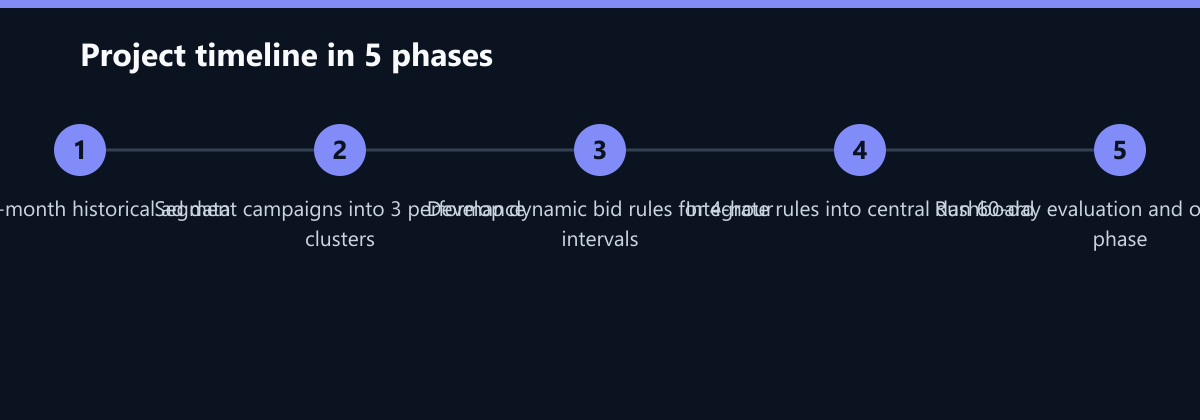
Next, we focused on campaign segmentation. Rather than applying a one-size-fits-all strategy, we divided the 50+ campaigns into three performance clusters based on historical data:
- Top-Performer: Campaigns with high conversion rates (CR) and stable margins. These were the core of the business.
- Optimization Potential: Campaigns with high Click-Through Rates (CTR) but low conversions. These indicated strong interest but poor landing page relevance or bid misalignment.
- Underperformer: Campaigns with high costs and low visibility. These were candidates for aggressive downsizing or pausing.
The heart of the solution was the development of the automation logic. We designed a set of dynamic bid rules that evaluated performance every four hours. The logic was designed to be responsive yet conservative to avoid volatility:
- Upscale Rule: If the conversion rate exceeded 5 % and the ACOS was below the target threshold, the system increased bids by 15 %. This allowed the brand to capture additional market share in high-performing segments.
- Downscale Rule: If the ACOS exceeded the target value for 24 consecutive hours, the system decreased bids by 20 %. This prevented budget drain on underperforming terms.
- Pause Rule: If a campaign or keyword generated no conversions for seven days, it was automatically paused. This immediately halted wasteful spend.
Finally, we integrated these rules into a central dashboard. The marketing team no longer needed to log into Amazon Ads daily. Instead, they received alerts only when performance deviated from the expected baseline by more than 15 %. This shift in workflow reduced daily manual intervention from four hours to just 30 minutes, freeing up the team to focus on creative strategy and new product launches.
How We Measured It
To ensure the results were statistically significant and not just a result of seasonal fluctuations, we established a rigorous measurement framework. We used a 60-day evaluation period following the full deployment of the dynamic bid rules.
The primary metric was ACOS, calculated as Ad Spend divided by Ad-attributed Sales. We compared this against the baseline period of the six months prior to implementation. To validate the impact on profitability, we tracked the Return on Ad Spend (ROAS) and the margin per item sold. We also monitored budget utilization to ensure that the automation was not simply cutting spend to improve ACOS artificially, but rather optimizing the allocation of the existing budget.
Data was collected directly from the Amazon Advertising API to avoid third-party reporting errors. We normalized the data for day-of-week effects (e.g., weekend spikes) to ensure a fair comparison. The measurement period covered two full monthly cycles, allowing us to observe the system’s behavior across different inventory levels and promotional events.
The Results
After the 60-day evaluation phase, the impact of the dynamic bid rules was clear. The automation reacted faster and more consistently than manual interventions, leading to significant improvements in key performance indicators.
The most notable achievement was the reduction in ACOS. It dropped from 32 % to 26.2 %, a relative improvement of 18 %. This brought the brand’s efficiency in line with, and slightly better than, the market average for the fashion sector. Concurrently, the ROAS increased from 3.1x to 3.8x, representing a 22 % improvement in return on investment.
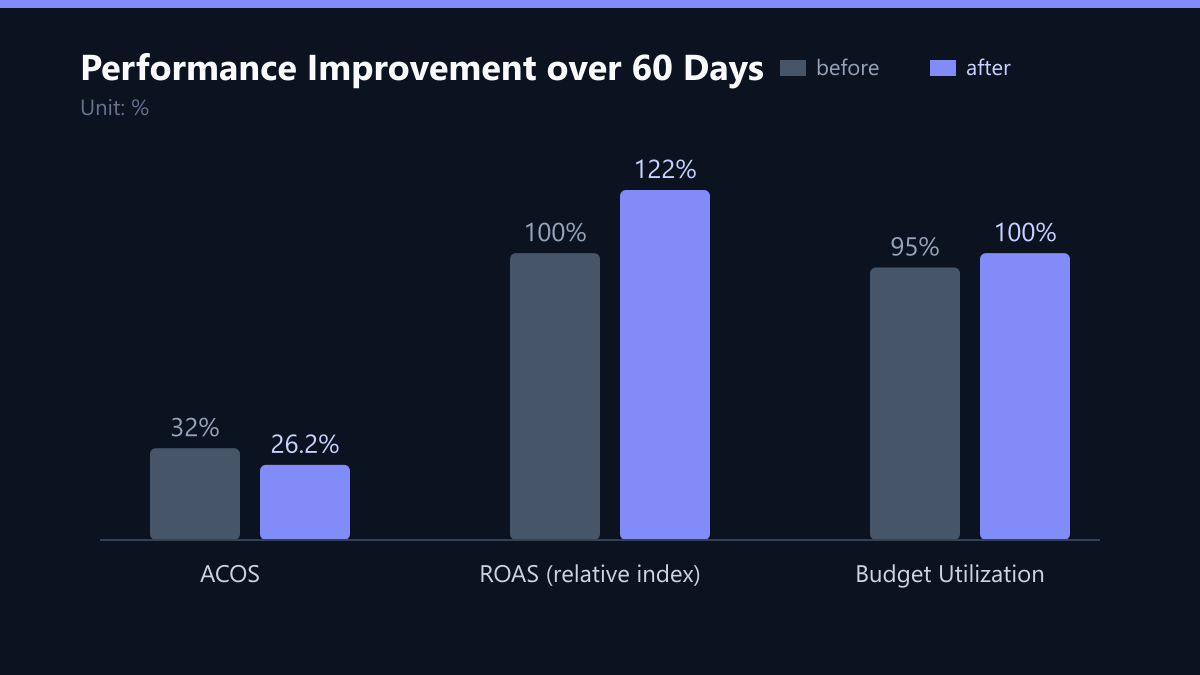
Beyond the top-line ad metrics, the operational efficiency gains were substantial. The margin per item sold increased by 4.5 %, directly impacting the bottom line. By pausing inefficient keywords and reallocating the budget to high-converting search terms, the conversion rate of top campaigns increased by 12 %. This strategic shift in visibility meant that the brand was not just spending less, but selling more efficiently. Budget utilization reached 100 %, indicating that the entire allocated budget was being put to work on high-potential opportunities, with no waste.
Lessons Learned
This project highlighted several critical insights for e-commerce brands looking to automate their ad management.
First, response time beats precision. We found that frequent, minor adjustments (every 4 hours) were more effective than rare, major corrections (weekly). The market moves quickly, and automation thrives on constant, small optimizations.
Second, segmentation is mandatory. Applying uniform bid rules across all products in the fashion industry is counterproductive. Different product categories have different margins, price points, and conversion behaviors. Segmenting campaigns allows for tailored strategies that respect these differences.
Third, monitoring remains necessary. Automation does not replace strategy. We still review the rules monthly to check for “drift”—where market conditions change so significantly that the original rules no longer apply. The human element is still vital for setting the strategic direction, but it no longer needs to handle the daily grind.
What We Would Do Differently Today
Looking back, there are two areas where we would refine our approach.
First, we would have implemented the data normalization phase earlier. The initial discrepancies in conversion tracking caused a two-week delay in the project timeline. Establishing a single source of truth before building the logic would have accelerated the rollout.
Second, we would have included a more gradual rollout of the pause rules. Initially, the 7-day pause rule was too aggressive for some seasonal items, leading to temporary visibility loss. A 10-day threshold or a “soft pause” (reducing bids by 50 % instead of pausing) would have been a smoother transition for the inventory management team.
For fashion brands with many SKUs, this method offers the fastest path to scaling ad budgets without sacrificing profitability. By letting the data drive the bids, you can achieve higher margins with less manual effort, ensuring that your marketing team can focus on what truly matters: growing the brand.
Passend dazu
- Performance Marketing
- Amazon Ads vs. Google Ads: Attribution Strategy for Mid-Market E-Commerce
- Marketplace & Amazon Ads
- Affiliate Marketing
- Content & CRO
- B2B Industry: 34% Reduction in CPA through Dynamic Google Ads Campaigns and HubSpot Attribution in the DACH Region
- Reduction of Reporting Effort by 40 Hours Monthly in the Scandinavian IT Services Sector through Automated KPI Reports
- Automated Campaign Management: 40% Increase in ROAS for a DACH Industrial Supplier through Dynamic Budget Allocation in Amazon DSP
- CRM Hygiene Project in the DACH Region: 40% Reduction in Duplicates and 10% Increase in Open Rate through Deduplicated Campaigns