The Starting Point: A Quality Problem, Not a Quantity Problem
When this B2B fintech, operating with a team of 150 employees across the UK, approached us, the initial assumption was that they needed more content. Their marketing team was already producing high-quality, technically dense insights into financial technology trends. However, despite the caliber of the writing, audience engagement was stagnating. The content was effectively trapped in a silo on their corporate blog, visible only to those who actively searched for them. For a company in the fast-paced UK fintech sector, this meant missing out on passive discovery and algorithmic amplification on social channels.
The core issue was not a lack of ideas or writing capability; it was a distribution bottleneck. The marketing team, consisting of a small handful of specialists, was spending a disproportionate amount of their week on manual formatting. They were re-typing LinkedIn posts, adjusting email teasers, and manually scheduling publications across different time zones. This manual effort led to inconsistent timing. Some weeks, the audience received three pieces of content; other weeks, they heard nothing for a fortnight. This irregularity trained the audience to ignore the brand, resulting in low reach and flat engagement metrics. The business goal was clear: they needed to amplify their voice and maintain a consistent presence without hiring additional marketing staff.
The Challenges: Why Manual Distribution Failed
We identified three specific friction points that were holding the marketing team back. First, Low Reach and Siloed Content: The primary value of the insights was locked behind a blog URL. Without active promotion on LinkedIn and email, the content had no organic legs. Second, High Manual Effort: Staff were spending an estimated 20 hours per week on distribution tasks. This time was not being spent on strategy or analysis, but on copy-pasting and formatting. Third, Inconsistent Timing: Because the process was manual, publication schedules varied wildly. This lack of rhythm meant that the algorithm on LinkedIn did not favor their posts, and email subscribers became desensitized to the irregular cadence.
The Tech Stack: Tools for Integration
To solve this, we avoided building a custom solution from scratch. Instead, we leveraged a robust, existing stack to ensure reliability and ease of maintenance. The core of the solution relied on HubSpot as the CRM and Marketing Automation hub, which already held the client’s contact data. We used Contentful as the headless CMS, which allowed us to structure content in a way that was API-friendly. For the logic layer, we employed Zapier to handle custom triggers and data mapping between platforms. Finally, we utilized the LinkedIn API to ensure that social posts were published with correct formatting and metadata, bypassing the need for manual posting.
Implementation: From Silos to Syndication
The implementation phase lasted six weeks. We approached this not as a single task, but as a series of iterative steps to ensure that the automation was reliable before scaling it up.
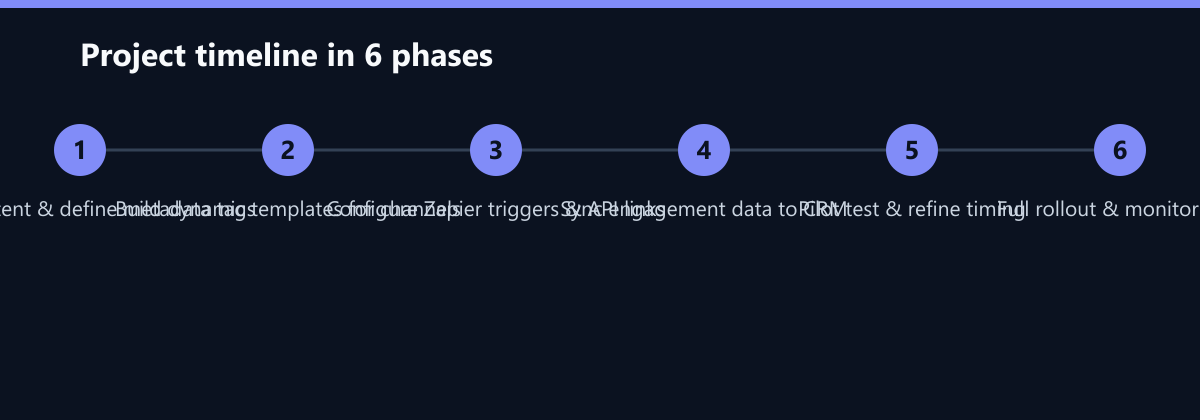
The first step was Content Structuring. We worked with the content team to define a set of metadata tags for every article. These tags included topic categories, target audience segments, and content type (e.g., thought leadership, product update, case study). This metadata was crucial because it allowed the automation to determine which channels and which templates to use for each piece of content. Without this structure, the automation would have been too generic to be effective.
Next, we focused on Template Creation. We built dynamic templates for three primary channels: LinkedIn snippets, email teasers, and executive summaries. These templates were designed to pull specific fields from the CMS, such as the article title, key takeaways, and a call-to-action button. The templates were tested extensively to ensure that the content looked professional and branded across all devices and platforms.
The third phase involved Automation Logic. Using Zapier, we configured triggers that would activate 24 hours after a blog post was published. This delay was intentional; it allowed the initial organic traffic from the blog to settle before we pushed the content to external channels. The triggers would then push the content to LinkedIn and email simultaneously. This simultaneous publication ensured that the audience saw the message across multiple touchpoints at the same time, maximizing the impact of each piece of content.
Finally, we implemented CRM Enrichment. This was a critical step that went beyond simple distribution. We set up a feedback loop where engagement data from LinkedIn and email was synced back to the CRM. If a lead clicked on a LinkedIn post or opened an email, their lead score in HubSpot was updated in real-time. This allowed the sales team to prioritize leads who were actively engaging with the content, rather than relying solely on static demographic data.
How We Measured It
To ensure that the automation was delivering value, we established a clear set of KPIs before launch. We tracked Engagement Rate on LinkedIn and email, defined as the total number of interactions (likes, comments, shares, clicks) divided by the total number of impressions. We also monitored Click-Through Rate (CTR) on email campaigns, measuring the percentage of recipients who clicked on a link in the email. Additionally, we tracked Lead Velocity, which is the number of qualified leads generated per quarter. Finally, we measured Manual Hours, tracking the time spent by the marketing team on distribution tasks before and after implementation. These metrics were collected directly from HubSpot and LinkedIn analytics, providing a single source of truth for performance.
The Results: Data-Driven Improvements
Within three months of full automation, the impact was significant. The system reduced manual distribution time by 80%, freeing up the marketing team to focus on strategy and content creation. More importantly, the audience response improved dramatically.
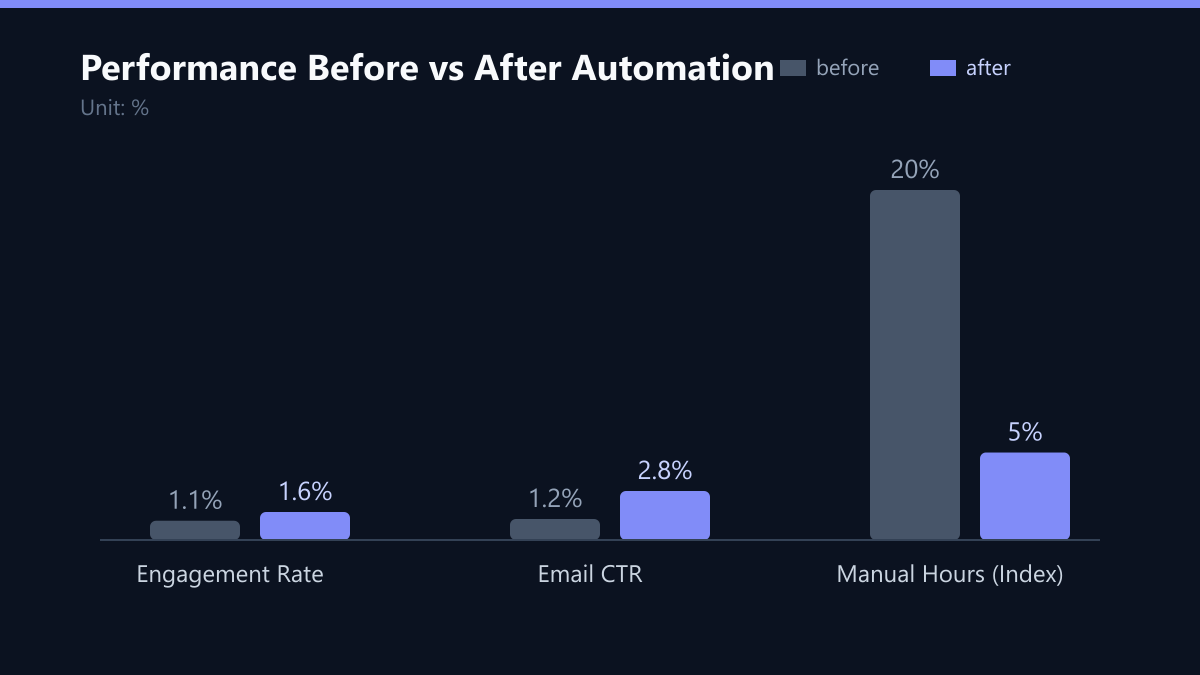
The Engagement Rate increased by 45% across LinkedIn and email channels. This was driven by the consistent timing and the improved formatting of the posts. The Click-Through Rate (CTR) on syndicated email campaigns rose from 1.2% to 2.8%, a 133% increase. This showed that the dynamic templates were resonating with the audience and driving them to take action. Lead Velocity also improved, with qualified leads growing by 32% quarter-over-quarter. This was a direct result of the CRM enrichment, which allowed sales to prioritize high-engagement leads. Finally, the marketing team saved approximately 15 hours per week on manual formatting and scheduling, a 75% reduction in manual effort.
Lessons Learned: What Worked and What Didn’t
This project highlighted several key insights that are relevant for any B2B marketing team. First, Automation is only as good as the content. The system worked because the source material was already strong. If the content had been low-quality, the automation would have simply amplified the problem. Second, Consistency wins. Regular, automated posting outperformed sporadic, high-effort manual campaigns. The audience and the algorithms both reward consistency. Third, Data feedback loops are essential. Syncing engagement data back to the CRM allowed sales to prioritize leads who actively engaged with content, leading to higher conversion rates.
What We Would Do Differently Today
While the project was a success, there are a few areas where we would refine our approach in the future. First, we would have invested more time in A/B testing the email templates before full rollout. We tested a few variations, but a more rigorous testing phase could have further improved the CTR. Second, we would have expanded the channel mix earlier. We focused primarily on LinkedIn and email, but adding Twitter/X or industry-specific forums could have further increased reach. Finally, we would have provided more training to the marketing team on how to adjust the metadata tags and templates. While the system was user-friendly, some team members struggled with the initial setup, which delayed the full rollout by a few days.
Scalability and Future Steps
The framework we built is highly scalable. It can easily accommodate new content types, such as webinars or whitepapers, without additional development effort. The metadata tags and templates can be extended to handle these new formats. The client is now looking to expand the automation to include video content and paid social amplification. The success of this project has paved the way for a more integrated marketing strategy, where content, distribution, and sales are tightly aligned through data. For any B2B company struggling with distribution efficiency, this case study demonstrates that the right automation can unlock significant value from existing content assets.