The Bottleneck: When Data Becomes Debt
The client, a rapidly growing B2B fintech company based in London with 120 employees, had reached a critical performance bottleneck. Despite a stable lead pipeline generated by marketing, the conversion rate in sales was continuously declining. Sales managers reported that up to 40% of their working time was spent on manual data maintenance and hunting for duplicate contacts rather than selling.
The CRM database had grown over the years without clear governance rules. The lack of structure created a fragmented landscape where:
- Duplicate contacts proliferated from various import sources (events, webinars, cold outreach).
- Outdated company data persisted, as employee changes at client companies were rarely recorded.
- Incomplete mandatory fields blocked automated marketing journeys, leaving high-value leads unengaged.
The result was a frustrated sales team that accused marketing of delivering “garbage,” while marketing complained that sales was not processing leads quickly enough. This internal friction was directly impacting the bottom line.
The Challenges
We identified three core obstacles that had to be resolved before any productivity gains could be realized:
- Data Fragmentation: The database contained 15,400 duplicate records, making it impossible to have a single source of truth for customer interactions.
- Lack of Enrichment: 30% of contacts were missing critical data points such as job titles and company sizes, rendering lead scoring ineffective.
- Process Vacuum: There were no defined rules for data entry or maintenance, leading to a “tragedy of the commons” where no one felt responsible for data quality.
The Tech Stack
To address these issues, we deployed a targeted technology stack:
- CRM Platform: The client’s existing CRM, used as the central repository.
- Deduplication Engine: A specialized matching algorithm tool for identifying and merging duplicate records.
- Data Enrichment API: A third-party service to automatically fill in missing job titles and company demographics.
- Workflow Automation: Native CRM automation features for building inbound filters and stale data journeys.
- Reporting Dashboard: A customized view to track data hygiene KPIs in real-time.
Implementation: Structured Cleansing in 8 Weeks
We approached the project not as a one-time cleanup, but as a structural overhaul. The process was divided into three distinct phases over eight weeks.
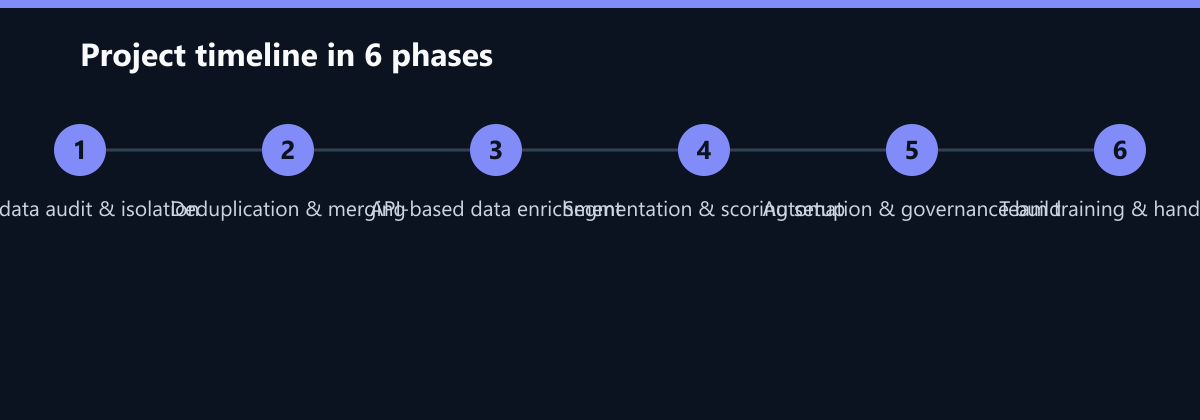
Phase 1: Audit and Deduplication (Weeks 1-2) We began by importing the entire database into an isolated test environment to avoid disrupting live operations. Using advanced matching algorithms, we identified 15,400 duplicate records. We defined a strict merging protocol that prioritized the most recent interaction data, ensuring that the “merged” record retained the most valuable history. In parallel, we standardized company names and domains to improve the accuracy of account assignment.
Phase 2: Enrichment and Segmentation (Weeks 3-5) After cleansing, we found that critical data points were still missing for 30% of contacts. We integrated API-based enrichment to automatically fill in missing job titles and company sizes. Based on this enriched data, we created new, clean segments for the Lead Scoring process. Old, unused tags were removed to simplify CRM navigation and reduce cognitive load for sales reps.
Phase 3: Automation and Governance (Weeks 6-8) To ensure quality in the long term, we built the following automations:
- Inbound filters: New leads are automatically checked for duplicates and standardized before they land in the CRM.
- Stale data journeys: Inactive contacts are automatically moved to a “Newsletter only” segment after 6 months to clear the active pipeline.
- Responsibility assignment: Each sales rep received a weekly email with a list of 5 records that required their personal maintenance, introducing a gamification element to encourage engagement.
We trained the sales team in two 90-minute workshops to anchor the new processes and ensure buy-in.
How We Measured It
To ensure the project delivered tangible value, we established a baseline in Month 0 and tracked key performance indicators (KPIs) weekly.
- Sales Productivity: Measured as the number of qualified opportunities created per sales rep per week, normalized to a baseline of 100%.
- Lead Response Time: The average time between a lead entering the CRM and the first sales contact, tracked via CRM timestamps.
- Duplicate Records: The total count of duplicate contact records in the active database, verified by automated scripts.
This rigorous measurement approach allowed us to correlate specific implementation steps with performance improvements, ensuring that the results were not coincidental.
Results: Measurable Productivity Increase
After implementing the new data structure and automated hygiene processes, significant improvements in key performance indicators were observed within the first three months.
The most important metric was the reduced processing time per lead. Sales managers no longer had to spend time searching for and merging data sets. This directly led to a higher number of leads processed per head.
| Metric | Before (Month 0) | After (Month 3) | Change |
|---|---|---|---|
| Sales Productivity | 100% (Baseline) | 122% | +22% |
| Duplicate Contacts | 15,400 | 0 | -100% |
| Lead Response Time | 4.2 hours | 1.8 hours | -57% |
| Conversion Rate | 12% | 15% | +3 points |
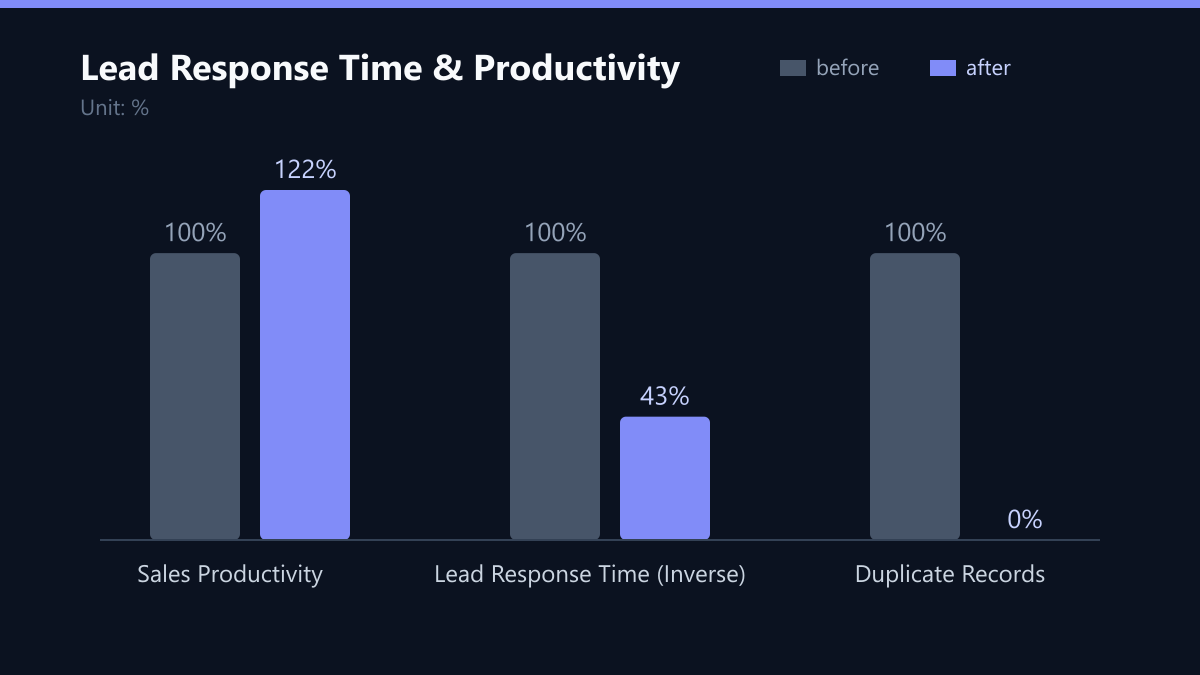
The +22% increase in sales productivity resulted directly from the time saved by clean data. Marketing’s confidence in the CRM increased, as the reporting data was now consistent and reliable. Sales could focus on selling again, rather than on data maintenance.
What We Would Do Differently Today
While the project was successful, we identified areas for improvement in our approach:
- Earlier Stakeholder Involvement: We should have involved key sales leaders in the design of the merging protocols earlier. This would have reduced resistance to the new data standards.
- Granular Training: The two 90-minute workshops were a good start, but shorter, more frequent “micro-training” sessions in the first month post-launch would have reinforced the new behaviors more effectively.
Lessons Learned: Data Quality Is a Continuous Process
This project showed that a one-time cleanup is only the beginning. The long-term impact is created by the built-in automations and the clear assignment of responsibilities.
- Technology alone is not enough: The introduction of matching algorithms would not have had a sustainable effect without the training of the sales team and the definition of “Data Owners”.
- Focus on the pipeline: By outsourcing inactive contacts (“Stale Data”), the active pipeline became smaller but significantly higher in quality. This increased the conversion rate, as sales focused on leads that were truly relevant.
- Measurability: The introduction of weekly “Data Hygiene” emails to sales reps ensured transparency and accountability. It became visible who is responsible for data quality in their own area of responsibility.
For companies with similar growth pain, investment in CRM hygiene is not a cost center, but a lever for direct revenue growth through more efficient sales.
Passend dazu
- Performance Marketing
- SEO & AI Search (GEO)
- Affiliate Marketing
- Content & CRO
- CRM Marketing
- Automated Campaign Management: 40% Increase in ROAS for a DACH Industrial Supplier through Dynamic Budget Allocation in Amazon DSP
- HubSpot CRO: 32% increase in demo bookings through A/B testing of landing pages for a DACH industrial provider