The Hidden Cost of Ad-Only Optimization
Many Amazon sellers fall into a common trap: they obsess over their Advertising Cost of Sales (ACOS) while ignoring the bigger picture. ACOS tells you how efficient your ads are in isolation, but it says nothing about the health of your overall business. A seller can have a stellar ACOS of 10% and still be losing money if their organic sales are negligible and their total ad spend consumes a huge portion of their total revenue.
This is where Total Advertising Cost of Sales (TACOS) becomes critical. TACOS measures your total ad spend against your total revenue, including both paid and organic sales. It reveals the true cost of growth. If you focus solely on ACOS, you might bid aggressively to lower that specific number, inadvertently starving your organic visibility. This creates a fragile business model where sales vanish the moment you pause your ads. To build a durable brand, you must decouple ad performance from total business performance and use TACOS as your primary strategic KPI.
Defining the Metrics: ACOS vs. TACOS
Understanding the precise definitions is the first step to fixing your profit margins.
- ACOS (Advertising Cost of Sales): This is the ratio of ad spend to ad-attributed revenue. Formula: Ad Spend / Ad Revenue. It answers the question: “How efficiently are my ads converting?”
- TACOS (Total Advertising Cost of Sales): This is the ratio of total ad spend to total revenue (paid + organic). Formula: Ad Spend / Total Revenue. It answers the question: “How much of my total business is being consumed by advertising?”
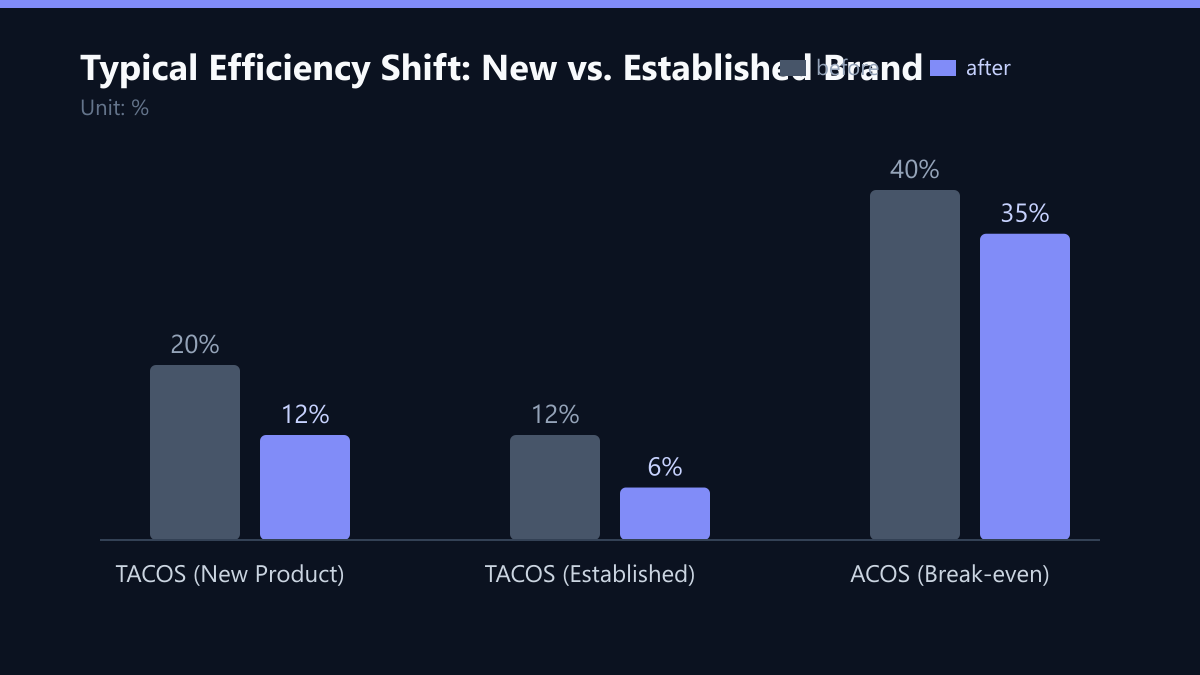
A low ACOS does not guarantee profit if organic sales stagnate. Conversely, a high ACOS can be perfectly acceptable if it drives significant organic growth, thereby lowering your TACOS over time. For example, if you spend €1,000 on ads and generate €2,000 in ad sales, your ACOS is 50%. But if that same €1,000 in ad spend boosts your organic sales by another €3,000, your total revenue is €5,000. Your TACOS is now 20%. The TACOS is the metric that reflects your actual marketing efficiency.
Why ACOS Alone Is a Dangerous Metric
Focusing exclusively on ACOS leads to short-term optimization traps. Sellers often bid aggressively to lower ACOS, which can mean reducing bids on high-intent keywords to save money. While this lowers the immediate cost per sale, it often results in lower ad rank and reduced visibility. Over time, your organic search placement erodes because you are no longer signaling to the algorithm that your product is relevant and competitive.
Key Risks of an ACOS-Only Focus:
- Rank Erosion: Your products drop in organic search results as ad visibility decreases.
- Budget Dependency: Sales drop sharply when ad budgets tighten or during platform outages because you have no organic safety net.
- False Efficiency: You see high profit margins on individual ad sales, but your overall return on investment (ROI) is low because total volume is insufficient to cover fixed operational costs.
To avoid this, you must view ads as an investment in brand equity, not just a transactional cost. TACOS provides the holistic view needed to make these strategic decisions. If your TACOS is declining while your revenue grows, you are on the right track. If TACOS rises, your ad spend is outpacing total sales growth, indicating a leak in your funnel.
Calculating Your Break-Even Points
Before you can optimize, you need to know your financial thresholds. The most critical calculation is your break-even ACOS. This is the maximum ad cost you can afford while maintaining zero profit on ad sales. It is directly tied to your gross margin.
Break-Even ACOS = Gross Margin %
For instance, if your product has a gross margin of 40%, your break-even ACOS is 40%. Any ACOS above 40% means you are losing money on every ad-attributed sale. However, this is only the floor. Your target ACOS should be significantly lower to account for operational costs, storage fees, and shipping. Your target TACOS should reflect your desired overall marketing efficiency. If you want ad spend to be 8% of your total revenue, your TACOS target is 8%.
Step-by-Step Calculation Process:
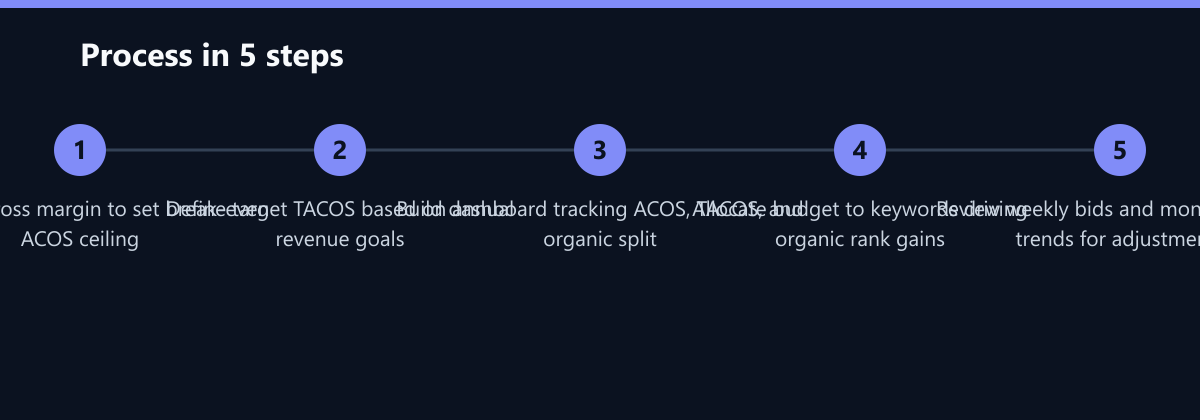
- Calculate your Gross Margin per unit (Price - COGS - FBA Fees).
- Set your Break-Even ACOS as the absolute ceiling for any campaign.
- Define your Target TACOS based on your annual total revenue goals.
- Monitor the gap between actual and target metrics weekly.
Optimizing the ACOS-TACOS Ratio
The relationship between ACOS and TACOS determines your growth trajectory. You are looking for a specific dynamic: a high ACOS with a low TACOS indicates strong organic conversion (ads are driving organic sales). A low ACOS with a high TACOS indicates weak organic traction (ads are only driving paid sales).
The goal is to keep ACOS below break-even while driving TACOS down through organic rank improvements. Here is how to achieve this balance:
- Increase Organic Visibility: Use ads to push keywords into top organic positions. Once a keyword holds an organic spot, you can lower the bid while maintaining sales volume.
- Diversify Traffic: Combine Sponsored Products with Sponsored Brands and Sponsored Display to capture different intent levels. This reduces reliance on a single traffic source.
- Monitor Share of Voice: Ensure that increased ad spend correlates with increased organic clicks. If ad spend goes up but organic clicks stay flat, your strategy is failing.
- Adjust Bids Dynamically: Lower bids on keywords with high ACOS and low organic contribution. Increase bids on keywords that are showing strong organic lift.
This balanced approach ensures that every dollar spent on ads contributes to long-term asset value, not just immediate transactions.
Implementing a KPI Dashboard
Manual tracking of ACOS and TACOS is error-prone and slow. You need to automate data collection to monitor real-time performance. A centralized dashboard should display both metrics side-by-side, along with organic sales growth rate. This allows you to spot anomalies quickly and make data-driven decisions.
Essential Dashboard Components:
- Daily/Weekly ACOS by Campaign: Identify underperforming ad groups that are dragging down overall efficiency.
- Monthly TACOS Trend: Track overall efficiency over time to see if your strategy is working.
- Organic vs. Paid Sales Split: Visualize the shift toward organic dominance. A healthy brand sees this ratio shift in favor of organic.
- Profit per Unit: Account for all costs, not just ad spend, to ensure true profitability.
Use this data to reallocate budget from low-performing campaigns to high-ROI opportunities. Regular reviews ensure your strategy adapts to market changes and seasonal fluctuations.
Typical Mistakes to Avoid
Even experienced sellers make these errors, which can sabotage their TACOS targets:
- Ignoring Seasonality: Failing to adjust TACOS targets during peak seasons (like Q4) when ad costs naturally rise. You might panic and cut budgets, losing organic rank for the following year.
- Chasing Low ACOS on Long-Tail Keywords Only: While long-tail keywords often have lower ACOS, they rarely drive significant volume or organic rank. Neglecting head terms can stall overall growth.
- Not Accounting for FBA Fees in Margin: If your gross margin calculation excludes FBA fees, your break-even ACOS is wrong. You might think you are profitable when you are actually losing money.
How You Measure Success
Success is not just about lowering numbers; it is about sustainable growth. Measure your success with these concrete KPIs:
- TACOS Reduction Rate: Aim for a 1-2% reduction in TACOS per quarter for established brands. If TACOS drops from 15% to 12% in six months, your organic engine is working.
- Organic Sales Percentage: Track the percentage of total sales that are organic. For a mature brand, this should be above 60-70%. If it is below 40%, you are too dependent on ads.
- ROAS (Return on Ad Spend) Stability: While ACOS is the inverse of ROAS, look for stability. A stable ROAS combined with growing organic sales is the ideal state. Use your dashboard to correlate bid changes with organic rank shifts to validate your strategy.
Checklist for Implementation
- Calculate current Gross Margin and Break-Even ACOS.
- Set a realistic TACOS target for the next 12 months.
- Set up a dashboard with ACOS, TACOS, and Organic Split.
- Identify top 10 keywords with high ACOS but low organic rank.
- Implement bid adjustments to prioritize organic rank gains.
- Schedule a monthly TACOS review to adjust strategy.
By shifting your focus from isolated ad efficiency to total business health, you transform your Amazon presence from a fragile ad-dependent store into a resilient brand. The metrics are simple, but the discipline to balance them is what separates profitable sellers from the rest.
Passend dazu
- Growth of qualified MQLs by 35% in Scandinavia through the automation of content clusters for a SaaS platform
- Performance Marketing
- Reduktion der Amazon Advertising ACOS um 18 % durch dynamische Bid-Regeln
- Automated Campaign Management: 40% ROAS Increase for a DACH Industrial Supplier through Dynamic Budget Allocation in Amazon DSP
- Marketplace & Amazon Ads
- Affiliate Marketing
- Content & CRO
- Amazon Ads vs. Google Ads: Attribution Strategy for Mid-Market E-Commerce
- Amazon Ads vs. Google Shopping: ROI Comparison for B2B Catalogs
- Amazon Ads vs. Google Shopping: Cost-Benefit Analysis for Mid-Market E-Commerce
- Amazon Attribution Setup: From Marketplace Clicks to CRM Leads
- Automated Amazon Feed Management: Preventing Spam and Performance Loss
- SEO Growth Through Partner Content for IT Services
- Content Refresh Strategies: How to Update Old Blog Posts for Traffic Growth
- ACoS Optimization: 5 Concrete Levers for Better Profitability
- Automated Pricing Rules in Amazon Seller Central for Maximum Margins
- Automated Pricing Strategies: 7 Tools for Dynamic Pricing on Amazon
- Systematic A/B Testing for Amazon Product Pages and Ads
- 15% Revenue Growth by Reactivating 18-Month-Old Leads
- Automated Inventory Synchronization: Preventing Stockouts on Amazon
- Sponsored Display Targeting for Retargeting Outside Amazon
- Amazon Marketing Cloud vs. GA4 for Deep Customer Insights
- Amazon Brand Registry: 7 Steps to Fully Secure Your Brand Against Counterfeiters
- How Hidden Amazon FBA Fees Impact Your Return on Ad Spend
- Automating Amazon Ad Bid Adjustments via API
- MQL vs. SQL: Definitions, Processes, and Tool Setups
- From Amazon FBA to Own Brand: Raising TACOS to 320 Percent
- TACOS vs. ROAS: Which KPI Measures Real Marketplace Profit
- How to Fix Negative ACOS: A 5-Step Audit for Underperforming Amazon Campaigns