The Financial Reality: Why ACoS Dictates Your Bottom Line
The Advertising Cost of Sales (ACoS) is not just a vanity metric; it is the primary indicator of your marketplace profitability. Defined simply as (Ad Spend / Ad Revenue) × 100, it reveals whether your advertising efforts are generating profit or silently eroding your margins. Many sellers optimize for clicks or visibility in isolation, failing to connect these actions to financial outcomes. The critical threshold is your break-even ACoS, which must be calculated based on your specific gross margin. If your gross margin is 30%, an ACoS of 35% guarantees a loss on every unit sold, regardless of volume.
To move from reactive to proactive management, you must define your maximum allowable advertising cost rate immediately. This baseline serves as the ceiling for all optimization efforts. Furthermore, you cannot evaluate campaigns in a vacuum. Segmentation by product category and customer segment is essential because a high ACoS might be acceptable for a new product launch focused on brand awareness, while the same value would be catastrophic for a mature, high-volume SKU.
Lever 1: Precision Bidding and Budget Reallocation
Bidding strategy is the most direct lever for cost control. Relying on automatic bids without manual oversight often results in overbidding on unprofitable search queries. The goal is to use dynamic bids that increase only when the probability of conversion is high, securing top-of-search placements when they matter most.
Choose your bid type based on product maturity:
- Dynamic, down only: Best for stable, established products to minimize costs.
- Dynamic, up and down: Suitable for aggressive launches or high-margin items where capturing extra volume is worth the risk.
- Fixed bids: Reserved exclusively for highly profitable, specific long-tail keywords.
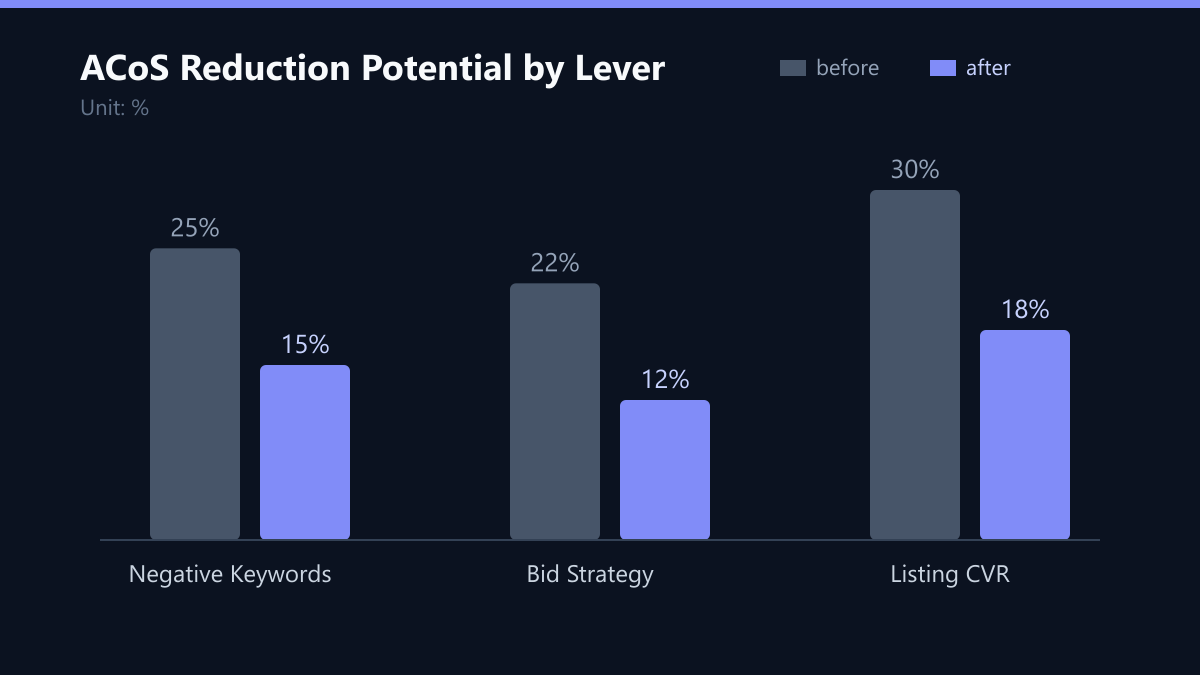
Budget allocation must be fluid. A weekly rebalancing process is required to move funds from underperforming campaigns (ACoS > 30%) to high performers (ACoS < 15%). This internal reallocation maximizes total ROI without requiring additional budget. For example, shifting €500/week from a 40% ACoS campaign to a 12% ACoS campaign can significantly improve overall account profitability.
Lever 2: The Power of Negative Keywords
Irrelevant search terms are a silent budget killer. If a user searches for “wireless headphones” and you sell “wired gaming headsets,” you pay for the click but rarely convert. Consistent maintenance of your negative keyword list is the single most effective way to reduce wasted spend.
Analyze your search term reports monthly, or weekly for high-volume accounts. Identify terms that generate clicks but zero conversions. Implement them using the correct match type:
- Exact negative matches: Block specific, irrelevant phrases.
- Phrase negative matches: Block entire word groups that fit your niche but not your specific product.
- Broad negatives: Use sparingly, as they risk excluding valid searches.
Conversely, expand your positive keywords using conversion data. If a long-tail keyword consistently produces an ACoS below 10%, isolate it in its own exact-match campaign. This allows you to bid higher on this proven winner without diluting the budget of broader, less efficient campaigns.
Lever 3: Listing Optimization as a Conversion Multiplier
Campaigns drive traffic, but the listing decides the purchase. A low ACoS is mathematically dependent on a high Conversion Rate (CVR). If your CVR drops, your effective ACoS rises because you are paying for the same traffic but generating less revenue.
Optimize your titles, bullet points, and A+ content to reinforce relevance for the specific search query. The closer the match between search intent and listing content, the higher the CVR and the lower the ACoS.
Key optimization areas include:
- Keyword Density: Ensure the primary keyword appears in the title and the first two bullet points.
- Visual Clarity: Use professional images that communicate the core benefit within seconds.
- Social Proof: Ensure positive reviews are visible to lower purchase barriers.
Consider the math: A listing with a 10% CVR requires half the advertising cost rate of a listing with a 5% CVR to achieve the same revenue. Investing in on-page optimization can double the efficiency of your ad spend. For instance, improving CVR from 8% to 12% can reduce your break-even ACoS from 25% to 16.6%.
Lever 4: Strategic Campaign Structure
Flat campaign structures hinder optimization. When all products and keywords are mixed, you cannot control bids or budgets precisely. You must group products and keywords logically to define different ACoS targets for different segments.
Separate campaigns by product type, target audience, or purchase stage:
- Brand Campaigns: Focus on your own brand. These should have the lowest ACoS target as these customers have high intent.
- Generic Campaigns: Focus on generic terms. A higher ACoS is acceptable here as you are acquiring new customers.
- Competitor Campaigns: Target competitor ASINs. The ACoS target should be based on your price advantage relative to the competitor.
Small, focused campaigns enable faster learning cycles for the advertising algorithm. You get clearer data on which keywords and placements are actually profitable. This granularity allows you to identify that a specific keyword works well for Product A but poorly for Product B, enabling precise bid adjustments.
Lever 5: Automation and Data-Driven Decisions
Manual optimization reaches its limits quickly when managing many SKUs. Rely on marketing automation to process data in real time. Use tools that automatically tie ACoS targets to bids, allowing you to react immediately to market changes without weekly manual checks.
Implement rule-based automation:
- Rule-based bids: Increase bid by 5% when ACoS < 20% for 7 consecutive days.
- Auto-pause: Pause a keyword after 10 clicks without a conversion.
- Reporting: Generate daily dashboards tracking ACoS, forecast, and budget consumption.
Combine this advertising data with CRM information to account for Customer Lifetime Value (CLV). A higher ACoS is often justified for customers with a high CLV, even if the first-order ROI is negative. For example, if a customer buys a €50 product initially but generates €200 in repeat purchases over a year, a 40% ACoS on the first order may still be highly profitable in the long run.
Typical Mistakes to Avoid
- Ignoring Seasonality: Failing to adjust bids for seasonal peaks leads to overbidding during low-conversion periods. Always review historical data before setting bids.
- Over-Optimizing Individual Keywords: Focusing too much on single keywords rather than campaign-level performance can lead to fragmented data and inefficient budget use.
- Neglecting Mobile Experience: If your listing looks poor on mobile, you lose conversions despite high ad spend. Ensure your A+ content is mobile-optimized.
How You Measure Success
To ensure your ACoS optimization is working, track these concrete KPIs:
- Blended ACoS: The overall ACoS across all campaigns. Target: Below your break-even point.
- ROAS (Return on Ad Spend): The inverse of ACoS. Target: Above 3.0 (or 300%) for most categories.
- TACoS (Total Advertising Cost of Sales): Ad Spend / Total Revenue. This metric shows if your advertising is growing the overall business or just cannibalizing organic sales. Target: Stable or decreasing over time.
- CVR by Campaign: Monitor conversion rates to identify which campaigns are driving quality traffic.
Checklist for Implementation
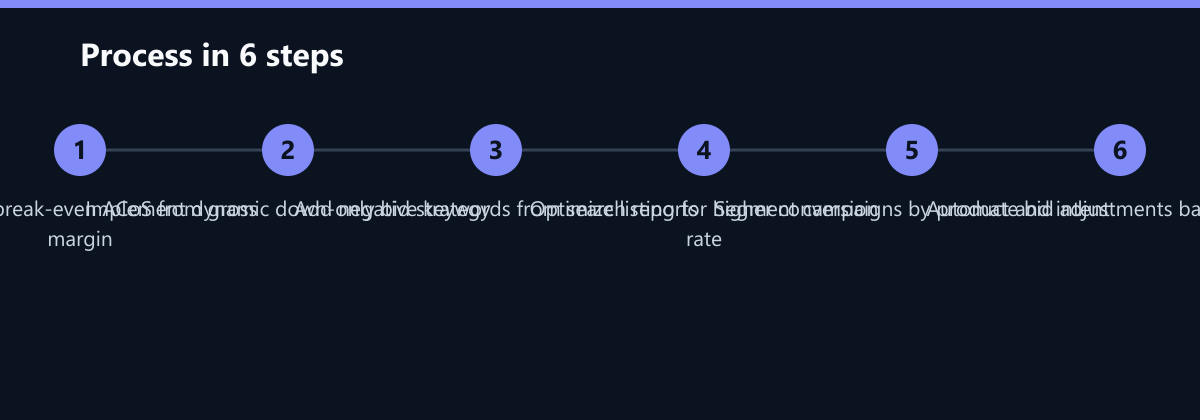
- Calculate break-even ACoS for each product category.
- Audit current bid strategies and switch to dynamic where appropriate.
- Review search term reports and add top 10 negative keywords.
- A/B test listing titles and images to improve CVR.
- Restructure campaigns to separate brand, generic, and competitor traffic.
- Set up automated rules for bid adjustments and pausing.
- Integrate ad data with CRM to analyze CLV impact.