The Stagnation of High-Volume Traffic
For many B2B SaaS companies in the Nordic region, the challenge is no longer visibility. It is relevance. Our client, a mid-sized B2B SaaS platform with 120 employees, had mastered the art of driving organic traffic. Their blog was active, their SEO was sound, and their monthly visitor counts were healthy. Yet, the marketing team faced a frustrating paradox: high traffic volume did not translate into high-quality pipeline. The sales team was overwhelmed with unqualified inquiries, while potential customers who were actually ready to buy were slipping through the cracks. The core issue was not a lack of content, but a lack of structure. High-value blog posts existed in silos, lacking the internal linking architecture necessary to guide users from top-of-funnel curiosity to bottom-of-funnel intent. Consequently, the marketing team was engaged in reactive, manual distribution, failing to capture user intent effectively across the fragmented Nordic market. This led to a low conversion rate where organic traffic to landing pages rarely resulted in qualified pipeline. The sales cycle was bloated, with teams engaging leads too late, often after multiple disconnected manual touchpoints that failed to build the necessary trust or context.
The Challenges
Before diving into the solution, it is crucial to understand the specific hurdles that made this transformation complex. We identified three primary obstacles that threatened to derail the project if not addressed immediately:
- Fragmented Content Architecture: The client had over 40 valuable articles, but they were scattered without a logical hierarchy. There were no pillar pages, and internal linking was ad-hoc. This made it impossible for both users and search engines to understand the thematic depth of the content.
- Reactive Sales Engagement: The sales team was waiting for inbound forms to be filled out. They had no visibility into which content a prospect had consumed, meaning they could not tailor their outreach. This resulted in generic pitches that failed to resonate with prospects who had already done significant research.
- Low Conversion Efficiency: Despite high traffic, the path from blog reader to qualified lead was broken. There were no automated triggers to nurture users based on their specific interest areas, leading to a high drop-off rate in the mid-funnel.
The Tech Stack
To solve these issues, we selected a lean but powerful technology stack that integrated seamlessly with the client’s existing infrastructure. Each tool served a specific purpose in the data flow from content consumption to CRM action.
- HubSpot: Served as the central CRM and marketing automation platform, handling lead scoring, email sequences, and sales pipeline management.
- Contentful: Used as the headless CMS to manage the content structure, allowing for flexible tagging and internal linking without being constrained by traditional theme limitations.
- Zapier: Employed for initial data synchronization and bridging gaps between the CMS and CRM during the setup phase, ensuring real-time data flow.
Implementation and Setup
The implementation phase was designed to be methodical, focusing on structure before automation. We implemented a structured content cluster strategy integrated directly into the client’s CRM and marketing automation stack. The focus was on automating user journeys based on content consumption patterns. First, we conducted a comprehensive audit of the existing 40+ articles. We then grouped these articles into 5 distinct thematic clusters, each anchored by a dedicated pillar page. This architectural shift transformed the blog from a list of posts into a navigable knowledge base.
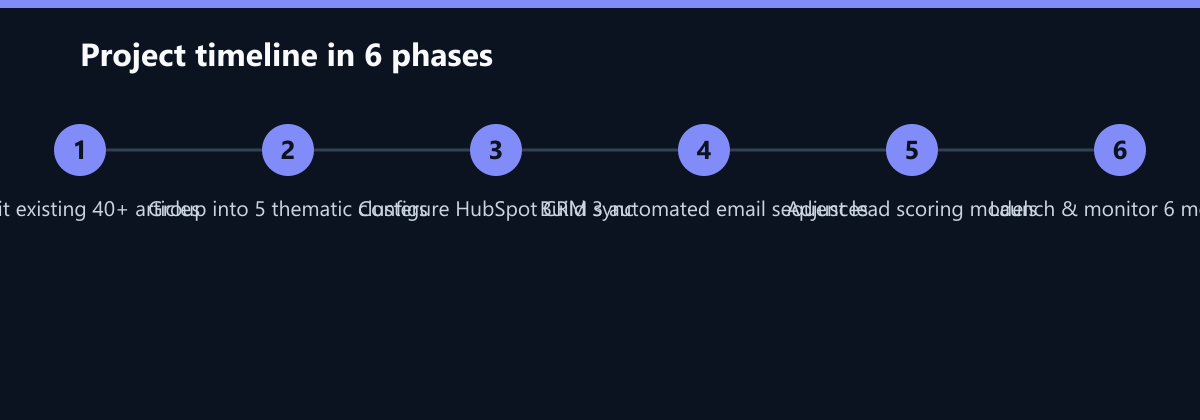
Simultaneously, we mapped out three automated email sequences. These sequences were not generic newsletters but were triggered specifically by cluster-specific page views. If a user engaged with content related to “Pricing Transparency,” they entered a sequence designed to address price objections and highlight ROI, rather than receiving a generic product overview. We also adjusted the lead scoring models within HubSpot. Previously, a single page visit might have added a small amount of score. Now, cluster engagement was weighted significantly higher. Visiting three articles within a single cluster triggered a much higher score than visiting three unrelated articles. This change ensured that sales reps were only alerted when a prospect demonstrated sustained interest in a specific solution area. The project ran over 12 weeks, with the first two weeks dedicated to technical setup and content tagging. The subsequent weeks were used to refine the email copy, test the triggers, and align the sales team with the new lead definitions.
How We Measured It
To ensure the project’s success was not anecdotal, we established a rigorous measurement framework. We defined “Qualified MQLs” not just by form fills, but by a combination of behavioral signals and firmographic data. A lead was considered qualified if they had a score above a certain threshold, which was primarily driven by cluster engagement. We tracked the baseline metrics for the quarter prior to implementation to establish a control group. For “Time on Site,” we specifically measured the average duration for users who engaged with at least two pages within a cluster, comparing this to the average for single-page visitors. The “Sales Cycle Length” was measured from the point of first contact (MQL creation) to the point of closed-won. By isolating these variables, we could attribute the changes directly to the content cluster strategy rather than broader market trends. We used HubSpot’s native reporting tools for CRM data and integrated Google Analytics 4 for behavioral metrics, ensuring a unified view of the customer journey.
Results and Impact
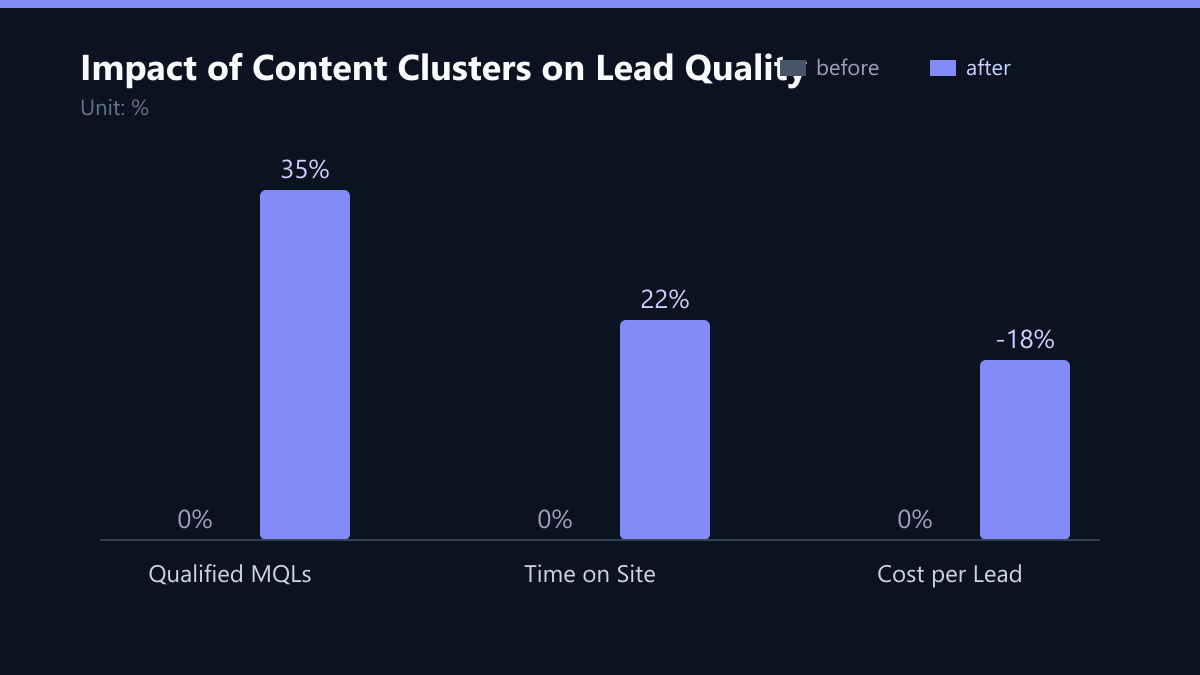
Within six months of launch, the automated content clusters significantly improved lead qualification and sales efficiency. The system reduced manual work for the marketing team while increasing pipeline velocity. The most striking result was the growth in qualified leads. Qualified MQLs increased by 35% compared to the previous quarter. This was not a result of increased traffic volume, but of increased conversion quality. The average time on site for cluster visitors rose by 22%, indicating that users were engaging more deeply with the content. Perhaps most importantly for the bottom line, the average sales cycle length decreased by 15%. This was due to earlier, more relevant engagement; sales reps could now start conversations based on the specific content the prospect had read, leading to faster trust-building and decision-making. Furthermore, the cost per qualified lead dropped by 18% through better targeting. By focusing resources on nurturing high-intent users through automated sequences, the marketing team spent less time on low-value leads and more time on optimizing the high-value journey.
What We Would Do Differently Today
Despite the success, every project offers lessons for future iterations. Looking back, there are two areas where we would adjust our approach. First, we would have prioritized the sales alignment workshops earlier. In the first month, there was some friction as sales reps adjusted to the new lead definitions. Conducting these workshops during the setup phase, rather than after launch, would have smoothed the transition and ensured immediate buy-in. Second, we would have implemented a more robust A/B testing framework for the email sequences from day one. We relied on best-practice copy initially, which worked well, but testing different subject lines and call-to-action placements could have accelerated the engagement metrics even further. These are minor adjustments, but they highlight the importance of continuous optimization in marketing automation.
Key Learnings and Strategic Takeaways
The success of this project relied on strict alignment between content strategy and technical implementation. Automation alone is insufficient without clear content architecture. The data showed that content cluster engagement provided much stronger intent signals than generic page views. A user who reads a pillar page and then dives into two supporting articles is in a fundamentally different buying stage than a user who bounces from one unrelated post to another. Regular reviews with sales teams were essential to ensure lead scoring rules remained relevant. As the product evolved, so did the topics of interest, and the scoring models had to adapt. Finally, maintenance is critical. Quarterly audits of cluster relevance were necessary to maintain high conversion rates. Content decays, and user interests shift. By treating the content clusters as a living system rather than a one-time setup, the client ensured that the benefits of the automation continued to compound over time. This case study demonstrates that for B2B SaaS companies, the path to growth often lies not in creating more content, but in structuring and automating the existing content to better serve the user journey.
Passend dazu
- Marketing Automation
- Content Drip Campaigns: Building Long-Term Relationships Through Automated Knowledge Sharing
- B2B SaaS Content Marketing: From Persona to Conversion
- Content & CRO
- Affiliate Marketing
- CRM Marketing
- Reduction of acquisition costs by 25% in the UK market through the integration of AI search signals into HubSpot funnels for a SaaS fintech
- Reduction of reporting effort by 40 hours monthly in the Scandinavian IT services sector through automated KPI reports
- Influencer collaboration in B2B: Measurable ROI increase through LinkedIn top voices for a Scandinavian industrial group
- Scaling B2B SaaS Growth in Scandinavia: 45% More MQLs via LinkedIn A/B Testing and CRM Sync
- Optimization of the content funnel bottom for an IT service provider in the UK: Converting 15% more visitors into qualified MQLs through targeted CTA placement
- Agreement on a unified attribution methodology in the Scandinavian logistics sector through the integration of CRM and web data
- From blog post to citation: How a financial software in Benelux is cited in AI answers
- Content Restructuring for AI Search: From Silos to Conversational Logic
- Logistikdienstleister in Skandinavien: Automatisierte Synchronisation von Content-Updates mit CRM-Scoring
- Mobile-First Content Design: Optimizing Scroll Depth and Interaction for B2B Websites
- B2B vs. B2C Email Strategies: Content and Automation Differences
- E-E-A-T for LLMs: Making Content Trustworthy for AI Search
- Content Clusters for AI Search: Silo vs. Thematic Approaches for B2B
- Ad Fatigue in Marketplaces: Detection and Solutions for B2B SaaS
- Reducing Commission Errors by 30% via Automation
- Generating 400 New MQLs Per Quarter With Segmented Content Drips in Asia
- Technical Whitepapers as Gated Content Drive 40% More MQLs in Southern Europe
- 28 % Growth in Qualified Inbound Leads via Entity Optimization
- FAQ Structure for AI: Positioning Your Content as the Primary Source
- Optimizing YouTube View-Through Conversions for SaaS
- Technical SEO vs. GEO: Key Factors for AI Content References
- Unified Measurement for the Mid-Market: Measurable Efficiency in Scandinavia
- Leveraging User-Generated Content to Reduce Churn in Nordic Subscription Markets
- SaaS Retargeting Strategies: Payback Period Under 90 Days in Mid-Market Scandinavia
- Tripling User-Generated Content Production in US E-Commerce