The Starting Point: A Data Black Hole
For a mid-sized B2B SaaS provider in the DACH region with 45 employees, affiliate marketing had become a double-edged sword. While partner channels contributed significantly to their lead volume, the lack of a centralized tracking system turned every month-end closing into a logistical nightmare. The team relied on a patchwork of Excel spreadsheets and manual email confirmations to track which partners drove which leads. This fragmented approach created a data black hole where critical insights were lost, and financial reconciliation became a time-consuming, error-prone process.
The core issue was not the volume of traffic, but the quality of the data surrounding it. Without a unified source of truth, the marketing team could not accurately calculate Customer Acquisition Cost (CPA) per partner. They could not see which affiliates were driving high-intent, converting leads versus those who were merely generating noise. This opacity led to inconsistent commission payments, strained relationships with top-performing partners, and a growing suspicion that budget was being wasted on low-quality traffic sources. The leadership team recognized that to scale their affiliate program effectively, they needed to move from manual reconciliation to automated, real-time attribution directly within their existing CRM, HubSpot.
The Challenges
Before diving into the technical solution, we identified three specific hurdles that had stalled previous attempts to improve affiliate tracking:
- UTM Inconsistency: Partners used a wide variety of UTM parameter formats, or omitted them entirely. This made it impossible to reliably link clicks to contact records in HubSpot.
- Attribution Disputes: The company had no defined rule for multi-touch scenarios. If a lead clicked from Partner A, then later from Partner B, the team had no clear policy on who deserved the commission, leading to frequent and heated disputes.
- Manual Reconciliation Bottleneck: The finance team spent approximately 40 hours per month manually matching HubSpot deal records with partner claims. This not only increased operational costs but also delayed commission payments by an average of two weeks, hurting partner morale.
The Tech Stack
We utilized the native capabilities of HubSpot Enterprise Edition to build this solution, avoiding the need for expensive third-party affiliate management software. The specific tools and features included:
- HubSpot Custom Properties: To store affiliate-specific data like ID, rate, and attribution date on Contact and Deal objects.
- HubSpot Workflows: To automate lead tagging, status updates, and partner notifications based on real-time data.
- UTM Standardization Scripts: A simple server-side rule to enforce a strict naming convention for all partner links.
- Custom API Endpoint: A lightweight integration to push daily commission data from HubSpot to the client’s ERP system.
- HubSpot Reporting: Native dashboards to visualize partner performance and CPA trends.
Implementation: Building the Framework
We designed a custom attribution framework directly inside HubSpot over a six-week period. The goal was to eliminate the need for external BI tools for this specific use case by embedding the logic into the CRM itself. We started by auditing the existing data to identify gaps and establish a baseline for accuracy.
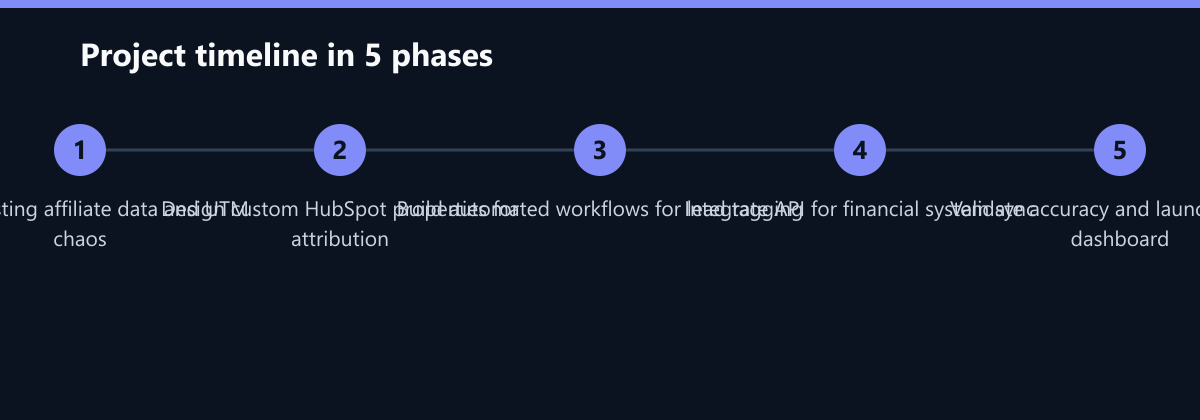
The first major component was the creation of Custom Affiliate Properties. We added fields for ‘Affiliate ID’, ‘Commission Rate’, and ‘Attribution Date’ to both Contact and Deal objects. This allowed us to carry affiliate data through the entire customer lifecycle, from the initial click to the final contract signature. Without these properties, the data would have been lost once the lead entered the sales pipeline.
Next, we addressed the UTM Standardization issue. We worked with the client’s web team to enforce a strict UTM parameter structure across all partner links. We implemented a server-side rule that rejected or corrected non-compliant UTM tags, ensuring that only clean, parseable data entered the system. This step was critical for data integrity and reduced the noise in the attribution logs significantly.
With the data structure in place, we built Automation Workflows to handle the logic. These workflows automatically tagged leads based on the first and last touch affiliate parameters. We configured specific triggers to update the affiliate status from ‘Lead’ to ‘Closed-Won’ only when a deal reached the ‘Contract Signed’ stage. This ensured that commissions were only calculated for deals that were actually won, preventing overpayments for leads that never converted.
Finally, we integrated a custom API endpoint to sync daily commission reports back to the client’s financial system. This automated the entire reconciliation process, ensuring zero manual data entry for the finance team. The system would pull the list of ‘Closed-Won’ deals with affiliate tags, calculate the commission based on the stored rate, and push the data to the ERP for payment processing.
How We Measured It
To validate the success of the implementation, we defined three key performance indicators (KPIs) and established a baseline before the launch.
- Customer Acquisition Cost (CPA): We calculated the average CPA per affiliate partner by dividing the total commission paid by the number of closed-won deals attributed to that partner. Before the implementation, this data was fragmented and often incomplete, but we used the best available spreadsheet data to establish a baseline.
- Manual Hours Saved: We tracked the time spent by the marketing and finance teams on affiliate reconciliation tasks. We used time-tracking logs from the three months prior to the implementation as our baseline.
- Attribution Accuracy: We defined this as the percentage of closed-won deals that had a correctly attributed affiliate tag without manual intervention. We measured this by auditing a sample of 100 deals after the implementation and comparing them against the partner claims.
We monitored these KPIs weekly during the first month and monthly thereafter. The data was pulled directly from HubSpot reports, ensuring that the metrics were consistent and reproducible.
The Results
Within three months of full implementation, the client achieved measurable improvements in efficiency and cost reduction. The automated system provided clear insights into which affiliates drove high-quality, converting leads, allowing the team to make data-driven decisions about their partner network.
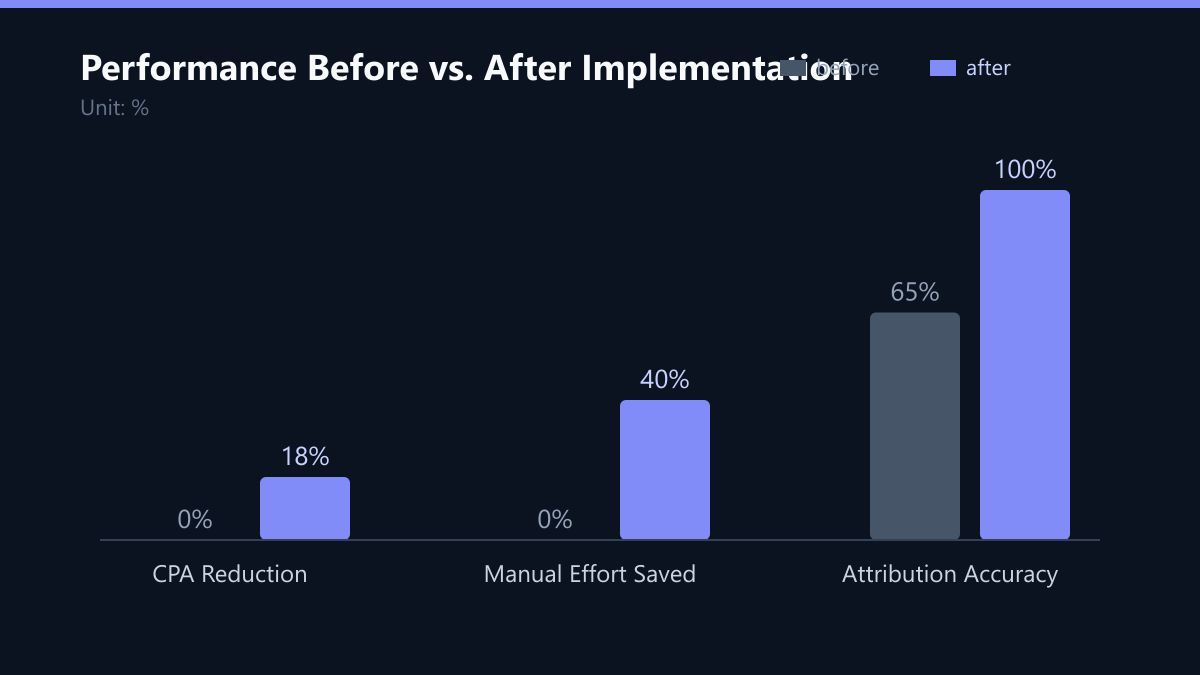
The most significant outcome was an 18% reduction in CPA. By having real-time visibility into partner performance, the marketing team was able to identify low-performing affiliates who were driving high costs with low conversion rates. They paused these partnerships and reallocated the budget to top-performing partners, resulting in a more efficient use of marketing spend.
Additionally, the team saved 40 hours monthly by eliminating manual spreadsheet management and reconciliation tasks. This freed up valuable time for the marketing and finance teams to focus on strategic initiatives rather than administrative overhead. The automation of the commission calculation and payment process also improved partner satisfaction, as payments were processed faster and more accurately.
Perhaps most importantly, the client achieved 100% attribution accuracy. The strict UTM standardization and automated workflows ensured that every deal was correctly attributed to the right partner. This eliminated the disputes that had previously strained relationships and built trust between the company and its affiliate partners. The clear, transparent data also made it easier to negotiate better terms with high-performing partners, as they could see exactly how their efforts were being valued.
Lessons Learned
This project highlighted the importance of defining attribution rules before technical implementation. Clear governance is crucial for partner trust. We learned that technical solutions cannot fix organizational ambiguity. If the business rules for attribution are not clear, the system will simply automate the confusion.
Key takeaways from the project include:
- Simplicity wins: A well-structured HubSpot setup outperformed complex external dashboards for this specific use case. For mid-sized companies, the native CRM features are often sufficient and more cost-effective.
- Real-time data drives action: Immediate visibility into partner performance enabled rapid budget adjustments. The ability to see CPA trends in real-time allowed the team to react quickly to changes in partner performance.
- Standardization is non-negotiable: Consistent UTM usage was the single most critical factor for data integrity. Without it, the entire attribution model would have failed.
For B2B SaaS companies relying on channel partners, integrating attribution directly into the CRM creates a single source of truth for marketing and finance. It reduces costs, improves efficiency, and builds stronger partner relationships.
What We Would Do Differently Today
While the project was a success, there are a few areas where we would refine our approach if we were to repeat it today.
First, we would have invested more time in the initial UTM standardization phase. While we implemented a server-side rule to enforce compliance, we could have worked more closely with the partners to provide them with pre-configured links. This would have reduced the burden on the partners and ensured higher compliance from the start.
Second, we would have introduced a more robust validation step for the API integration. While the system worked well, we experienced a few minor data sync issues in the first month. Implementing a more robust error-handling mechanism and alerting system would have caught these issues earlier and reduced the time spent on debugging.
Finally, we would have built a more detailed partner-facing dashboard from the outset. While the internal reporting was comprehensive, the partners had to rely on manual reports to see their performance. Providing them with a self-service dashboard would have further improved transparency and reduced the number of support requests we received.
Passend dazu
- Automated Creative Rotation to Solve Ad Fatigue with HubSpot and Meta
- Affiliate Networks for B2B SaaS: EPC and Cookie Duration Comparison
- Affiliate Marketing
- Tracking & Attribution
- Content & CRO
- Automated Partner Payouts: CRM Workflow for SaaS Affiliate in the UK Market
- B2B Industry: 34% CPA Reduction through Dynamic Google Ads Campaigns and HubSpot Attribution in the DACH Region
- B2B Customer Retention: HubSpot Integration with Discord Communities for a Scandinavian SaaS Startup
- Compliant Partner Attribution for Fintech Affiliates in Southern Europe
- Why First-Click Attribution Distorts B2B Performance Marketing
- Automated CRM Data Cleaning: Fixing Duplicates and Missing Fields in HubSpot
- Dynamic Creative Optimization for B2B SaaS: Boosting CTRs
- Automated Affiliate Workflows in HubSpot: From Click to Payout
- Automate Affiliate Commissions with HubSpot Workflows
- HubSpot vs. Impact: Affiliate Software for the Mid-Market Toolchain
- Automated Partner Reports: Templates for Salesforce and HubSpot
- Combining Personalization and CRO in HubSpot for B2B SaaS
- HubSpot vs. PartnerStack: The Right Affiliate Platform for B2B Mid-Market
- Cutting B2B Acquisition Costs by 25% in Benelux Logistics
- Cross-Device Attribution: Counting Mobile and Desktop Separately
- Multi-Marketplace Attribution: Amazon and Shopify Data in HubSpot
- Bridging the Attribution Gap: Linking Offline Events to Digital Journeys
- Automated Partner Recruiting: Scaling Your Affiliate Network Without Manual Effort
- HubSpot Smart Content Setup Guide for B2B SaaS
- Cross-Device-Attribution in Singapur: SEA-Kampagnen synchronisiert mit HubSpot
- Automated Price Synchronization: Connecting ERP, Amazon, and HubSpot
- Marketing Mix Modeling for a US Healthcare Provider
- Automating SaaS Onboarding for 500 UK Clients
- HubSpot and GEO Integration: Automated Content Optimization for AI Search
- Setting Up Automated Weekly KPI Reports in HubSpot to Save 10 Hours
- High-Impact Ad Extensions to Lower CPC in B2B SaaS
- 7 Common Mistakes in Automated Sales Trigger Design
- HubSpot Affiliate Journeys: 32% Increase in Partner Activation in DACH B2B
- Ad Fatigue in Marketplaces: Detection and Solutions for B2B SaaS
- Generating 500 New Leads in 3 Months via Reddit Marketing for a US SaaS Provider
- Automated Cross-Selling Journeys for B2B Resale
- Automated Inventory Forecasting for a UK Tech Accessory Retailer
- Cutting CAC by 34% in Spanish E-Commerce with LinkedIn and HubSpot
- Automated Affiliate Content Pipeline: Briefings and Reports
- From FBA Chaos to Automated Inventory Control: Cutting TACOS by 42%
- B2B Crisis Communication: 5 Templates for Automated Negative Review Responses
- Automated CIO Nurture Journeys Drive 8x ROI for SaaS Webinars
- HubSpot vs. Slack: Automating B2B Community Onboarding for SaaS
- From Click to Contract: Building an Automated Affiliate Journey in HubSpot