The Silent Killer of Marketplace ROI
Marketplace advertising operates on a high-volume, low-margin logic. Unlike owned channels, you compete for attention in a crowded feed where users have high intent but low patience. Ad fatigue occurs when users see the same creative too often, leading to decreased engagement and rising costs. For B2B SaaS, this is critical because the sales cycle is long and trust is built through consistent, non-intrusive messaging. When fatigue sets in, your cost per acquisition (CPA) spikes while conversion rates drop. The algorithm interprets low engagement as poor ad quality, further reducing your delivery. This creates a vicious cycle where you pay more for less traffic. Identifying this early prevents budget waste and protects brand perception.
Leading Indicators vs. Lagging Metrics
You cannot manage what you do not measure. Standard metrics like CTR and CPC are lagging indicators. You need leading indicators to spot fatigue before it impacts revenue. Frequency is the primary driver, but it must be analyzed alongside engagement quality. Monitor these specific KPIs to detect saturation before it becomes a financial problem:
- Frequency: Average number of times a user sees the ad. A frequency above 3.0 in display or 5.0 in social often signals saturation.
- CTR Decline Rate: A drop of more than 20% over a 14-day period indicates creative exhaustion.
- CPM Inflation: Rising costs per thousand impressions without increased relevance suggest the auction is penalizing your ad.
- View-Through Conversions: A decrease in assisted conversions signals that the ad is no longer influencing the decision path.
Why Marketplaces Accelerate Fatigue
Marketplaces like Amazon, eBay, or B2B platforms have unique dynamics that speed up ad fatigue. Users browse with high intent but low patience. The same user may visit the platform multiple times a week. This high revisit rate means your ad appears frequently in their daily workflow. Additionally, marketplace algorithms prioritize engagement. If your creative does not refresh, the system reduces your impression share. This forces you to bid higher to maintain visibility. Dynamic creative optimization is often underutilized in these environments. Static images become stale quickly in a fast-scrolling feed.
Key drivers include:
- High Revisit Rates: Users check marketplaces daily for price comparisons.
- Competitive Density: Competitors rotate creatives faster than typical B2B advertisers.
- Contextual Irrelevance: The same ad appears in different search contexts, reducing perceived relevance.
Automating Creative Rotation and Testing
Manual creative management does not scale in marketplace environments. You need an automated system that tests variations and retires underperformers. Marketing automation allows you to link creative performance with lead scoring and lifecycle stages. Implement a tiered creative strategy to ensure the right message reaches the right user at the right time:
- Broad Appeal: Generic value propositions for cold traffic.
- Feature-Specific: Highlight specific B2B SaaS features for warm traffic.
- Social Proof: Use case studies or testimonials for hot leads.
Use your CRM data to segment audiences. Exclude users who have already converted or reached a certain stage in the sales cycle. This prevents showing a “Sign Up” ad to someone who just closed a deal. Automation rules can trigger creative swaps based on real-time performance data. If CTR drops below a threshold, the system automatically promotes a new variation.
The Power of Granular Segmentation
One-size-fits-all messaging is the fastest way to trigger fatigue. B2B buyers have different pain points depending on their role and company size. Audience segmentation ensures that each user sees a message relevant to their specific context. Create distinct segments based on:
- Job Title: Engineers care about API documentation; CTOs care about security and scalability.
- Company Size: SMBs need ease of use; Enterprises need integration capabilities.
- Geographic Location: Localize messaging for DACH, Benelux, or North American markets.
By serving tailored ads, you increase relevance and reduce the perceived intrusiveness. This maintains high engagement rates even with higher frequency. Your marketing automation platform should sync these segments daily to ensure ad targeting remains precise. Stale data leads to mis-targeting and accelerated fatigue.
Typical Mistakes in Marketplace Advertising
Even with the best tools, teams often fall into traps that accelerate fatigue. Here are four common errors to avoid:
- Ignoring Frequency Caps: Relying on default settings without setting specific caps for display (3.0) and social (5.0) leads to oversaturation in high-traffic marketplaces.
- Static Creative Assets: Using a single static image for weeks in a fast-scrolling feed. This fails to capture attention in competitive auctions where competitors rotate assets weekly.
- Poor Audience Exclusions: Failing to exclude converted users or those in the late stages of the sales cycle, resulting in irrelevant messaging and wasted spend.
- Lack of Data Sync: Disconnecting CRM data from ad platforms, causing stale audience segments and mis-targeting that reduces relevance scores.
How You Measure Success
To ensure your fatigue management strategy is working, track these concrete KPIs:
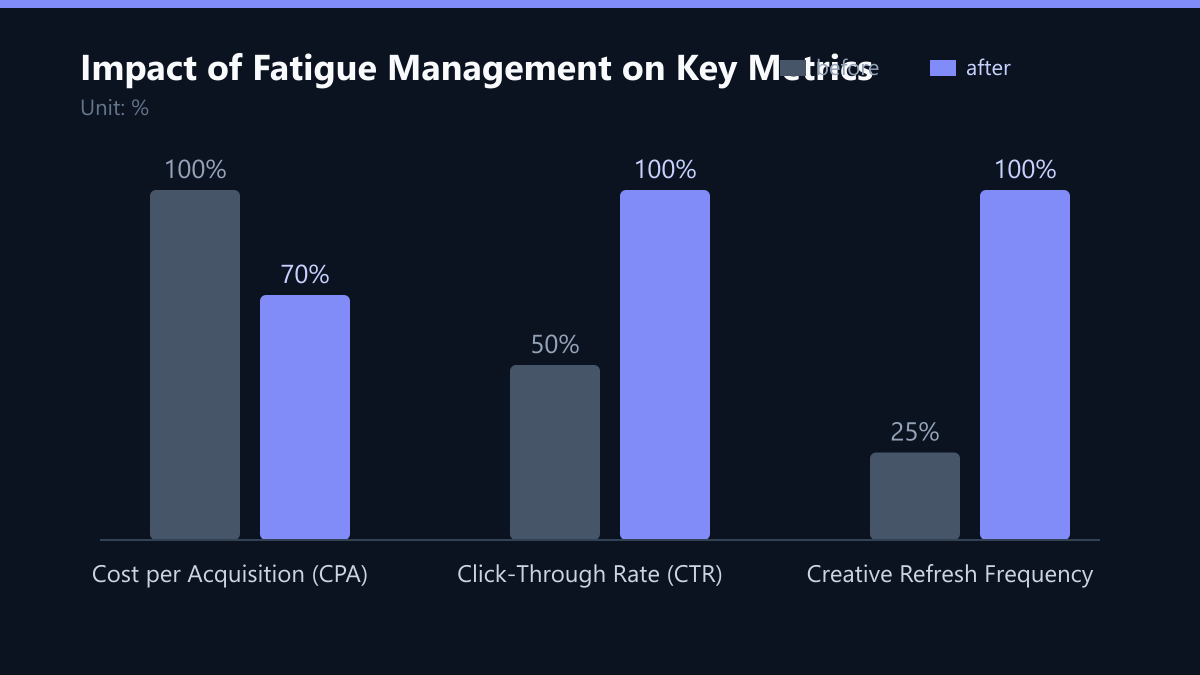
- CPA Reduction: Aim for a 20-30% reduction in CPA within the first quarter of implementing automated creative rotation.
- CTR Stability: Maintain CTR within 10% of the initial baseline over a 30-day period, indicating that creative fatigue is being effectively managed.
- Frequency Efficiency: Keep average frequency below 3.0 for display and 5.0 for social while maintaining high impression share.
- Creative Refresh Rate: Track the percentage of active creatives that are refreshed every 2-4 weeks. Aim for a refresh rate of at least 50% of your active inventory every month.
Measure these metrics weekly using your analytics platform. Compare performance before and after implementing automation rules to quantify the impact of your strategy.
Long-Term Strategy for Sustainable ROI
Ad fatigue is not a one-time fix but an ongoing management process. Build a system that continuously optimizes your marketplace presence. Data integration between your ad platform, CRM, and analytics tools is essential. This closed-loop system provides visibility into the full customer journey. Key actions for long-term success include:
- Weekly Creative Audits: Review top and bottom performers. Retire the bottom 20%.
- A/B Testing Cadence: Test new hooks and visuals every two weeks.
- Budget Reallocation: Shift budget from fatigued audiences to high-potential segments.
- Cross-Channel Coordination: Ensure marketplace ads align with email and content marketing efforts.
Consistency in brand voice is crucial, but consistency in creative execution is not. Balance familiarity with novelty. By treating ad fatigue as a core operational metric, you protect your ROI and maintain a competitive edge in crowded marketplace environments.
Implementation Checklist
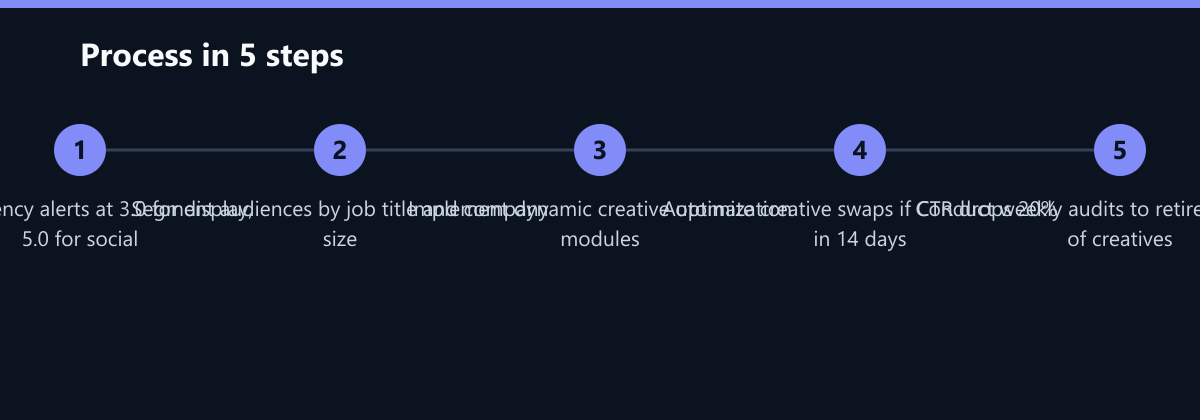
- Audit Current Performance: Review the last 30 days of data to identify baseline CTR, CPA, and frequency metrics.
- Set Frequency Alerts: Configure alerts in your ad platform for frequency thresholds of 3.0 (display) and 5.0 (social).
- Segment Your Audience: Create distinct segments based on job title, company size, and geographic location using CRM data.
- Implement Dynamic Creative: Set up dynamic creative optimization modules to swap headlines, CTAs, and images based on audience segments.
- Automate Creative Swaps: Configure automation rules to trigger creative swaps if CTR drops by 20% over a 14-day period.
- Conduct Weekly Audits: Schedule weekly reviews to retire underperforming creatives and test new variations.
- Monitor KPIs: Track CPA, CTR, and frequency efficiency weekly to measure the impact of your strategy.
By following this structured approach, you can effectively manage ad fatigue and maintain high ROI in competitive marketplace environments. Remember, ad fatigue is a continuous challenge, but with the right tools and processes, it can be turned into a competitive advantage.
Passend dazu
- Performance Marketing
- SEO & AI Search (GEO)
- Growth of qualified MQLs by 35% in Scandinavia through the automation of content clusters for a SaaS platform
- Cutting Fraud Costs by 42 % via Lead Validation
- Affiliate Marketing
- Content & CRO
- CRM Marketing
- High-Impact Ad Extensions to Lower CPC in B2B SaaS
- 5 KPIs to Identify Bot Traffic in Affiliate Programs
- Affiliate Networks for B2B SaaS: EPC and Cookie Duration Comparison
- Automated Pricing in Marketplaces: Algorithms Over Manual Excel Updates
- Localized Campaigns for Italian Industrial Manufacturer: 18% More Conversions
- Automating VAT and Customs Compliance for EU Marketplace Sales
- TACOS vs. ROAS: Which KPI Measures Real Marketplace Profit
- Retargeting Fatigue: Balancing Frequency and Message Rotation