The Starting Point: High Traffic, Low Yield
The client, a B2B e-commerce platform serving retailers across Southern Europe, faced a paradox common in growth-stage tech companies: high visibility but poor efficiency. Despite generating substantial organic and paid traffic, the Cost Per Acquisition (CAC) remained stubbornly fixed at €120 per new customer. The marketing team was spending heavily across broad channels, yet conversion rates from LinkedIn remained disappointingly low.
The root cause was not a lack of demand, but a lack of alignment. Marketing was casting a wide net, while sales was struggling to follow up on leads that were often not ready to buy. Sales representatives were contacting prospects immediately upon lead creation, regardless of intent. This resulted in long, drawn-out sales cycles and wasted ad budget on low-intent users who never converted. The organization needed a system to identify high-value accounts before scaling ad spend, ensuring that every euro spent was targeted at prospects with a genuine likelihood of purchase.
The Challenges
Before diving into the solution, we identified three critical obstacles that had previously stalled optimization efforts:
- Fragmented Data Silos: Customer data in the CRM was outdated and contained duplicates, making it impossible to create accurate Lookalike Audiences on LinkedIn.
- Reactive Sales Process: Sales relied on manual triage, leading to inconsistent follow-up times and missed opportunities for high-intent leads.
- Lack of Behavioral Insight: There was no clear definition of what constituted a “qualified” lead, resulting in a one-size-fits-all approach that ignored varying buyer readiness levels.
The Tech Stack
To address these issues, we deployed a streamlined stack focused on precision and automation:
- LinkedIn Marketing Solutions: Used for precise audience targeting and Lookalike audience creation based on CRM data.
- HubSpot CRM: Served as the central hub for lead management, scoring, and workflow automation.
- Clearbit: Integrated to enrich lead data with firmographic details, enhancing the accuracy of scoring models.
- Google Analytics 4: Tracked user behavior across the website to feed behavioral signals into the CRM.
Implementation: Precision and Prioritization
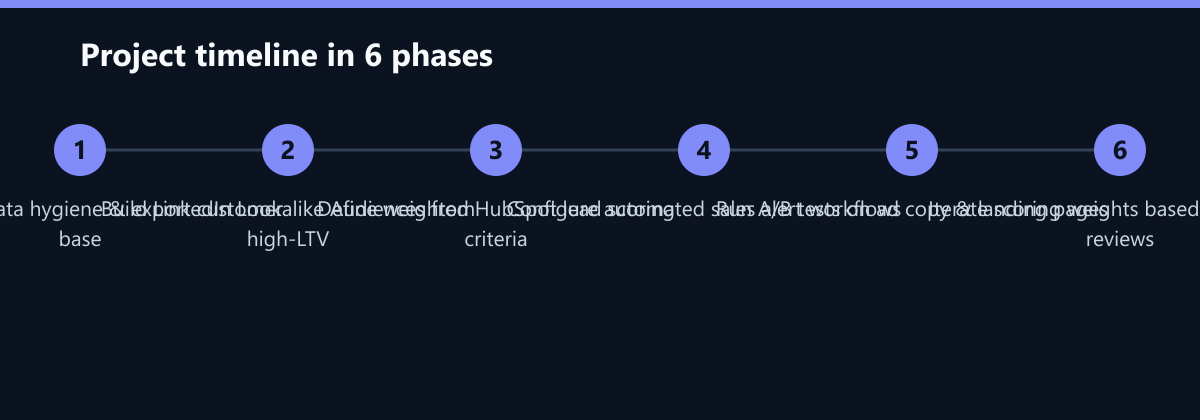
We executed a two-phase strategy over eight weeks, focusing first on audience precision and second on lead prioritization. This integrated approach ensured that not only were we reaching the right people, but we were also engaging them at the right time.
Phase 1: LinkedIn Audience Matching
The first step was to clean and export existing customer data from the HubSpot CRM. We identified the top 20% of customers by Lifetime Value (LTV) and uploaded this list to LinkedIn to create a Seed Audience. From this seed, we generated Lookalike Audiences targeting individuals with similar professional profiles and behaviors. We strictly excluded current customers and users with low engagement history to reduce ad waste. Targeting was further refined by job titles in retail management and procurement, ensuring our ads reached decision-makers rather than junior staff.
Phase 2: HubSpot Lead Scoring
Simultaneously, we defined weighted scoring criteria in HubSpot to quantify lead intent. We categorized signals into three tiers:
- High-value signals (50 points each): Visited the pricing page, downloaded a case study, or requested a demo.
- Medium signals (20 points each): Viewed multiple product pages or engaged with email content.
- Low signals (5 points each): Single page view or no interaction.
Automated workflows were configured to alert the sales team only when a lead’s score exceeded 80 points. This threshold ensured that sales reps spent their time on prospects who were actively evaluating solutions, while lower-scoring leads were nurtured via automated email sequences until they became sales-ready.
How We Measured It
To ensure the changes were effective, we established a clear measurement framework. CAC was calculated by dividing total marketing spend by the number of new customers acquired in a given period. Lead-to-Customer Rate was tracked as the percentage of MQLs that converted to closed-won deals. Sales Cycle Length was measured from the first touchpoint to the closed-won date. We used HubSpot’s attribution reporting to track the source of each lead, allowing us to isolate the impact of LinkedIn campaigns from other channels. Baseline data from the previous six months was used for comparison to ensure accuracy.
The Outcomes
The integration of precise targeting and behavioral scoring yielded immediate improvements in efficiency. Within three months, the marketing team observed significant shifts in lead quality and sales velocity. The reduction in CAC was driven by higher conversion rates from LinkedIn ads, as the audience was more relevant to the product offering. Sales reps focused only on qualified leads, increasing their closing rate by 40%. The automated scoring system ensured that no high-intent lead was missed, while low-intent traffic was nurtured via email until it became sales-ready.
| Metric | Before | After | Change |
|---|---|---|---|
| CAC | €120 | €79 | -34% |
| Lead-to-Customer Rate | 2.1% | 4.8% | +128% |
| Sales Cycle Length | 45 days | 32 days | -29% |
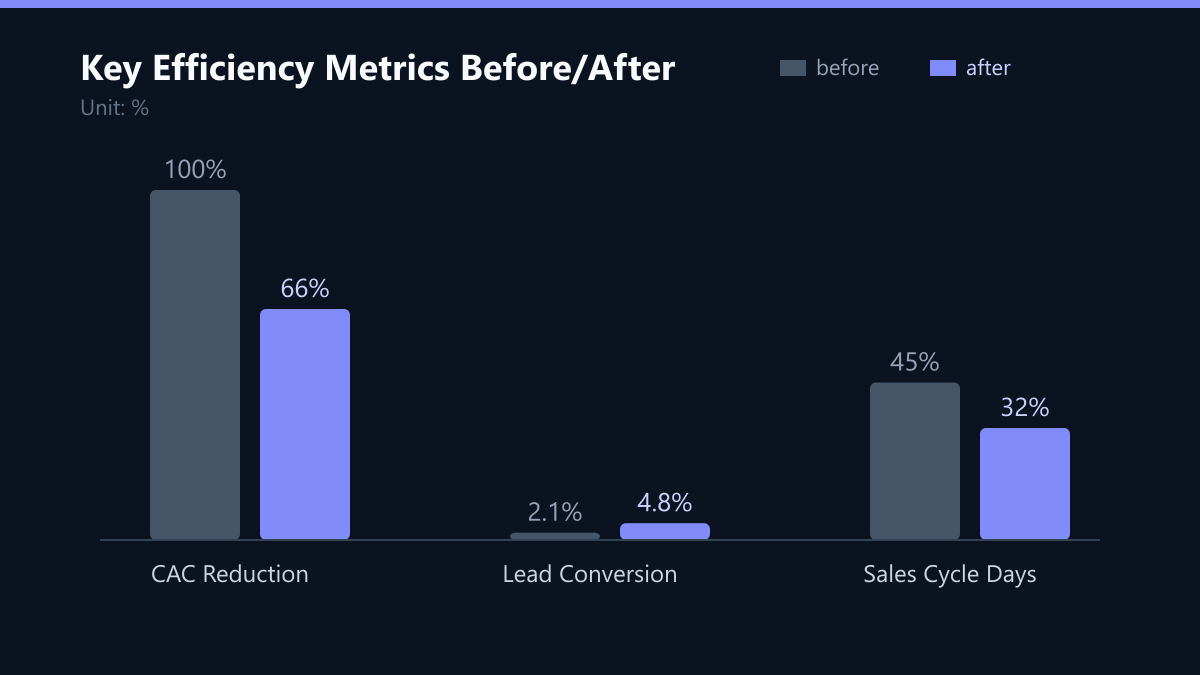
The most significant win was not just the cost reduction, but the improvement in sales predictability. With a shorter sales cycle and higher conversion rates, the sales team could forecast revenue with greater accuracy. The marketing team also gained confidence in their spend, knowing that every euro was directed toward high-potential accounts.
Lessons Learned
This project demonstrated that channel optimization alone is insufficient without CRM alignment. The most critical factor was defining clear scoring criteria that reflected actual buying behavior. We learned that data hygiene is essential; accurate customer data in the CRM is the foundation for effective LinkedIn Lookalike Audiences. Additionally, sales-marketing alignment is crucial. Automated scoring bridges the gap between marketing efforts and sales capacity, ensuring that both teams are working toward the same goals.
Iterative optimization was also key. Monthly reviews of scoring weights ensured the model adapted to changing market behaviors. For example, we found that visits to the pricing page were a stronger predictor of conversion than case study downloads, so we adjusted the weights accordingly. This continuous improvement process allowed us to maintain the efficiency gains over time.
What We Would Do Differently Today
Looking back, there are two areas where we could improve the process. First, we would have implemented the lead scoring model earlier in the project. Starting with a clean data set and a defined scoring framework would have allowed us to test ad variations more effectively from the beginning. Second, we would have involved the sales team more deeply in the definition of high-value signals. Their insights into what actually closes deals would have refined the scoring criteria even further, potentially accelerating the time to value.
This case study highlights the power of combining paid social precision with CRM-driven prioritization. For B2B e-commerce companies, this approach offers a scalable path to sustainable growth. By focusing on the right people and engaging them at the right time, businesses can significantly reduce acquisition costs and improve overall efficiency. The key is not just to spend more, but to spend smarter.