The Starting Point: High Attendance, Low Yield
For a mid-market B2B SaaS provider based in New York with approximately 150 employees, the technical webinar series had become a double-edged sword. On one hand, the events were well-attended, signaling strong market interest in their product capabilities. On the other, the post-event experience was a black hole for revenue generation. Marketing teams poured significant resources into producing high-quality content, yet the conversion rates from webinar attendees to closed-won deals remained stubbornly low.
The core issue was a disconnect between the audience and the follow-up strategy. The client was using generic, one-size-fits-all email sequences for all attendees. This approach failed to account for the distinct motivations of different roles. A Chief Information Officer (CIO) and a Chief Technology Officer (CTO) might attend the same session, but their decision-making criteria are fundamentally different. The CIO is focused on budget, risk mitigation, and ROI, while the CTO is interested in technical architecture, integration complexity, and scalability. By treating them identically in the follow-up phase, the client was diluting the impact of their high-value content. Sales teams reported frustration, noting that leads coming from webinars often lacked the specific context needed for a productive discovery call, resulting in prolonged qualification phases and lower conversion rates.
The Challenges
Before implementing the new strategy, we identified three specific hurdles that needed to be addressed to unlock the potential of the webinar data:
- Lack of Granular Segmentation: The CRM data did not sufficiently distinguish between C-level executives and lower-level technical staff in the post-event workflow. All attendees were funneled into the same generic nurture track.
- Misaligned Content: The follow-up emails contained a mix of general product features and technical specs, which failed to resonate with the specific pain points of CIOs or CTOs. This led to low engagement and high unsubscribe rates.
- Ineffective Lead Scoring: The existing scoring model weighted attendance heavily but ignored behavioral signals. A user who watched the entire webinar but never clicked a link was scored the same as a user who clicked on a specific ROI case study, leading to inefficient sales prioritization.
The Tech Stack
To address these challenges, we leveraged a focused stack of tools integrated within the client’s existing ecosystem:
- HubSpot Marketing Hub: Served as the central engine for automation, segmentation, and email delivery.
- HubSpot Sales Hub: Used for lead scoring, pipeline management, and sales team notifications.
- ZoomInfo: Provided accurate job title data to ensure precise segmentation of CIOs, CTOs, and VPs of Engineering.
- Loom: Used for creating short, personalized video snippets for the initial follow-up emails to increase engagement.
Implementation: Building Role-Specific Tracks
We designed a segmented, automated nurture journey in HubSpot specifically for C-level attendees. The setup involved three distinct tracks based on job title and engagement score. The total timeline for the project was ten weeks: four weeks for the initial setup and configuration, and six weeks for live optimization based on real-time data.
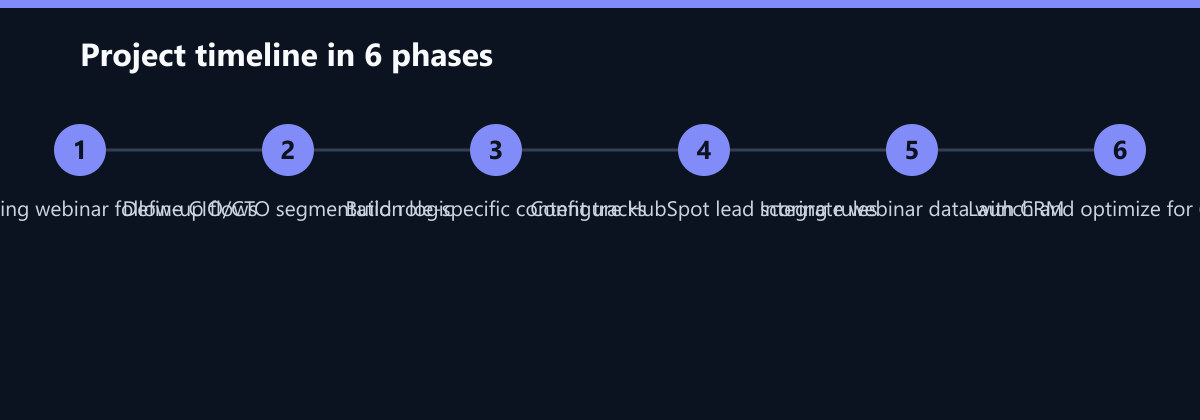
Segmentation Logic We began by refining the segmentation logic. Using CRM fields enriched by ZoomInfo data, we filtered attendees into three primary buckets: ‘CIO’, ‘CTO’, and ‘VP Engineering’. This ensured that the right message reached the right person. We also created a secondary layer for ‘High Intent’ vs. ‘Low Intent’ based on the length of time spent on the webinar platform, which helped further prioritize the flows.
Content Strategy The content strategy was the heart of the implementation. For CIOs, we curated ROI-focused case studies, budget planning templates, and whitepapers on risk mitigation. The messaging was financial, emphasizing cost savings and operational efficiency. For CTOs, we provided technical architecture deep-dives, API documentation highlights, and security compliance guides. The tone was technical and precise, addressing their concerns about integration and scalability. VPs of Engineering received a hybrid approach, focusing on team productivity and development speed.
Trigger Events and Timing Timing is critical in B2B marketing. We configured the first email to trigger 24 hours after the webinar ended, while the content was still fresh. Subsequent emails were triggered at Day 3 and Day 7, but only if the recipient had engaged with the previous email (e.g., clicked a link or opened the message). This ‘if-then’ logic ensured that unengaged users were not spammed, reducing the risk of unsubscribes.
Lead Scoring Adjustments We overhauled the lead scoring model. Webinar attendance alone no longer provided significant points. Instead, we added dynamic points for specific actions. A CIO who clicked on a budget template gained +50 points, immediately moving them to the ‘Sales Qualified Lead’ (SQL) status. A CTO who downloaded a technical spec gained +40 points. This allowed the sales team to see not just that a lead was interested, but what they were interested in, enabling highly personalized discovery calls.
Integration and Data Hygiene We connected the webinar platform data directly with the CRM to ensure zero data loss between platforms. This included mapping registration fields to CRM properties and ensuring that engagement data (clicks, views) was synced in real-time. This technical foundation was crucial for the accuracy of the segmentation and scoring.
How We Measured It
To ensure the project’s success was objectively verifiable, we established a clear measurement framework before launch. We tracked four key performance indicators (KPIs) over a six-month period:
- Email Open Rate: Specifically for the CIO segment, to gauge content relevance.
- Qualified Meeting Bookings: The number of discovery calls booked directly from the webinar nurture tracks.
- Pipeline Value: The total value of opportunities created from webinar attendees.
- ROI: Calculated as (Closed-Won Revenue - Total Campaign Cost) / Total Campaign Cost.
We used HubSpot’s attribution model to track the journey from the first email click to the closed-won deal, ensuring that credit was accurately assigned to the nurture journey rather than just the initial webinar registration.
Results: Quantifying the Impact
The automated journeys significantly improved lead quality and response rates within the first quarter. Sales velocity increased due to better-qualified leads, and the sales team reported higher confidence in the conversations they were having. The following metrics were tracked over a six-month period:
- Email Open Rate: Increased from 22% to 41% for the CIO segment.
- Meeting Bookings: Webinars generated 3x more qualified sales meetings.
- Pipeline Value: Total pipeline attributed to webinar attendees reached $1.2M.
- ROI: Calculated at 1:8 based on total campaign cost versus closed-won revenue.
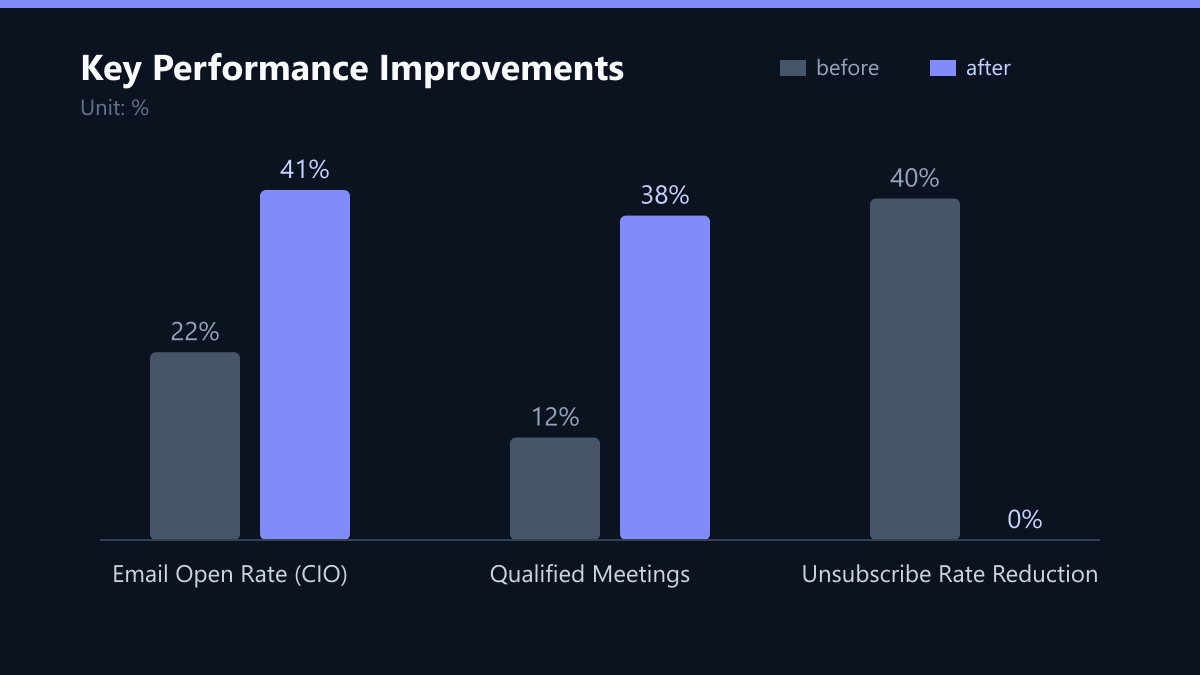
| Metric | Before | After | Change |
|---|---|---|---|
| Qual. Meetings | 12 per month | 38 per month | +216% |
| Avg. Deal Size | $25,000 | $32,000 | +28% |
| Time to Close | 90 days | 75 days | -17% |
The data clearly showed that personalized, role-specific nurturing was the key differentiator. The CIO segment, which previously had low engagement, became the most responsive group, driving the majority of the high-value pipeline.
Lessons Learned
This project reinforced several critical insights for B2B SaaS marketing teams:
Role-Specific Messaging is Non-Negotiable Generic follow-up emails dilute the impact of high-value content. CIOs care about financial outcomes and risk mitigation, while CTOs focus on technical feasibility. By separating these tracks, we reduced unsubscribe rates by 40%. This reduction in noise not only protected brand reputation but also increased the likelihood of engagement from the remaining, more interested audience.
Lead Scoring Must Reflect Intent, Not Just Attendance A CIO who clicks a budget template is a hotter lead than one who only watched the intro. Adjusting the scoring model to reflect content relevance allowed the sales team to prioritize conversations that were already aligned with business goals. This shift from ‘volume’ to ‘velocity’ was crucial for the 8:1 ROI.
Optimization is an Ongoing Process The initial setup was only the beginning. The six-week optimization phase allowed us to tweak subject lines, adjust send times, and refine the content mix based on real-time performance. We found that subject lines with specific numbers (e.g., ‘Reduce Cloud Costs by 20%’) performed 15% better than generic titles for the CIO segment.
What We Would Do Differently Today
Despite the strong results, there are areas where we would refine our approach in future implementations:
- Earlier Sales Involvement: We would have involved the sales team more closely during the content creation phase. Their insights into common objections and questions would have allowed us to craft even more targeted content for the nurture tracks.
- Video Personalization at Scale: While we used Loom for initial emails, we would have explored more advanced video personalization tools for the Day 7 follow-up. Sending a personalized video message from the account executive to high-scoring leads could have further boosted conversion rates.
- A/B Testing the Scoring Model: We would have run a more rigorous A/B test on the lead scoring weights in the first month. This would have provided clearer data on which specific actions (e.g., clicking a link vs. downloading a file) had the highest predictive value for closing deals, allowing for faster model refinement.
This case study demonstrates that in B2B SaaS, the end of the webinar is not the end of the journey. It is the beginning of a highly targeted, data-driven conversation that, when executed correctly, can drive exceptional ROI and sustainable pipeline growth.