The Hidden Cost of Intuition in Performance Marketing
Most marketing teams still rely on gut feelings when writing ad copy. This approach is not just inefficient; it is expensive. Without systematic testing, you are essentially guessing which words resonate with your audience, leading to inconsistent results and wasted budget. In the B2B SaaS and mid-market sectors, where customer acquisition costs (CAC) are high, every percentage point of Click-Through Rate (CTR) matters.
Structured testing transforms ad creation from an art into a science. By isolating variables, you remove noise from your performance metrics. This clarity allows you to scale winning messages with confidence. The core benefits are clear: higher CTR, lower Cost Per Acquisition (CPA), and a deeper understanding of customer pain points. Data beats opinion every time.
Method 1: Headline Value Proposition Testing
The headline is the gatekeeper. It is the first element users see and determines whether they stop scrolling or keep moving. If your headline fails, your body copy is irrelevant. To optimize this, you must test different value propositions to see what resonates most with your specific audience segment.
Consider these effective headline variations for B2B contexts:
- Benefit-led: “Cut Onboarding Time by 50%”
- Problem-aware: “Tired of Manual Data Entry?”
- Social Proof: “Trusted by 500+ SaaS Companies”
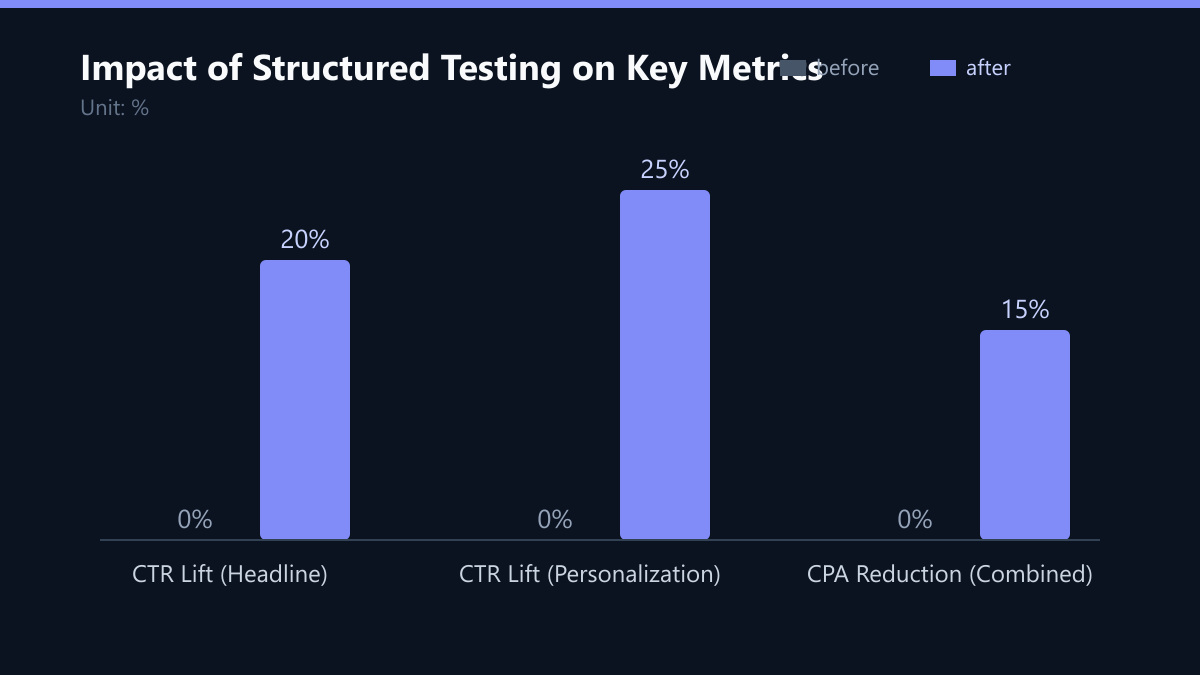
When running this test, keep the body copy and CTA identical. Change only the headline. This isolation ensures that any lift in performance is directly attributable to the headline change. A 20% lift in CTR from a single headline tweak can significantly reduce your overall ad spend, making this the highest-ROI test to start with.
Method 2: Call-to-Action (CTA) Optimization
Your CTA tells the user what to do next. Weak or vague CTAs create friction. Users need a clear, low-effort next step. Testing specific, action-oriented verbs against generic ones is a powerful way to improve conversion rates.
Common CTA pairs for B2B SaaS include:
- “Start Free Trial” vs. “See Demo”
- “Get Started” vs. “Book a Call”
- “Learn More” vs. “Download Guide”
Specificity reduces cognitive load. When a user knows exactly what happens after the click, they are more likely to click. However, you must track both CTR and post-click conversion. A CTA that drives clicks but not signups is a vanity metric. Focus on the full funnel impact to ensure you are driving quality leads, not just traffic.
Method 3: Emotional Tone vs. Rational Logic
B2B buyers are human. They make decisions based on a mix of logic and emotion. Understanding this duality is key to effective copywriting. Test whether your audience responds better to fear of missing out (FOMO) or logical benefits.
Tone variations to test include:
- Urgency: “Limited Slots Available This Month”
- Security: “SOC 2 Compliant and Secure”
- Efficiency: “Save 10 Hours a Week”
Analyze your customer journey stage. Top-of-funnel users may respond to broad emotional hooks that address general pain points. Bottom-of-funnel users prefer specific, logical proof and risk mitigation. Segment your audience and test different tones for each group. This targeted approach often outperforms one-size-fits-all messaging significantly.
Method 4: Length and Information Density
Do users prefer short, punchy copy or detailed explanations? There is no universal answer. It depends on your product complexity and audience sophistication. However, you can find your sweet spot through testing.
Use this testing framework:
- Short copy: 1-2 sentences, focus on one benefit.
- Medium copy: 3-4 sentences, benefit + proof + CTA.
- Long copy: 5+ sentences, detailed problem-solution narrative.
Best practices include matching copy length to ad placement and using bullet points for scannability. For complex B2B SaaS products, longer copy often performs better for search ads where intent is high. For display or social ads, shorter copy tends to win due to lower attention spans. Test both formats within the same channel to find your optimal density.
Method 5: Personalization and Dynamic Insertion
Generic ads treat all users the same. Personalized ads speak directly to the individual. Use dynamic insertion to tailor ad copy based on user behavior, industry, or demographics.
Personalization triggers include:
- Industry: “Best CRM for [Industry] Teams”
- Company Size: “Solutions for Enterprises”
- Location: “Local Support in [City]”
Implementation steps:
- Identify high-value segments in your CRM.
- Create copy variations for each segment.
- Use ad platform variables for dynamic insertion.
- Monitor performance per segment.
Personalized ads typically see 20-30% higher CTR. They also improve quality scores, which lowers your cost per click. While this method requires more setup, it delivers compounding returns over time.
Typical Mistakes to Avoid
Even with the right methods, teams often fall into traps that invalidate their data.
- Stopping Tests Too Early: Many marketers stop a test after 2-3 days because one variant is “winning.” This is statistical noise. You need consistent data over a full business cycle (7-14 days) to account for weekly patterns.
- Testing Multiple Variables at Once: Changing the headline, image, and CTA simultaneously makes it impossible to know what drove the result. Stick to single-variable tests for clear insights.
- Ignoring Post-Click Metrics: Focusing solely on CTR can lead to “clickbait” copy that attracts low-intent users. Always monitor CPA and conversion rate to ensure quality.
- Lack of Documentation: If you don’t log your hypotheses and results, you will repeat the same tests. Create a central knowledge base to speed up future iterations.
How You Measure Success
To determine if your ad copy testing is working, you need concrete KPIs and a clear measurement method.
Key Metrics to Monitor:
- CTR (Click-Through Rate): Measures ad relevance. Target: 2-5% for B2B search ads.
- CPA (Cost Per Acquisition): Measures cost efficiency. Target: Reduce by 10-15% per quarter.
- ROAS (Return on Ad Spend): Measures return on investment. Target: 4:1 or higher for B2B SaaS.
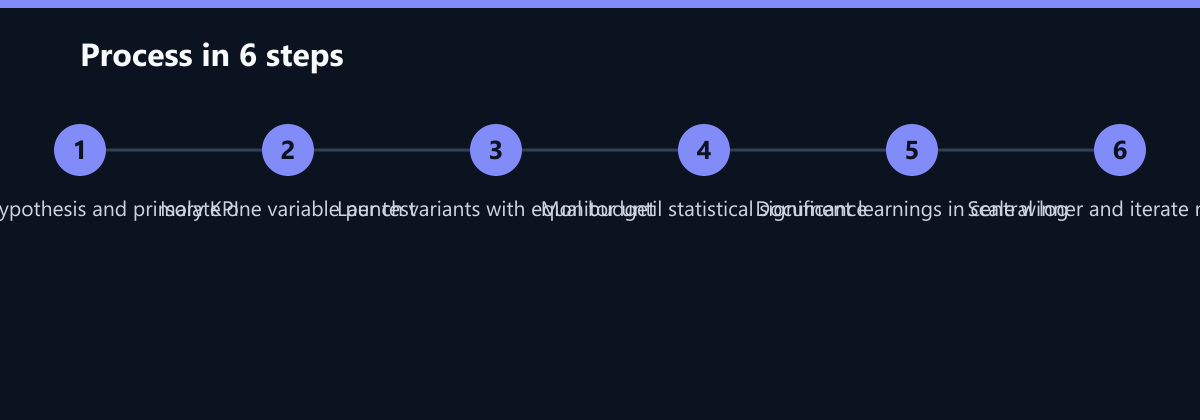
Measurement Method: Use a statistical significance calculator to determine when your test results are valid. Do not rely on raw numbers. A 5% lift with 100 clicks is not significant. A 5% lift with 1,000 clicks is. Set a baseline using your current top-performing ad as the control. Compare new variants against this standard. If a new variant outperforms the control by a statistically significant margin (usually 95% confidence level), it becomes the new baseline.
Checklist for Your Next A/B Test
- Define the Hypothesis: “If we change the CTA to ‘Book a Call,’ CTR will increase by 10% because it reduces friction.”
- Select the Variable: Choose one element to change (e.g., CTA only).
- Create Variants: Write the control and the test variant. Ensure they are identical in all other aspects.
- Set the Duration: Plan for 7-14 days to capture weekly trends.
- Allocate Budget: Split traffic 50/50 between control and variant.
- Monitor Daily: Check for technical issues, not performance. Do not peek at results to decide early.
- Analyze at Significance: Use a calculator to confirm statistical significance before making decisions.
- Document Learnings: Record the hypothesis, result, and insight in your central log.
- Scale the Winner: Implement the winning variant across all relevant campaigns.
- Iterate: Start the next test based on the new baseline.
Iterating for Sustained Growth
Testing is an ongoing process, not a one-time event. Establish clear KPIs before you start. Track CTR, CPA, and conversion rate. Use statistical significance tools to validate results.
Document every test. Keep a log of hypotheses, results, and learnings. This knowledge base speeds up future testing cycles. Share insights across your team. Align creative, media, and sales on what works. Continuous iteration is the key to sustained performance improvement. By systematically applying these five methods, you turn ad copy from a guesswork exercise into a predictable engine for growth.
Passend dazu
- Performance Marketing
- SEO & AI Search (GEO)
- Increasing the open rate by 41% for a Southern European SaaS provider through personalized subject lines and A/B testing
- Scaling B2B SaaS Growth in Scandinavia: 45% More MQLs via LinkedIn A/B Testing and CRM Sync
- Affiliate Marketing
- Content & CRO
- CRM Marketing
- A/B Testing in HubSpot: A Step-by-Step Guide for Significant B2B Results
- B2B A/B Testing: Statistical Significance and Common Pitfalls
- B2B Email Automation: 7 Workflow Templates That Boost Revenue
- Content Refresh Strategies: How to Update Old Blog Posts for Traffic Growth
- Systematic A/B Testing for Amazon Product Pages and Ads
- A/B Testing in Practice: Calculating Significance and Sample Size Correctly
- Creative Optimization: A/B Testing Methods to Lower CPC in LinkedIn Campaigns