The Initial Bottleneck
The client, a mid-market B2B SaaS provider based in Singapore with 120 employees, was facing a critical growth stagnation in the Asia-Pacific (APAC) region. Despite having a robust product and a capable sales team, the marketing engine was failing to deliver qualified leads at scale. The core issue was a fundamental misalignment between their marketing approach and the cultural and business diversity of the APAC market.
Marketing efforts were treated as a monolith. Japan, India, and Southeast Asia were grouped into a single “APAC” bucket in the CRM. This one-size-fits-all messaging resulted in a frustratingly low MQL conversion rate of just 2%. The customer acquisition cost (CAC) was climbing, and the sales team was spending excessive time qualifying leads that were not a good fit. A significant portion of the pipeline was stagnant, with 60% of leads going cold before any meaningful sales outreach could occur. The data was clear: generic content was being ignored, and the lack of segmentation was eroding the efficiency of the entire go-to-market strategy.
The Challenges
Breaking down the monolithic APAC segment revealed several specific operational and strategic hurdles:
- Cultural Dissonance in Messaging: Standardized value propositions failed to resonate. For instance, emphasizing “speed” in Japan, where thoroughness and trust are paramount, often backfired. In India, focusing on “scalability” was more critical than “compliance,” yet the same message was sent to both.
- CRM Data Fragmentation: The existing CRM structure did not support granular behavioral tracking. It was impossible to distinguish between a lead in Tokyo who downloaded a technical spec and a lead in Mumbai who viewed a pricing page, as both were tagged simply as “APAC - SaaS.”
- Content Relevance Gap: There was a lack of high-value, region-specific assets. The library consisted mostly of generic whitepapers and newsletters that did not address local regulatory, economic, or cultural pain points.
- Misaligned Sales-Marketing Handoff: The definition of an MQL was outdated. Sales teams were receiving leads that met volume criteria but lacked quality signals, leading to a high drop-off rate in the early stages of the sales cycle.
The Tech Stack
- HubSpot Marketing Hub: The central platform for managing segmentation, email automation, and lead scoring.
- HubSpot Sales Hub: Used for real-time lead alerts and tracking the MQL-to-SQL conversion journey.
- Canva & Adobe Creative Cloud: For designing localized visual assets and case study layouts.
- Google Analytics 4: To track on-site behavior and attribute engagement to specific content assets.
- ZoomInfo: For enriching lead data with firmographic details to refine segmentation.
Implementation: From Monolith to Micro-Segments
The project was executed over a 12-week timeline, divided into three distinct phases: Audit & Strategy, Content & Build, and Launch & Optimize. The primary objective was to redesign the marketing automation strategy in HubSpot to focus on hyper-segmented content drip campaigns.
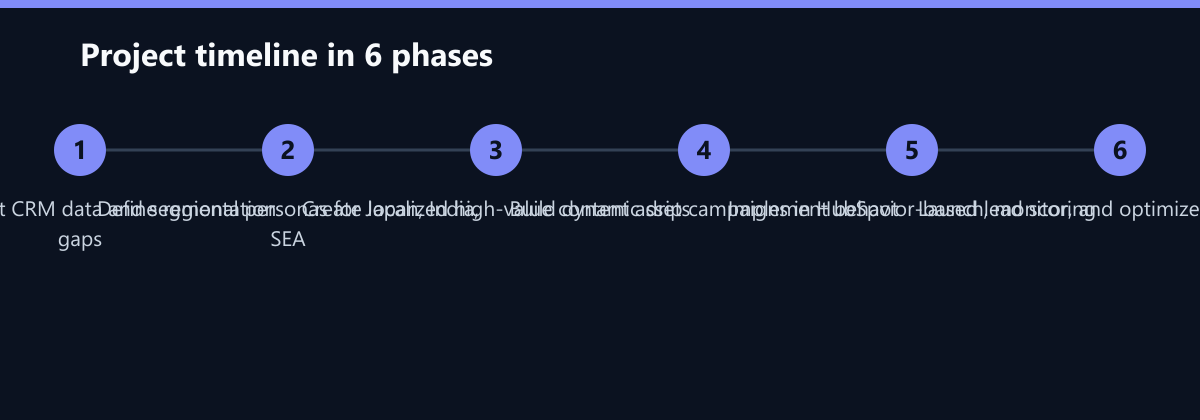
Phase 1: Audit & Strategy (Weeks 1-3) We began by auditing the existing CRM data and mapping the customer journey. We identified three primary sub-regions with distinct characteristics: Japan, India, and Southeast Asia. For each region, we developed detailed buyer personas based on industry, company size, and engagement behavior. This was not just a geographic split; it was a behavioral one. We defined “High-Intent” behaviors specific to each market, such as downloading a localized whitepaper or attending a regional webinar.
Phase 2: Content & Build (Weeks 4-9) Instead of direct translation, we developed region-specific content assets. This involved deep-dive research into local pain points. For Japan, we focused on data privacy and security compliance. For India, we highlighted scalability and cost-efficiency. For Southeast Asia, we emphasized mobile-first accessibility and rapid deployment.
We then built the drip campaign structure in HubSpot. The sequence was designed to nurture leads gradually, providing value at each touchpoint:
- Day 1: A welcome email featuring a region-specific value proposition and a link to a localized landing page.
- Day 4: A case study relevant to their specific industry and region, demonstrating tangible results.
- Day 10: An invitation to a webinar scheduled in their local time zone, with a localized agenda and speakers.
- Day 18: A direct call-to-action for a demo, personalized by the lead’s dynamic score.
Crucially, we implemented dynamic lead scoring. The system was configured to trigger a sales alert only when a lead engaged with three or more high-value assets. This ensured that the sales team was notified only when a lead demonstrated genuine interest and fit, rather than just opening an email.
Phase 3: Launch & Optimize (Weeks 10-12) We launched the campaigns in a staggered manner, starting with the Southeast Asia segment to test the infrastructure, followed by India, and finally Japan. During this phase, we monitored engagement metrics daily, adjusting send times and subject lines based on A/B testing results. We also held weekly syncs with the sales team to refine the lead scoring criteria based on their feedback regarding lead quality.
How We Measured It
To ensure the changes were driving real business value, we established a rigorous measurement framework. We moved beyond vanity metrics like open rates and focused on pipeline impact.
- MQL Volume: We tracked the number of new MQLs generated per quarter, comparing it against the baseline of 150 MQLs. This metric directly indicated the effectiveness of the segmentation and content strategy in attracting qualified leads.
- MQL-to-SQL Conversion: This was the primary KPI for quality. We measured the percentage of MQLs that were accepted by the sales team as Sales Qualified Leads (SQLs). This metric validated whether the new lead scoring criteria were accurately identifying high-potential customers.
- Email Click-Through Rate (CTR): We monitored CTR to gauge content relevance. A higher CTR indicated that the localized content was resonating with the audience, leading to deeper engagement.
- Sales Cycle Length: We tracked the average time from MQL creation to closed-won deal. A reduction in this metric indicated that the leads were better qualified and required less nurturing time, allowing the sales team to close deals faster.
Results: Sustainable Pipeline Growth
The impact of the segmented approach was immediate and sustained. Within two quarters, the client achieved a significant transformation in their APAC lead generation performance.
- MQL Volume: The number of new MQLs generated per quarter increased from 150 to 400, a +167% increase. This surge was driven by the higher relevance of the content and the broader reach of the segmented campaigns.
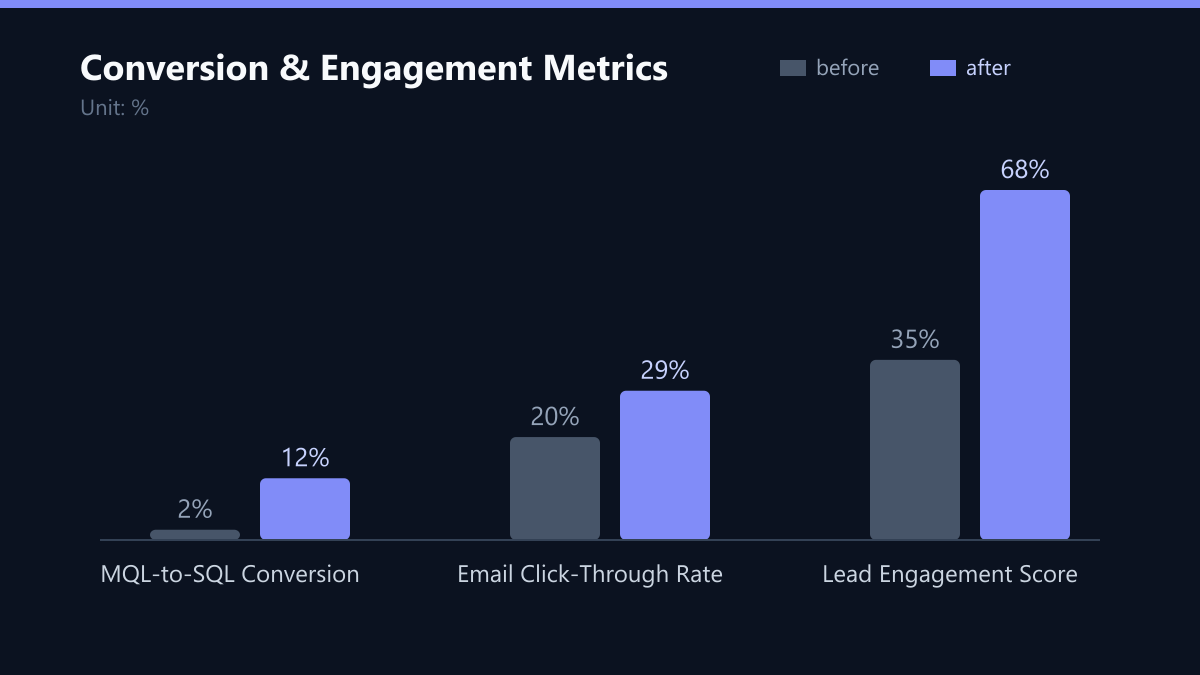
- Conversion Rate: The MQL-to-SQL conversion rate improved dramatically from 2% to 12%. This five-fold increase meant that the sales team was spending less time on unqualified leads and more time on opportunities with high potential.
- Engagement: Email click-through rates rose by 45% due to the relevance of the localized content. Leads were more likely to engage with materials that spoke to their specific regional and industry challenges.
- Sales Cycle: The average time to close was shortened by 18 days. This reduction was a direct result of better-qualified leads who required less education and nurturing, allowing the sales team to move them through the pipeline more efficiently.
Lessons Learned
This project underscored a critical principle: localization is about cultural relevance, not just language. In diverse markets like APAC, generic content fails to connect. The success of this initiative hinged on several key takeaways.
First, segment by behavior, not just geography. We found that leads in Japan who downloaded technical specifications had different needs than those who viewed pricing pages. By creating sub-segments based on engagement behavior, we were able to deliver highly targeted content that resonated with each lead’s specific stage in the buyer’s journey.
Second, invest in high-value assets. We discovered that one well-crafted, region-specific case study outperformed five generic newsletters. The depth and relevance of the content were far more important than the volume. This insight led us to focus our content budget on creating fewer, but higher-impact, assets.
Third, align sales and marketing. The new lead scoring criteria were co-created with the sales team. This collaborative approach ensured that the definition of an MQL matched the sales team’s ideal customer profile. Regular feedback loops between marketing and sales were essential for continuously refining the scoring model and improving lead quality.
What We Would Do Differently Today
While the project was a success, there are areas where we would refine our approach in future engagements.
- Earlier Investment in Content Production: The content creation phase was the most time-consuming part of the project. In the future, we would allocate more time and resources to content development in the early stages, ensuring that high-quality assets are ready before the campaigns go live. This would allow for a smoother launch and faster iteration.
- More Granular Initial Segmentation: We started with three broad regional segments. Looking back, we could have benefited from even finer granularity in the initial phase, perhaps splitting Southeast Asia into further sub-regions based on economic development levels. This would have allowed for even more tailored messaging from the outset.
- Proactive Sales Training: While we collaborated with the sales team on lead scoring, we could have invested more in training them on how to interpret the new lead signals. Providing them with clear guidelines on how to engage with different lead segments would have further accelerated the sales cycle reduction.
This case study demonstrates the power of hyper-segmentation and localized content in driving sustainable growth in complex, diverse markets. By moving away from a one-size-fits-all approach and investing in culturally relevant, behavior-based nurturing, B2B SaaS companies can significantly improve their lead quality, conversion rates, and overall sales efficiency.
Passend dazu
- Performance Marketing
- Reducing Return Rates with A+ Content and Brand Stores CRO
- Boosting Organic Rankings with A+ Content and Review Strategies
- Content & CRO
- Affiliate Marketing
- CRM Marketing
- Growth of qualified MQLs by 35% in Scandinavia through the automation of content clusters for a SaaS platform
- Industry 4.0 Provider in Benelux: Reduce Lead Generation Costs by 45% with Segmented Landing Pages and A/B Testing
- Optimization of the content funnel subpage for an IT service provider in the UK: Converting 15% more visitors into qualified MQLs through targeted CTA placement
- Improving Lead Quality in the UK Market with Segmented E-Mail Journeys for B2B Logistics
- Scaling UK Lead Volume by 40% with Segmented LinkedIn Ads
- Cutting Webinar Costs by 25% with Multilingual Content Repurposing
- Technical SEO vs. GEO: Key Factors for AI Content References
- Converting Passive Webinar Registrants with On-Demand Content
- Leveraging User-Generated Content to Reduce Churn in Nordic Subscription Markets
- Tripling User-Generated Content Production in US E-Commerce