The Starting Point: A Mismatch of Expectations
The client, a mid-sized B2B cloud infrastructure provider based in the Midwest with 150 employees, was experiencing a frustrating paradox. Their advertising budget was increasing, and they were generating a steady stream of clicks. Yet, the return on investment was deteriorating. Despite high ad spend, their landing pages failed to convert traffic into qualified demos. The cost per lead (CPL) had doubled over six months, and the sales team was complaining about the low quality of incoming inquiries.
The core issue was not a lack of traffic, but a fundamental mismatch between search intent and page content. Users clicking on generic cloud keywords landed on complex, feature-heavy pages that did not address specific pain points. Consequently, bounce rates exceeded 65%, and the cost per lead (CPL) had doubled over six months.
The Challenges
We identified three concrete challenges that were blocking conversion growth:
- Generic Targeting: The ad campaigns were structured around broad keywords like “cloud solutions” or “infrastructure services.” This attracted a mix of casual researchers and serious buyers, but the landing page treated them all the same.
- High Friction Forms: The demo request form required eight fields, including optional data points that added little value to the initial sales conversation. This created unnecessary friction for users who were already skeptical about sharing contact details.
- Underutilized Channel Potential: The client was primarily focused on Google Ads, overlooking the unique user base of Bing, which often skews towards older, higher-income professionals with higher purchase intent in B2B sectors.
The Tech Stack
To address these issues, we utilized a focused stack of tools:
- Bing Ads: For campaign management and leveraging specific intent data.
- HubSpot CMS: For building and managing the dynamic landing page variants.
- Google Analytics 4: For tracking user behavior and conversion paths.
- Hotjar: For session recordings to understand user friction points on the landing pages.
- A/B Testing Platform: To test form variations and headline copy.
How We Measured It
Before making any changes, we established a clear baseline. We defined “Conversion” as a completed demo request form. We tracked “Bounce Rate” as the percentage of single-page sessions where no interaction occurred. For “Cost Per Lead,” we divided total ad spend by the number of qualified leads reported by the sales team. We used a 4-week lookback period to smooth out weekly fluctuations and ensure that the improvements were statistically significant and not just short-term noise. We also monitored “Time on Page” to gauge engagement depth.
The Implementation
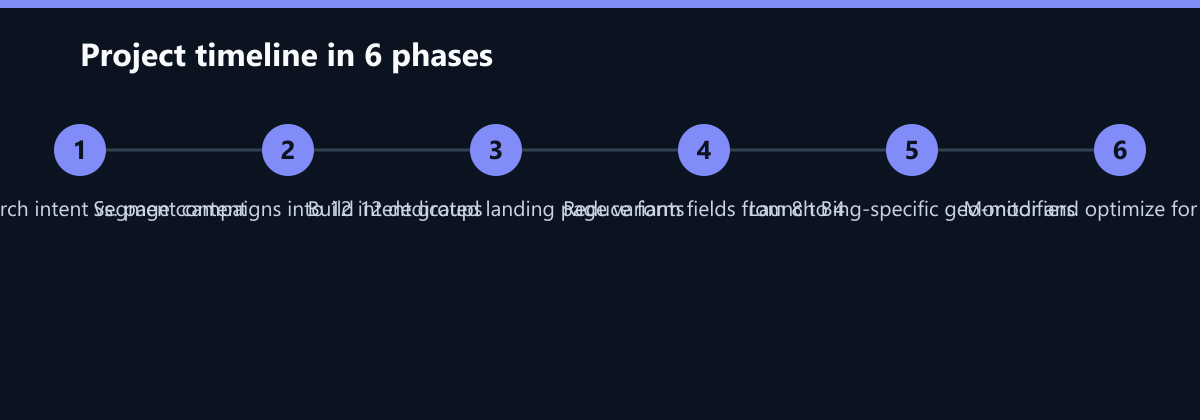
We focused on aligning Bing Ads campaigns with highly specific landing page variants. The project ran over eight weeks, combining technical SEO fixes with copy restructuring. Our approach was to move from a “one-size-fits-all” strategy to a highly segmented, intent-based model.
Key actions included:
- Intent-based Segmentation: We split broad campaigns into 12 distinct keyword groups based on user intent. For example, we separated queries related to “compliance” from those related to “scalability” or “cost reduction.” Each group had its own ad copy and landing page.
- Dynamic Landing Pages: Each of the 12 groups received a dedicated page with tailored headlines and social proof relevant to that specific use case. A user searching for “HIPAA compliant cloud storage” saw a page focused on security certifications and healthcare case studies, not a generic overview of all cloud services.
- Form Optimization: We reduced form fields from 8 to 4, removing non-essential data points to lower friction. We kept only Name, Email, Company, and a dropdown for “Primary Interest.” This simplified the user journey significantly.
- Bing-Specific Adjustments: We leveraged Bing’s higher purchase intent data by adding location-based modifiers for on-premise migration queries. We noticed that users in specific industrial hubs were more likely to be in the market for migration services, so we tailored the messaging to address legacy system concerns.
The Results
The targeted approach yielded immediate improvements in engagement and conversion metrics. Within the first four weeks, bounce rates dropped significantly as visitors found relevant information immediately. The sales team reported that the leads were more qualified and easier to engage in initial calls.
Key performance indicators after 8 weeks:
- Conversion Rate: Increased from 1.2% to 1.5% (+25%).
- Cost Per Lead: Decreased by 18% due to higher quality traffic.
- Bounce Rate: Reduced from 65% to 48%.
- Demo Bookings: Up 32% month-over-month.
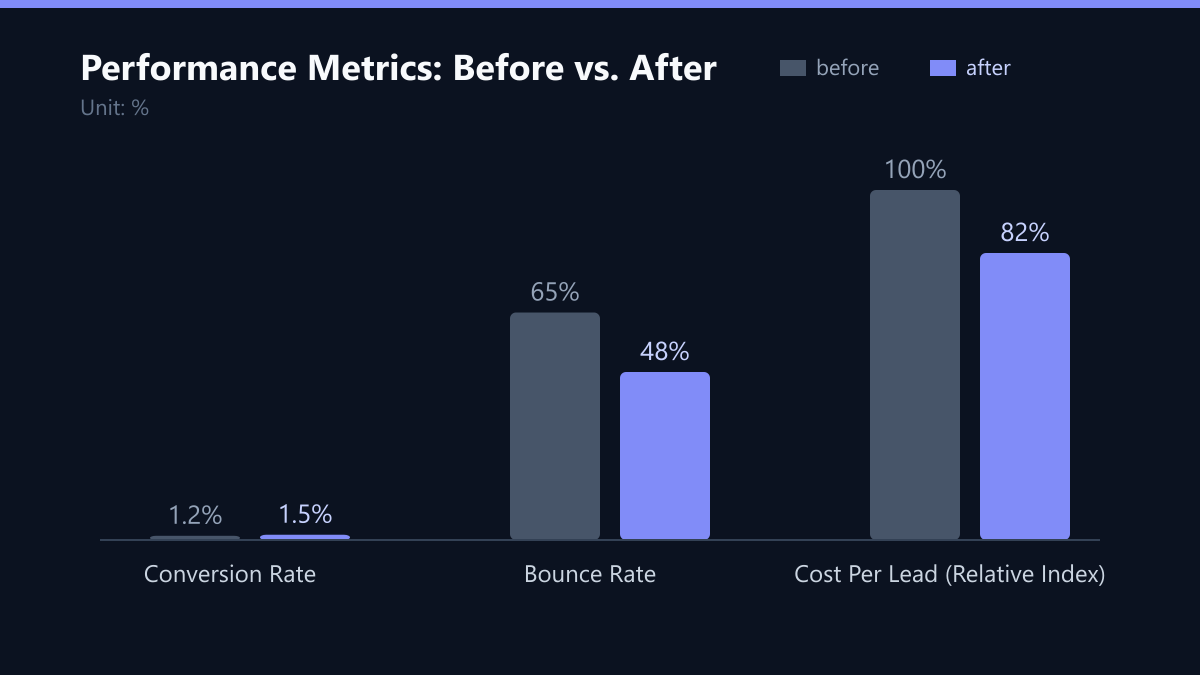
The alignment between ad copy and landing page content ensured that users felt understood, leading to higher trust and more qualified leads. The reduction in form fields did not compromise lead quality; instead, it removed a barrier that was discouraging potential customers from taking the next step.
What We Would Do Differently Today
Looking back at the project, there are a few areas where we could have been more efficient:
- Earlier A/B Testing on Headlines: We spent the first two weeks building all 12 landing pages before launching. In hindsight, we should have tested a few headline variations on the top three intent groups first to validate the messaging before rolling out the full set. This could have saved us about a week of development time.
- More Aggressive Geo-Targeting: While we added location-based modifiers, we could have been more aggressive with geo-targeting from the start. We found that certain regions had significantly higher conversion rates, and we could have reallocated budget earlier to focus on those high-performing areas.
- Integration with CRM from Day One: We integrated the new lead data with the CRM after the first two weeks. Integrating this from day one would have allowed for more accurate attribution and faster feedback loops with the sales team.
Lessons Learned
This project highlighted that broad targeting in B2B cloud services is inefficient. Users expect immediate relevance when searching for technical solutions. They do not want to wade through generic content to find the specific answer to their problem.
Key takeaways:
- Specificity Wins: Generic ‘cloud solutions’ pages underperform compared to use-case-specific landing pages. The more specific the user’s intent, the more specific the page content must be.
- Form Friction: In B2B, reducing form fields can significantly improve conversion without sacrificing lead quality. Ask for less information upfront and qualify the lead later in the sales process.
- Bing Underutilization: Bing often provides higher intent traffic for enterprise software, making it a critical channel for B2B cloud providers. It is not just a secondary channel; it can be a primary driver of high-quality leads.
By matching the user’s specific query to a tailored page, we turned anonymous traffic into qualified prospects. This approach is not just about better copy; it is about respecting the user’s time and intent. When users feel that the content is directly addressing their needs, they are more likely to engage and convert. For B2B companies, this level of specificity is no longer optional; it is a requirement for sustainable growth in a competitive digital landscape.
Passend dazu
- Performance Marketing
- SEA (Google & Bing Ads)
- Affiliate Marketing
- Content & CRO
- 32 % geringere Akquisekosten durch GEO-optimierte Produktseiten
- B2B Industry: Reducing CPA by 34% through Dynamic Google Ads Campaigns and HubSpot Attribution in the DACH Region
- Singapur-Logistikanbieter: 45% schnellere Lead-Zuweisung an Vertrieb durch automatisierte E-Mail-Benachrichtigungen
- B2B Email Automation: 5 Journey Types That Increase Conversion Rates
- Klaviyo Flow Optimization in Benelux E-Commerce: 22% Revenue Increase through Reactivating Email Sequences
- Steigerung der Engagement-Rate um 45% via automatisierte Content-Syndication in der Finanzbranche UK
- Influencer Collaboration in B2B: Measurable ROI Increase through LinkedIn Top Voices for a Scandinavian Industrial Conglomerate
- Automatisierter Social Proof hebt Landingpage-Konversion um 18 Prozent
- 19 Percent Increase in Form Completions via Simplified HubSpot Paths
- Manufacturing in Asia: Optimizing Campaign Budgets by 25% through Server-Side Data Synchronization between AdWords and SAP
- Cutting Checkout Abandonment by 30% Through UX Optimization
- Boosting SaaS Cross-Selling: 24 Percent CTR Increase via In-App Messages