The Stagnation
The client, a mid-sized industrial manufacturer with 150 employees based in the USA, found itself in a common but frustrating position: high ad spend, low return. Despite consistent investment in digital advertising, the quality of leads flowing into the CRM was stagnating. The sales team was overwhelmed with unqualified inquiries, while genuine prospects were dropping off before ever reaching a human being. The primary culprit was a complex, multi-step lead capture process designed years ago that no longer aligned with modern user behavior. Prospects were required to fill out lengthy forms with excessive fields, creating a significant barrier to entry in a competitive B2B landscape.
The Challenges
Before diving into the solution, we identified three specific structural issues that were hampering performance:
- Excessive Friction: The initial form contained 12 mandatory fields, including sensitive data like company revenue and specific product interests, which most prospects were unwilling to share at the top of the funnel.
- Static Content: The landing pages offered the same message to every visitor, regardless of their source or industry segment, leading to lower engagement rates.
- Inefficient Routing: Leads were routed to sales based on a simplistic volume model rather than intent, causing sales reps to waste time on low-probability contacts.
The Tech Stack
To address these issues, we leveraged the following tools within the existing ecosystem:
- HubSpot CRM: The central platform for managing leads, contacts, and automated workflows.
- HubSpot Marketing Hub: Used for landing page creation, A/B testing, and campaign management.
- Google Analytics 4: For tracking user behavior and conversion paths across the website.
- Hotjar: To record user sessions and heatmaps, identifying exactly where users dropped off on the forms.
How We Measured It
To ensure the changes delivered tangible value, we established a rigorous measurement framework before implementation began. We defined the baseline metrics using a 90-day historical average from the previous quarter. Form completion rate was calculated as the number of successful submissions divided by the number of form views. Cost Per Lead (CPL) was derived by dividing total ad spend by the number of new leads created. Sales Qualified Leads (SQLs) were tracked via manual tagging by the sales team, validated by a 10% random audit to ensure consistency. This method allowed us to isolate the impact of the CRM changes from broader market fluctuations.
Implementation
We began with a comprehensive audit of the existing HubSpot setup. Using session recordings and funnel analysis, we mapped the user journey and identified every point of friction. The core strategy focused on a radical simplification of the lead capture process, shifting the philosophy from “capture everything upfront” to “capture intent first, details later.”
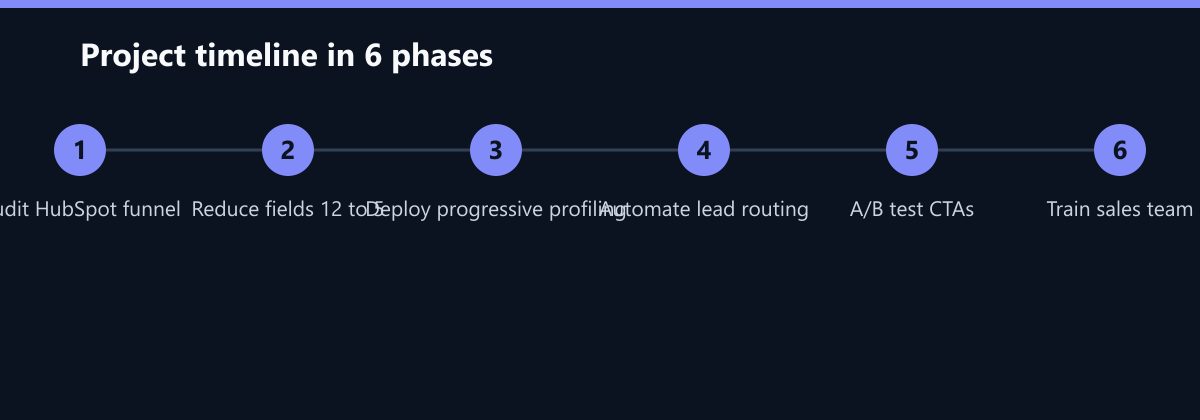
The first major action was restructuring the forms. We reduced the mandatory fields from 12 to just 5 essential data points: Name, Work Email, Company Name, Phone Number, and a single dropdown for “Primary Interest.” This reduced the cognitive load on the user and lowered the perceived effort required to submit. To compensate for the lost data, we implemented progressive profiling. This feature allows HubSpot to update a contact’s record over time. If a user returns to the site, the form dynamically adjusts to ask for the next missing piece of information, such as company size or specific product needs, without ever asking for data they have already provided.
Next, we overhauled the lead scoring model. Instead of scoring based on the number of fields completed, we prioritized intent signals. Visiting pricing pages, downloading whitepapers, or attending webinars carried higher weight than simply opening an email. This new model was integrated into an automated routing workflow. High-intent leads were instantly routed to the sales team with a detailed summary of their activity, while lower-intent leads were placed into a longer-term nurturing sequence.
We also conducted extensive A/B testing on the call-to-action buttons and landing page headlines. By testing different value propositions, we found that a benefit-led headline combined with a low-friction CTA (“Get a Quick Quote” vs. “Request Detailed Proposal”) significantly improved engagement. The entire implementation phase, including technical setup in HubSpot, workflow configuration, and training for the marketing and sales teams, took four weeks. This timeline allowed us to move quickly while ensuring the team was comfortable with the new processes.
Results
Within three months of the launch, the impact was clear. The reduction in friction directly influenced user behavior, leading to a higher volume of conversions without any increase in ad spend. The sales team reported that the conversations they were having were more relevant, thanks to the better initial intent signals. The following table summarizes the key performance indicators before and after the optimization:
| Metric | Before | After | Change |
|---|---|---|---|
| Form Completion Rate | 4.2% | 5.0% | +19% |
| Cost Per Lead | $120 | $98 | -18% |
| Sales Qualified Leads | 45/month | 62/month | +37% |
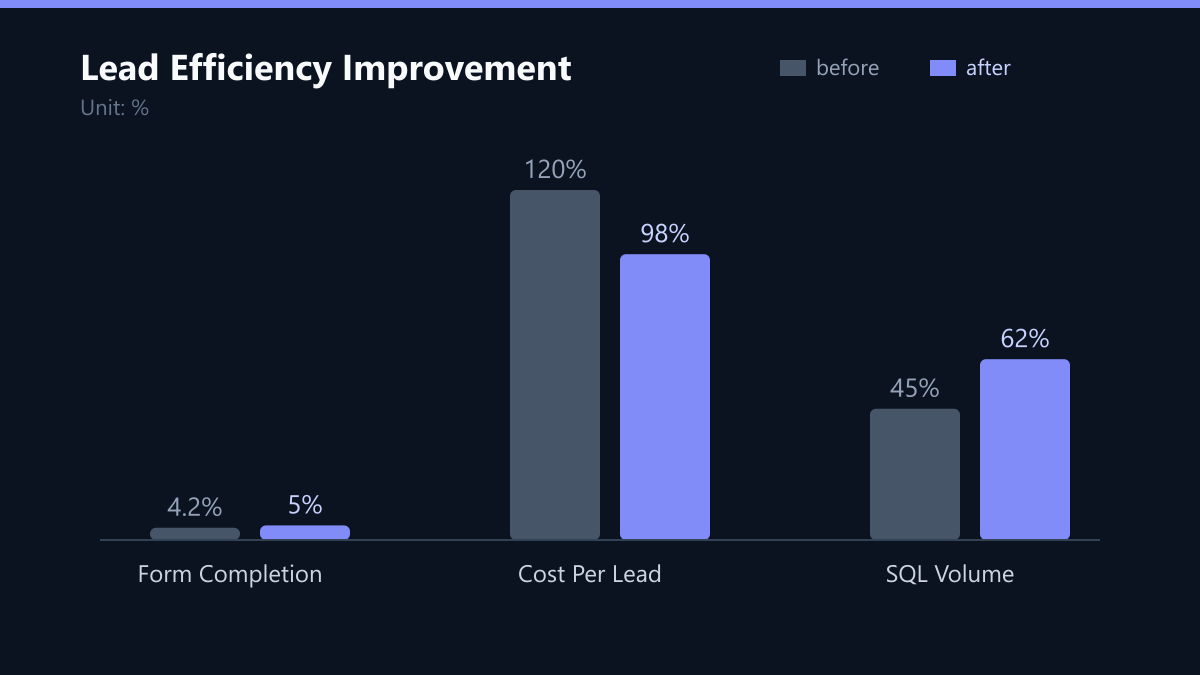
The 19% increase in form completion rate was the most immediate win. By removing unnecessary barriers, we made it easier for prospects to take the next step. The 18% reduction in Cost Per Lead was a direct result of this efficiency; with more leads coming through the same ad spend, the cost per acquisition dropped significantly. Most importantly, the 37% increase in Sales Qualified Leads demonstrated that the quality of the leads had improved. The new scoring model ensured that sales reps were spending their time on prospects who were genuinely ready to buy, rather than wasting hours on tire-kickers.
Lessons Learned
This project reinforced a critical lesson in B2B lead generation: less is often more. Collecting every possible data point upfront creates unnecessary barriers that drive potential customers away. Progressive profiling proved to be a highly effective alternative for enriching data post-conversion, allowing us to build a complete profile over time without sacrificing conversion rates. The sales team’s feedback was overwhelmingly positive, noting that the initial intent signals provided by the new scoring model helped them prioritize their outreach effectively.
We also learned the importance of aligning marketing and sales on what constitutes a “qualified” lead. By involving the sales team in the definition of the scoring criteria, we ensured that the leads being routed to them were actually useful to their workflow. This alignment reduced friction between the two departments and created a more collaborative environment.
What We Would Do Differently Today
While the results were strong, there are areas where we would refine the approach if we were to run this project again. First, we would have implemented a more granular segmentation strategy from the start. While we did segment by industry, we could have further personalized the journey based on company size and specific product lines, which might have yielded even higher conversion rates.
Second, we would have invested more in the initial training for the sales team. While the workflows were automated, the sales reps needed to adapt to the new lead profiles and scoring logic. A more comprehensive training program, including role-playing scenarios for the new types of leads, could have accelerated their adoption of the new process.
Finally, we would have considered a phased rollout of the form changes. Instead of launching the new 5-field form to all traffic at once, we could have tested it with a smaller segment of high-intent traffic first. This would have allowed us to validate the impact on lead quality before scaling the change across the entire funnel, potentially reducing the risk of any short-term dips in lead quality.