The Hidden Lever: Why Extensions Matter More Than Bids in Mid-Market
In the B2B mid-market, competing against enterprise giants with massive ad budgets is a losing strategy if you rely solely on bidding. You cannot outspend a Fortune 500 company. However, you can outperform them on relevance. Ad extensions are the most underutilized lever for mid-market businesses to gain visibility without increasing cost-per-click (CPC).
Ad extensions add relevant additional information to your ads. They increase visibility in the search results and signal relevance to both the user and the algorithm. In the mid-market, you often compete against larger budgets. Extensions make more efficient use of the available space. You stand out from the competition without raising your CPC.
The mechanics are straightforward but powerful:
- Larger ad: Up to 3 lines of title and 4 lines of description, plus extension lines.
- Higher relevance: A direct answer to the search intent.
- Better position: Quality Score rises with a higher expected CTR.
When your ad occupies more real estate on the page, it captures more attention. But more importantly, when your ad answers the user’s specific question immediately, the click-through rate (CTR) increases. This feeds back into Google’s algorithm, lowering your CPC and improving your Ad Rank. It is a virtuous cycle that costs nothing to implement but requires strategic precision.
Sitelinks: The Primary Driver of Click-Through Rate
Sitelinks are the most widely used and most effective extension. They take users directly to specific subpages, bypassing the homepage. In a B2B context, this is critical. B2B buyers are not window shoppers; they are problem solvers. They want the specific solution, not a tour of your company history.
Sitelinks accelerate the purchase process. Users immediately find the product or solution they are looking for. This reduces friction and increases the likelihood of conversion.
- Direct navigation: Skip the homepage, land on the solution.
- Keyword specificity: Match the ad group theme exactly.
- Conversion path: Shorten the path to contact or demo request.
The key to success here is specificity. Avoid generic terms like “Home” or “About Us.” These are wasted opportunities. Instead, focus on value propositions that mirror the search intent. If the ad group is for “CRM Implementation,” your sitelinks should be “CRM Migration Services,” “Data Import Tools,” and “ROI Calculator.”
Consider the user journey. A mid-market IT director searching for “cloud security audit” does not want to click through to a generic “Services” page. They want to see that you offer “Penetration Testing” and “Compliance Audits.” By providing these direct links, you signal that you understand their specific pain point. This relevance drives the CTR up, often by 10-15% compared to ads without sitelinks.
Structured Snippets: Building Trust Through Clarity
Structured Snippets list what you offer. They use predefined categories from Google, such as “Services,” “Brands,” or “Products.” For SaaS and service providers, this extension is ideal. It immediately shows which services or product types are relevant to the searcher.
- Categories: Use “Services,” “Brands,” or “Products.” Choose the one that best fits your business model.
- Content: List specific offerings, e.g., “CRM Setup,” “Email Automation,” “API Integration.”
- Length: Keep entries under 35 characters for full visibility.
This extension works best when your service portfolio is clear and distinct. It filters out irrelevant clicks and attracts qualified leads. For example, if you offer multiple software solutions, a Structured Snippet under the “Products” category can list “Project Management,” “Time Tracking,” and “Resource Planning.” This helps the user self-qualify before they even click.
In B2B, trust is currency. By clearly stating what you do, you reduce the cognitive load on the buyer. They don’t have to guess if you offer what they need. You are transparent. This transparency builds trust, which is a prerequisite for high-value B2B decisions.
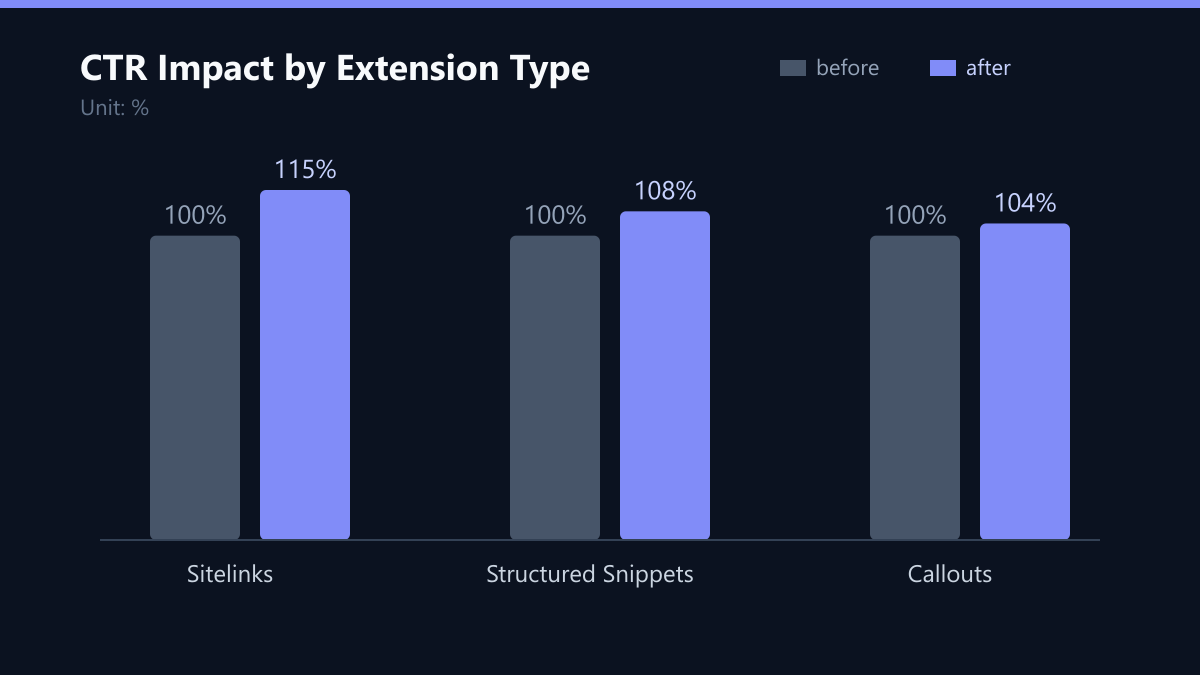
The data shows that while Sitelinks provide the biggest CTR lift, Structured Snippets provide the second-highest impact, particularly for service-based businesses. The lift is less dramatic than Sitelinks but still significant, often adding 5-8% to the baseline CTR. This makes them a high-value, low-effort addition to your ad strategy.
Callouts: The Micro-Copy That Converts
Callouts are short, static texts. They highlight unique selling propositions (USPs). They are the “cherry on top” of your ad. Use them for fast response times, certifications, or guarantees. They complement the main ad without taking up too much space.
- Examples: “Free Consultation,” “24/7 Support,” “ISO 27001 Certified.”
- Length: Maximum 25 characters per callout.
- Number: Up to 10 callouts per ad group, but only 2–3 display.
Avoid vague claims. Be specific. “Fast Setup” is better than “Quick Solution.” Specificity builds trust in B2B decisions. A B2B buyer is risk-averse. They want to know that you are reliable, certified, and responsive. A callout like “ISO 27001 Certified” immediately addresses security concerns for an IT buyer. A callout like “24-Hour Response” addresses urgency for a marketing director.
The power of callouts lies in their brevity. You have 25 characters to make a compelling case. Every word must count. Avoid filler words. Instead of “We offer free consultation,” use “Free Consultation.” Instead of “We have 24/7 technical support,” use “24/7 Tech Support.” Punchy, direct language resonates better with busy professionals.
Price and Product Extensions: The Niche Case
Price Extensions show concrete prices or price ranges. They are ideal for product-based B2B businesses. However, for pure SaaS subscriptions, they are often not suitable because prices are complex. Use them only when the price is a clear differentiator.
- Application: Hardware, add-ons, or clear price tiers.
- Caution: Ensure prices are accurate and up to date.
- Alternative: Use Structured Snippets for SaaS features instead.
If your pricing model is subscription-based with tiers, consider using a custom landing page linked via Sitelinks instead of Price Extensions. Displaying a single price for a complex SaaS product can be misleading and lead to high bounce rates. It is better to link to a “Pricing” page where the user can see the full context. Price Extensions are a powerful tool, but they are a specialized one. Use them when you can, but do not force them into a model where they do not fit.
Systematic Testing: The Path to Sustainable CTR Growth
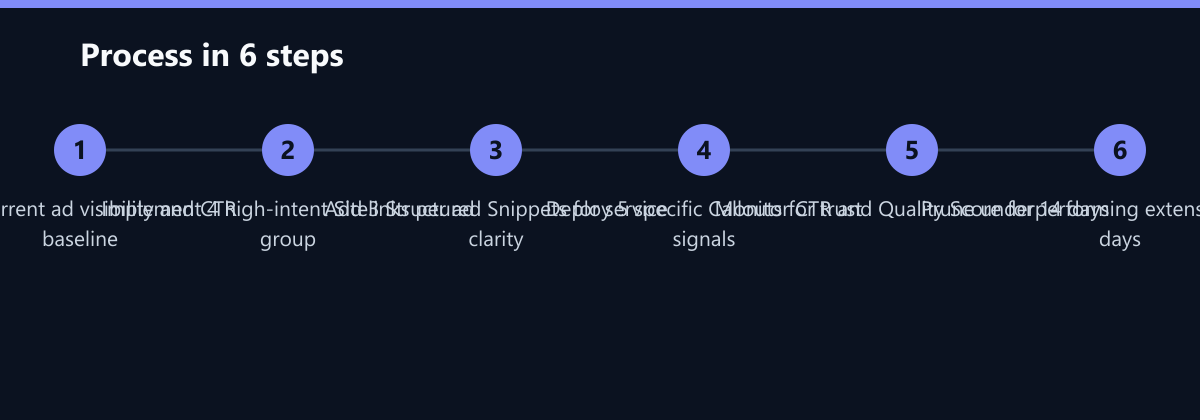
Not all extensions are equal. Testing is not a one-time event; it is a continuous process. Start with sitelinks and callouts. Add structured snippets. Observe CTR changes over at least 14 days. This period is crucial because it allows for enough data volume to make a statistical judgment.
- Segmentation: Test per industry or campaign theme. Do not mix results from different verticals.
- Metrics: Track CTR, CTR by position, and conversion rate.
- Iteration: Remove underperforming extensions after 30 days.
Remember, more extensions do not always mean better CTR. Relevance is key. Ensure every extension directly supports the ad’s promise. If a callout does not align with the search intent, remove it. If a sitelink leads to a page with high bounce rate, fix the page or change the link.
Typical Mistakes to Avoid
Many mid-market marketers make the same errors with ad extensions. Avoid these pitfalls to maximize your ROI:
- Generic Labels: Using “Home” or “Contact” as sitelink labels. This wastes premium real estate. Always use value-driven labels that match the search intent.
- Ignoring Character Limits: Truncating text due to exceeding character limits (25 for callouts, 35 for snippets). Always test your extensions in the Google Ads preview tool to ensure they display fully.
- Mismatched Intent: Using the same extensions for all ad groups. A “Free Demo” callout might work for top-of-funnel, but not for bottom-of-funnel pricing searches. Tailor extensions to the funnel stage.
- Neglecting Maintenance: Leaving outdated extensions in place. If you no longer offer a specific service, remove it from your Structured Snippets. Outdated information erodes trust and lowers CTR.
How You Measure Success
To determine if your extension strategy is working, you need to track the right KPIs. Do not just look at overall CTR. Look at the following:
- CTR Lift: Compare the CTR of ads with extensions vs. ads without (if possible via A/B testing) or track the trend over time. A 10-15% lift is a strong indicator of success.
- Quality Score: Monitor the Quality Score for your ad groups. An increase in Quality Score is a direct result of improved expected CTR from extensions.
- CPC Reduction: As Quality Score improves, your CPC should decrease. Track the average CPC over a 30-day period to see the cost savings.
- Conversion Rate by Extension: If you have conversion tracking, look at which extensions lead to higher conversion rates. This helps you prioritize which extensions to keep and which to remove.
Checklist for Implementation
Use this checklist to ensure you are implementing ad extensions correctly:
- Audit Current Ads: Review all existing ads and note which extensions are currently enabled.
- Define Search Intent: For each ad group, clearly define the primary search intent and the user’s goal.
- Create Sitelinks: Develop 4-5 sitelinks per ad group that directly address the search intent. Ensure labels are under 25 characters.
- Develop Snippets: Create 3-4 structured snippets using the correct category (Services, Products, Brands). Ensure entries are under 35 characters.
- Write Callouts: Draft 5-10 callouts per ad group. Focus on USPs, certifications, and guarantees. Keep under 25 characters.
- Enable and Monitor: Enable the extensions in Google Ads. Set up a report to track CTR, Quality Score, and CPC for the next 14 days.
- Iterate: After 14 days, review the data. Remove underperforming extensions. Test new variations.
By following this structured approach, you can maximize the impact of your ad extensions and drive sustainable growth in your B2B mid-market campaigns. The key is consistency, relevance, and continuous optimization. Do not set and forget. Treat your extensions as a dynamic part of your marketing strategy, not a static add-on.
Passend dazu
- Email Journey for SaaS: 22% Conversion Increase in the UK Market through Behavioral Triggers
- 40% Reduction of the Email Unsubscribe Rate in the DACH Mid-Market Through Dynamic Segmentation in HubSpot
- Performance Marketing
- SEO & AI Search (GEO)
- Fintech Onboarding Automation: Boosting the Activation Rate by 25% in the UK Market
- Synchronizing Marketing and Sales Numbers in the US Mid-Market
- Affiliate Marketing
- Content & CRO
- CRM Marketing
- Understanding the A9 Algorithm: Boosting Product Rankings with Optimized Backend Search Terms
- AI Search Monitoring: Tools and KPIs for Measuring AI Visibility
- Content Mix Analysis: Which Asset Types in the Nurturing Flow Generate the Longest Engagement Duration
- CRO Checklist: 12 Critical Points for B2B Mid-Market Landing Pages
- High-Impact Ad Extensions to Lower CPC in B2B SaaS
- Customer-Specific Product Recommendations in Benelux Trade: 18% Increase in Average Order Value
- TACOS vs. ROAS: Which KPI Measures Real Marketplace Profit
- Unified Measurement for the Mid-Market: Measurable Efficiency in Scandinavia
- Short Video Production for Mid-Market: DIY Setups Under 500 Dollars