The Stagnant Pipeline Problem
For a Swedish B2B SaaS provider with 120 employees, the middle of the sales funnel had become a black hole. Despite a steady influx of initial leads, the majority of prospects in the DACH and Nordics regions went silent after the first few touchpoints. The sales team found themselves trapped in a cycle of low-efficiency cold calling, spending disproportionate amounts of time on contacts who had not interacted with the brand in weeks. The data painted a clear picture: the average sales cycle had stretched to 94 days, significantly outpacing the industry benchmark of 60 days. This inefficiency wasn’t just a metric; it was a bottleneck that prevented the team from scaling revenue without proportional headcount growth. The core issue was visibility. In a crowded B2B landscape, leads simply forgot the offer or deprioritized it when no further value was delivered. Without continuous, non-intrusive touchpoints, the momentum of the initial interest dissipated, leaving the sales team to chase ghosts rather than nurture warm opportunities.
The Challenges
Before implementing any new strategy, we had to address three specific hurdles that were hindering performance:
- Data Fragmentation: The CRM contained email addresses but lacked the granular profile data needed for high-precision social retargeting. Many records were incomplete, making it difficult to build accurate custom audiences.
- Ad Fatigue Risk: The leads in question had already seen initial outreach materials. There was a high risk of overwhelming them with repetitive messaging, leading to negative brand sentiment or unsubscribes.
- Lack of Sales Integration: Marketing efforts were siloed. Even if a lead re-engaged with an ad, the sales team had no immediate visibility of this behavior, leading to missed opportunities and delayed follow-ups.
The Tech Stack
To execute this strategy, we leveraged a lean but powerful stack:
- LinkedIn Marketing Platform: For native ads and professional audience targeting.
- Meta Ads Manager: For broad retargeting and social proof campaigns.
- HubSpot CRM: For lead scoring, automation, and data synchronization.
- Clearbit API: For contact data enrichment and LinkedIn ID mapping.
Implementation: A Two-Stage Retargeting Strategy
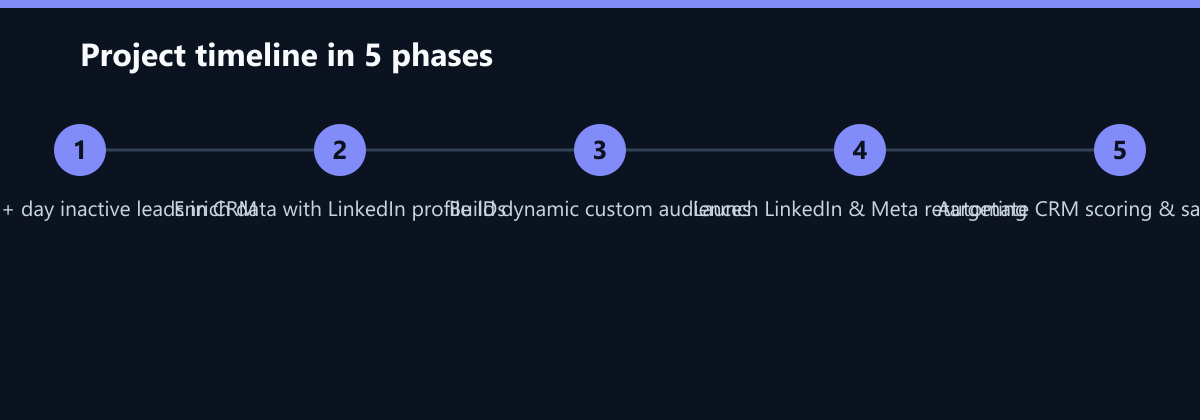
We designed a phased approach to re-activate inactive pipeline leads, focusing on the synergy between social advertising and CRM data. The goal was not to acquire new leads, but to wake up the ones already in the pipeline.
Phase 1: Segmentation and Data Enrichment
The first step was to identify the target group. We filtered the CRM for all leads with more than 30 days of inactivity. This ensured we were only targeting prospects who had shown initial interest but had gone cold. To make social retargeting effective, we needed to map these email addresses to social profiles. We used the Clearbit API to enrich contact records with LinkedIn profile IDs. This step was critical; without clean mappings, our custom audiences would have been too small to generate statistically significant results. We then uploaded these enriched lists to LinkedIn and Meta to create dynamic custom audiences.
Phase 2: Campaign Design and Execution
We adopted a dual-platform strategy, leveraging the unique strengths of each channel. On LinkedIn, we ran Native Ads focused on case studies. The messaging was professional and authority-driven, targeting specific job titles and industries of the inactive leads. The goal was to remind them of the value proposition through social proof from similar companies. On Meta, we used retargeting ads with a more personal touch. These ads featured testimonials and short product demos, aimed at decision-makers in the C-segment. To prevent ad fatigue, we implemented strict frequency capping, limiting impressions to four per week per user. This ensured the brand remained visible without becoming annoying.
Phase 3: CRM Automation and Integration
The most critical component was the integration with the sales process. We tracked all ad interactions via UTM parameters. In the CRM, we set up automation rules: a click on a retargeting ad triggered an automatic lead score increase of +10 points. If a lead registered two interactions within seven days, the system automatically created a warm task for the sales rep. This ensured that marketing efforts translated directly into actionable sales opportunities, closing the loop between digital touchpoints and human follow-up.
How We Measured It
To ensure the strategy was effective, we established clear KPIs before launch. We tracked the average sales cycle length by comparing the time from lead creation to closed-won for cohorts before and after the campaign. The lead activation rate was measured as the percentage of previously inactive leads (30+ days) that re-engaged (clicked, opened, or replied) within the 90-day window. Finally, we calculated the Cost per Qualified Lead (CPL) by dividing total ad spend by the number of leads that met our MQL criteria. These metrics allowed us to quantify the impact on both efficiency and cost.
Results: Measurable Pipeline Velocity
Within 90 days, the strategy delivered tangible improvements. The activation rate of inactive leads surged, indicating that the retargeting messages resonated with the audience. The sales team reported that the warm tasks generated by the automation rules were significantly easier to convert than cold calls. The data confirmed this anecdotal feedback with hard numbers.
| KPI | Before | After | Change |
|---|---|---|---|
| Avg. Sales Cycle | 94 days | 62 days | -34 % |
| Lead Activation Rate | 8 % | 22 % | +175 % |
| Cost per Qualified Lead | 450 € | 310 € | -31 % |
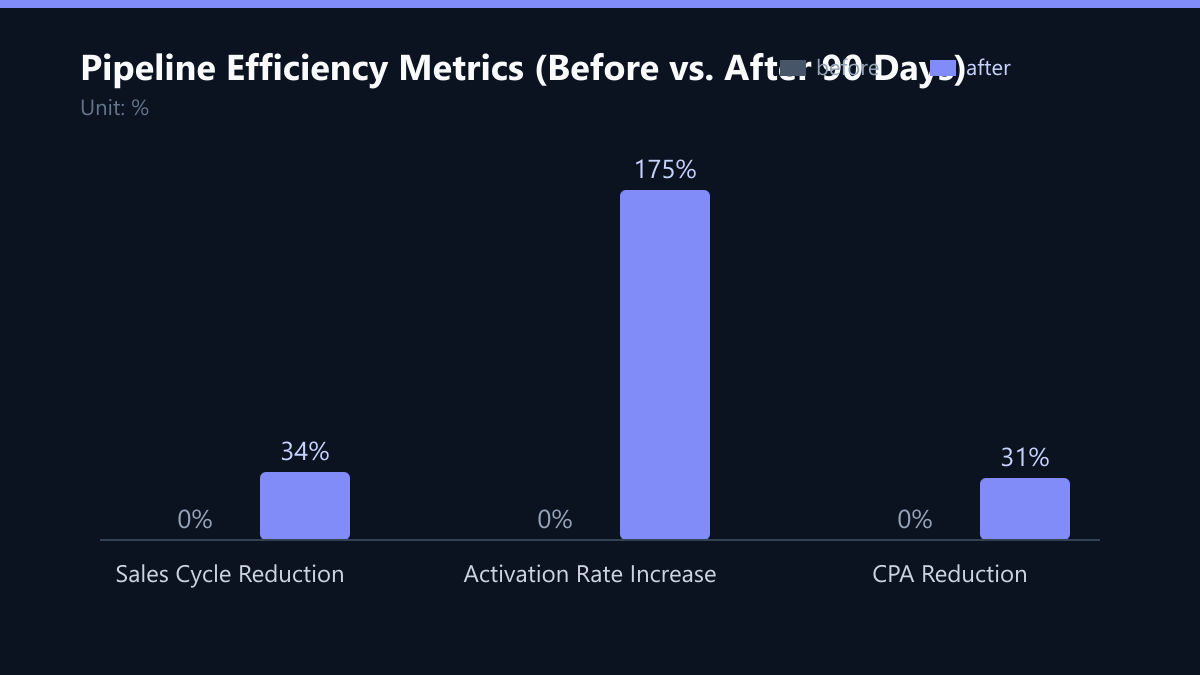
The shortening of the sales cycle by 32 days was the most impactful result. It allowed the sales team to close more deals per quarter without expanding headcount, directly improving revenue per employee. The higher activation rate reduced the reliance on pure cold outreach, freeing up sales time for high-value activities. The reduction in CPL demonstrated that the investment in retargeting was not only effective but also more cost-efficient than traditional acquisition channels.
Lessons Learned
This case study highlights that retargeting is not just a branding tool but a powerful activation instrument in B2B. Several key insights emerged from the process:
- Data Quality is Non-Negotiable: The success of the campaign hinged on the quality of the data enrichment. Without clean LinkedIn mappings, the custom audiences would have been too small to drive meaningful results. Investing time in data hygiene is often more valuable than increasing ad spend.
- Timing Beats Volume: Short, focused campaign phases (4–6 weeks) performed better than prolonged, diffuse presence. The urgency and freshness of the messaging kept the leads engaged. Extending the campaign beyond this window showed diminishing returns.
- Sales Integration is Key: Automating tasks based on ad interactions ensured that marketing effects were directly visible in the CRM. This alignment between marketing and sales was crucial for translating digital engagement into closed deals. Without this integration, the value of the retargeting would have been largely invisible to the sales team.
What We Would Do Differently Today
While the results were strong, there are areas for improvement:
- Earlier Data Hygiene: We spent more time than necessary on data enrichment in the first week. Implementing a stricter data quality check before campaign launch could have accelerated the start of the campaign.
- More Granular A/B Testing: We could have tested more variations of the ad copy and creative to identify the highest-performing messages more quickly. This would have allowed for even greater optimization of the CPL.
- Broader Funnel Integration: While the focus was on the middle funnel, we could have integrated this strategy with top-of-funnel content to create a more seamless journey from awareness to conversion.
Conclusion
For B2B SaaS companies struggling with stagnant pipelines, retargeting via LinkedIn and Meta is a highly effective solution. By combining precise data enrichment with automated CRM integration, businesses can significantly reduce sales cycles, increase activation rates, and lower acquisition costs. The key is to treat retargeting not as an afterthought, but as a core component of the sales and marketing strategy, ensuring that every lead is nurtured to its full potential.
Passend dazu
- Performance Marketing
- SEO & AI Search (GEO)
- Affiliate Marketing
- Content & CRO
- CRM Marketing
- Reduction of reporting effort by 40 hours monthly in the Scandinavian IT services sector through automated KPI reports
- Reduktion der Amazon Advertising ACOS um 18 % durch dynamische Bid-Regeln
- B2B industry: Reduction of CPA by 34% through dynamic Google Ads campaigns and HubSpot attribution in the DACH region