The Growing Pain of Static Ads
For many B2B SaaS companies, the initial surge in paid social performance often masks a deeper structural issue: creative fatigue. Our client, a B2B SaaS provider based in Stockholm with a team of 45 employees, experienced this exact phenomenon. Over a period of three months, their cost per click (CPC) on LinkedIn and Facebook had escalated by 40%. This was not a temporary fluctuation but a steady, upward trend that directly impacted their customer acquisition cost and overall profitability.
The root cause was clear upon analysis. The marketing team was relying on a small set of static creatives that had been running continuously. As the same target audiences were exposed to these identical messages repeatedly, engagement metrics began to deteriorate. Lead quality declined, and the sales pipeline started to shrink. The team was operating reactively, manually monitoring dashboards and only addressing issues after significant budget waste had already occurred. This lack of a systematic process for refreshing ad assets created a bottleneck that manual intervention could no longer solve.
The Challenges
Addressing this issue presented several specific hurdles that went beyond simply “changing the ads.” First, there was the speed of decay. Fatigue sets in faster than human reaction times; by the time a marketer notices a dip in CTR, the ad has often already burned through its effective budget. Second, the team lacked a centralized repository for creative assets. New variations were scattered across different drives and email threads, making it difficult to track which messages had been tested and which were new. Third, audience overlap was a significant problem. New, retargeting, and lookalike audiences were not properly segmented, leading to the same users seeing multiple ads from the same campaign, further accelerating fatigue. Finally, there was a disconnect between marketing efforts and sales outcomes. The team was optimizing for clicks, but without feedback from the CRM, they could not distinguish between a click that led to a qualified lead and one that was merely noise.
How We Measured It
To ensure the solution was effective, we established a rigorous baseline and measurement framework before implementing any changes. We defined “fatigue” using two specific, quantifiable triggers: a frequency count exceeding 3.0 for any individual user over a 30-day period, or a click-through rate (CTR) dropping below 0.8% sustained for 48 hours. These thresholds were chosen based on historical data from the client’s account, representing the point where marginal returns on ad spend began to diminish significantly.
We tracked three primary KPIs to measure success: Average CPC, Cost per Lead (CPL), and Lead-to-Opportunity Rate. The baseline period was the three months prior to implementation, during which the average CPC was €4.50, the CPL was €180, and the lead-to-opportunity rate was 12%. We used the ad platform’s native reporting tools for immediate metrics like CPC and CTR, while integrating with the CRM to track the downstream impact on lead quality and opportunity creation. This dual-layered approach ensured that we were not just optimizing for cheap clicks, but for valuable business outcomes.
The Tech Stack
The solution required a tight integration of several tools to create a seamless automated workflow.
- CRM System: Used to track lead status and exclude converted users from ad audiences.
- Ad Platforms (LinkedIn/Facebook): The execution layer where rules were configured and ads were served.
- Content Management System (CMS): A centralized repository for all creative assets, tagged by message angle and format.
- Workflow Automation Tool: The glue that connected the CMS, ad platforms, and CRM, executing the logic for fatigue detection and creative swapping.
Implementation: Building the Automated Rotation Engine
Our approach was to build an integrated workflow that connected the client’s CRM, ad platforms, and content management system. The goal was to shift from reactive monitoring to proactive, automated management. We began by organizing 12 distinct video and static variations in a centralized repository. Each asset was tagged by its message angle, ensuring that we were rotating not just visuals, but distinct value propositions that appealed to different buyer personas.
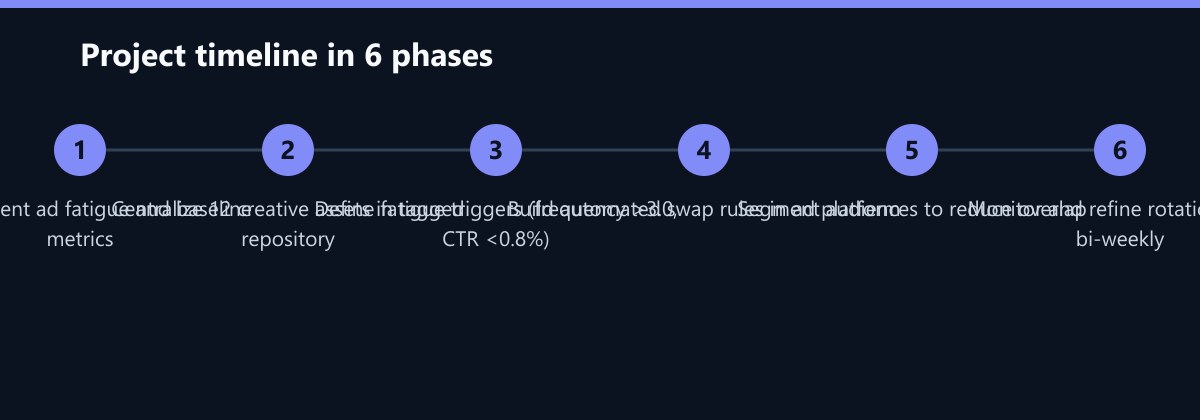
The core of the system was the fatigue detection logic. We configured automated alerts in the ad platform to trigger when frequency exceeded 3.0 or CTR dropped below 0.8% for 48 hours. When these triggers were met, the system would automatically pause the fatigued ad and launch the next variation from the pool. This process was entirely rule-based, removing the need for human intervention in the day-to-day management of ad swaps. Additionally, we implemented strict audience segmentation, splitting users into new, retargeting, and lookalike groups to minimize overlap and ensure that each segment received the most relevant message at the right stage of the funnel.
The implementation phase took four weeks. This included two weeks for data auditing and baseline establishment, one week for building the automation rules, and one week for testing and refinement. We tested three different rotation frequencies before settling on a bi-weekly refresh cycle for top-performing audiences. This cycle allowed enough time for new creatives to gather statistical significance while preventing the long-term exposure that leads to fatigue.
Results: Stability and Growth
After six months of running the automated system, the results were transformative. The volatility in ad spend costs disappeared, replaced by a stable and predictable performance curve. The average CPC dropped from €4.50 to €3.10, representing a 31% reduction. This was not a one-time dip but a sustained improvement, as the system continuously cycled through fresh assets before fatigue could set in.
The impact on lead quality was equally significant. The cost per lead decreased from €180 to €125, a 30% reduction. More importantly, the quality of these leads improved. By integrating with the CRM and excluding converted users, we ensured that our ad spend was focused on high-potential prospects. This resulted in a 15% increase in the lead-to-opportunity rate, rising from 12% to 18%. The sales team reported that the leads coming through the pipeline were better qualified and more engaged, leading to shorter sales cycles.
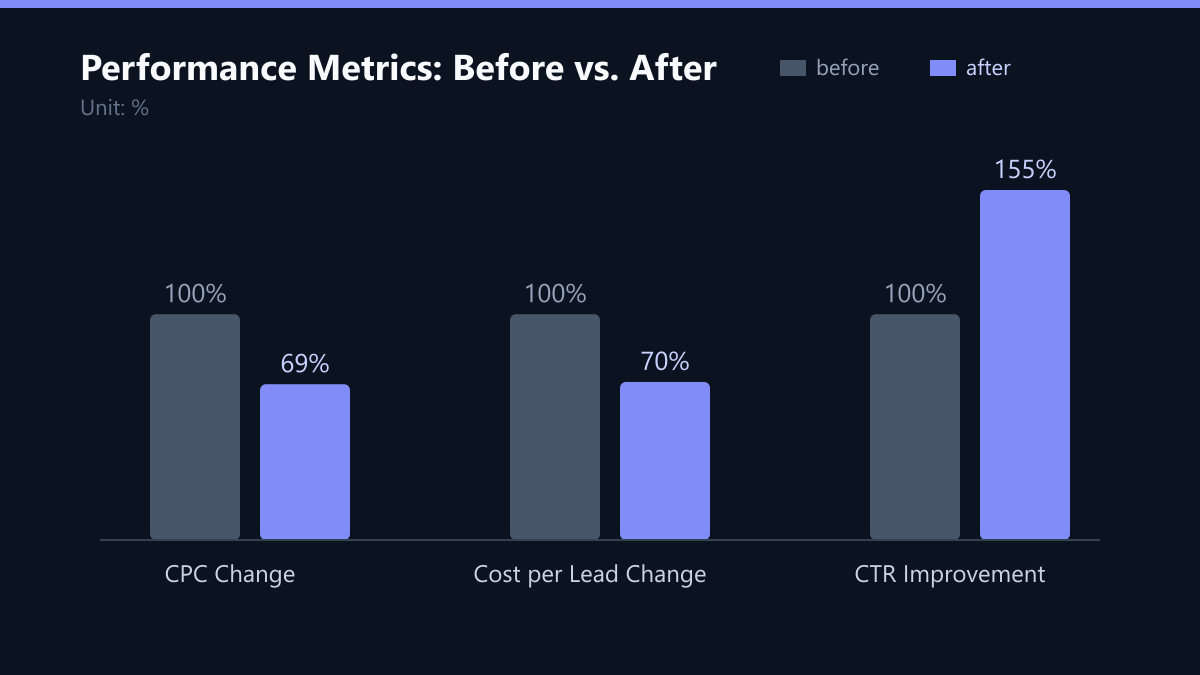
The click-through rate (CTR) also saw a substantial improvement, rising from 0.9% to 1.4%, a 55% increase. This was a direct result of the fresh creative content. Users were more likely to engage with ads that felt new and relevant, rather than repetitive and stale. The system’s ability to detect fatigue early and swap in fresh assets ensured that the audience always had a reason to click.
What We Would Do Differently Today
While the results were highly successful, the process highlighted areas for improvement. First, we would have invested more time in the initial creative strategy. The 12 assets we started with were good, but they were all relatively similar in tone and style. In hindsight, we should have pushed for more diverse creative angles, including user-generated content and case study videos, to provide a wider range of messages to rotate through. This would have further extended the lifespan of the campaign and reduced the frequency of swaps.
Second, we would have implemented a more granular A/B testing framework from the start. While we did test different rotation frequencies, we did not extensively test the creative assets themselves against each other in a controlled manner. A more structured testing process would have allowed us to identify the top-performing message angles faster and allocate more budget to them, potentially accelerating the CPC reduction.
Finally, we would have involved the sales team earlier in the process. While the CRM integration was crucial, the sales team’s feedback on lead quality was valuable but came after the system was already running. Collaborating with sales from the beginning to define what a “qualified” lead looks like in terms of ad engagement metrics would have allowed us to refine the targeting and messaging even more precisely, potentially leading to an even higher lead-to-opportunity rate.
Lessons Learned
The primary lesson from this project is that proactive management beats reactive fixes. Manual monitoring is insufficient for scaling paid social campaigns, especially in competitive B2B markets. Fatigue sets in faster than teams can manually react, and the cost of waiting is wasted budget and lost leads.
Automating the boring parts, such as ad swapping and budget reallocation, allows the marketing team to focus on strategy and creative development. It frees up valuable time for higher-impact activities, such as analyzing customer behavior and refining the overall marketing message. Additionally, diversifying creative angles is crucial. Rotating messages, not just visuals, ensures that different buyer personas are engaged with content that resonates with their specific needs and pain points.
Monitoring frequency is a simple but powerful metric. Keeping frequency under 3.0 for cold audiences maintains relevance and prevents ad blindness. Finally, integrating with the CRM is not just a nice-to-have; it is essential for maximizing ROI. Feeding lead data back into ad platforms allows for continuous optimization, ensuring that marketing efforts are aligned with sales outcomes and that the pipeline is filled with high-quality opportunities. This case study demonstrates that with the right automation and strategy, it is possible to stabilize costs and drive growth in a competitive digital landscape.