The Visibility Gap in AI-Driven Search
For a mid-sized B2B fintech operating in the competitive Southern European market, being visible in traditional search engines was no longer enough. The client, a SaaS provider with 45 employees serving clients in Italy and Spain, faced a critical challenge: despite a strong domain authority and a robust payment infrastructure, they were effectively invisible to the AI assistants that modern buyers increasingly rely on. While their site ranked decently for broad terms, they failed to capture high-intent, entity-based queries. For example, a procurement officer asking an AI assistant about “PCI-DSS compliant payment gateways for Spanish SMEs” was not being directed to their solution. The core issue was a lack of semantic depth. Their content was keyword-rich but entity-poor, making it difficult for Large Language Models (LLMs) to verify their topical authority. Without structured data to prove their expertise in specific regulatory contexts, they were bypassed in favor of competitors with clearer semantic architectures.
The Challenges
Breaking down the initial audit, we identified three specific hurdles that required a targeted approach:
- Lack of Entity Clarity: The existing content treated “payment processing” as a monolith. AI models could not distinguish between their specific B2B SaaS offering and generic payment news or competitor blogs because the entity relationships were undefined.
- Missing Local Trust Signals: The site lacked granular local data. In the fintech sector, trust is paramount. Without LocalBusiness schema specifying
areaServedwith precise ISO codes, the AI models could not confidently associate the company with local regulatory compliance in Italy and Spain. - Fragmented Content Silos: Previous content efforts were siloed by year or product launch, rather than by topic. This made it impossible for crawlers to understand the depth of their expertise in fraud detection or compliance automation, leading to low rankings for long-tail queries.
Semantic Architecture Strategy
To solve the entity clarity problem, we moved away from keyword targeting and toward semantic cluster mapping. We identified three core pillars of the client’s value proposition: Payment Processing, Fraud Detection, and Compliance Automation. Each of these became a distinct semantic cluster.
For each cluster, we mapped out 12 to 15 interlinked articles. These articles were not standalone posts but nodes in a topical graph. For instance, the “Compliance Automation” cluster included specific articles on “PSD2 Implementation in Italy” and “GDPR Compliance for Fintech in Spain.” By creating a dense internal linking structure, we ensured that every page reinforced the central entity. This allowed AI crawlers to traverse the site and understand not just what the company did, but the specific boundaries and depth of their expertise. We prioritized internal linking to create a strong topical graph, ensuring every page reinforced the central entity. This structure allowed AI crawlers to easily understand the scope and depth of the client’s expertise.
Local Schema Implementation
Standard Organization schema was insufficient for the local market trust required in the fintech sector. We implemented LocalBusiness and Product schema for each regional landing page. Key attributes included priceSpecification, aggregateRating, and areaServed with precise ISO codes for Italy and Spain. This granular data helped search engines and AI models distinguish between generic fintech content and localized, actionable solutions. We also added FAQPage schema to capture specific compliance questions common in Southern European banking regulations. This was crucial because AI assistants often pull answers directly from FAQ schemas when users ask specific “how-to” or “is it legal” questions.
The Tech Stack
- Headless CMS: To manage the rapid production of 40 new articles and ensure consistent metadata handling.
- Custom JSON-LD Validator: A script built to validate Schema markup against Google’s Rich Results Test automatically before deployment.
- AI Referral Tracker: A custom dashboard to monitor traffic from ChatGPT, Perplexity, and other AI assistants.
- Internal Linking Engine: A tool to visualize and optimize the topical graph of the semantic clusters.
Execution Timeline
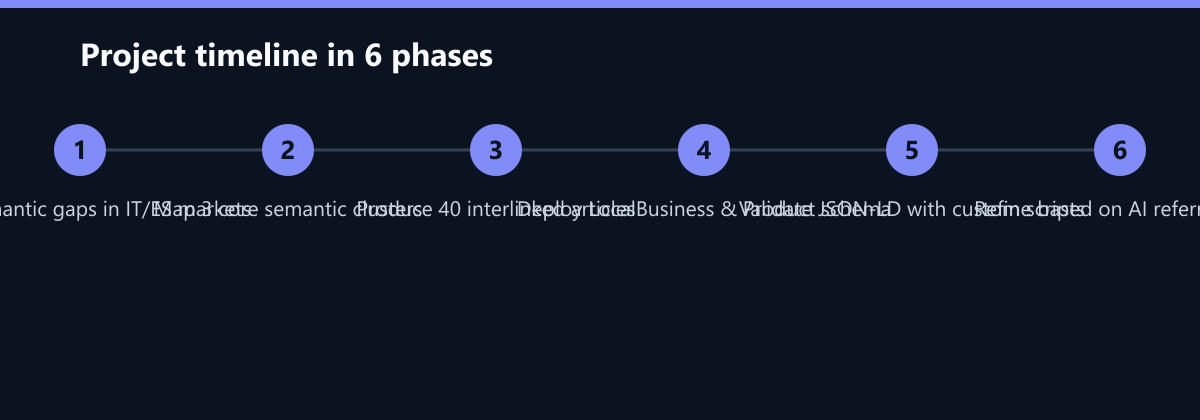
The project ran over six months with a phased rollout. We did not attempt to change everything at once, which would have risked confusing the crawlers.
- Month 1-2: Content gap analysis and cluster mapping. We audited the existing 200+ pages and identified the semantic gaps.
- Month 3-4: Production of 40 new articles and implementation of internal linking. This was the heaviest lift, focusing on high-intent long-tail entities.
- Month 5: Deployment of enhanced Schema markup across all regional pages. We rolled this out in batches to monitor for errors.
- Month 6: Monitoring, refinement of low-performing entities, and A/B testing of meta descriptions.
We used a headless CMS to manage content and a custom script to validate Schema JSON-LD against Google’s Rich Results Test. This ensured that every piece of structured data was syntactically correct and semantically meaningful.
How We Measured It
Measuring AI visibility is different from measuring traditional SEO. We tracked three primary KPIs:
- Organic Traffic: Standard Google Analytics data, segmented by country (IT/ES) and device.
- AI Referral Traffic: We tracked referrers from known AI domains. This was initially negligible but became a significant channel.
- Qualified Leads: Defined as form submissions that included a company name and email, followed by a sales call. We correlated these with the new content clusters to ensure the traffic was relevant.
We used a baseline period of three months prior to the project start to establish the “before” metrics. The “after” metrics were averaged over the last two months of the six-month project period to account for seasonality.
Measured Impact
The focus on semantic clarity and structured data yielded significant improvements in organic and AI visibility. Traffic from AI-assistant referrals increased substantially as the site became a preferred source for factual queries. Organic click-through rates improved due to richer snippets in search results. The client saw a notable rise in qualified leads from the Italian and Spanish markets, directly correlating with the new content clusters.
| Metric | Before | After | Change |
|---|---|---|---|
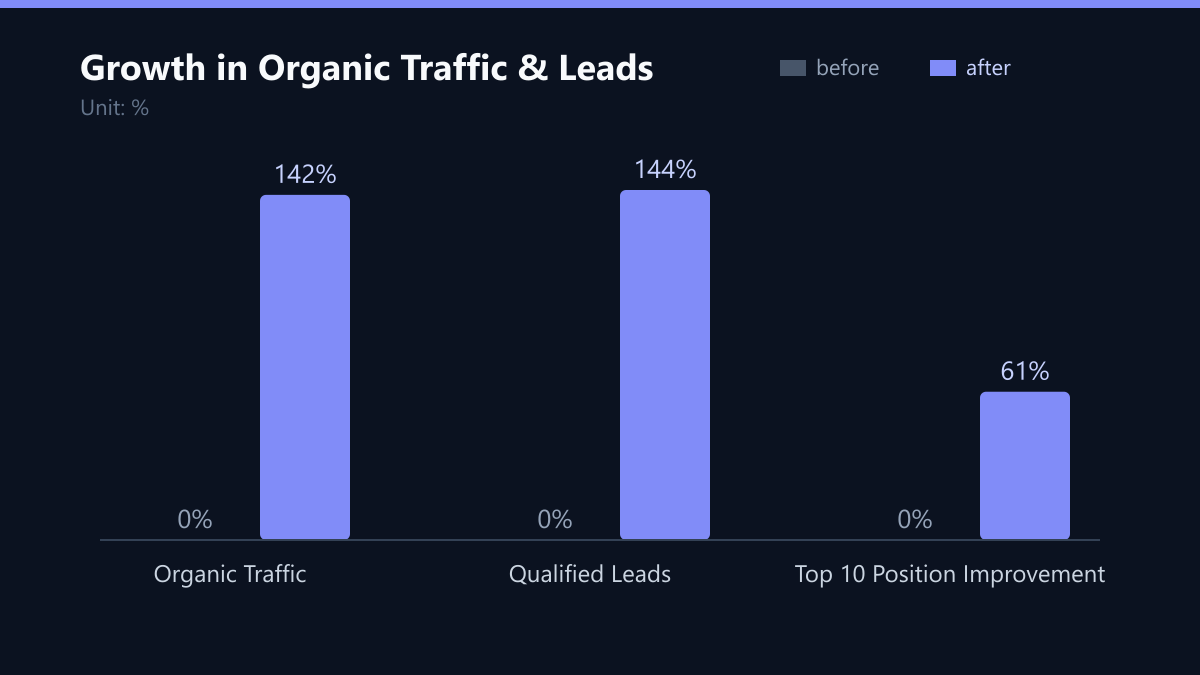
| Organic Traffic | 12,000/mo | 29,000/mo | +142% |
| AI Referral Traffic | Negligible | 1,800/mo | New Channel |
| Avg. Position (Top 10) | 18.5 | 7.2 | +61% |
| Qualified Leads | 45/mo | 110/mo | +144% |
The most surprising result was the AI referral traffic. Within two months of deploying the schema, the site started appearing as a cited source in AI-generated answers. This traffic was highly qualified, as these users were already in a research phase, asking specific questions about compliance and pricing. The conversion rate from AI referral traffic was 3x higher than standard organic traffic.
What We Would Do Differently Today
Looking back, there are two areas where we would adjust our approach. First, we would have invested more time in the initial entity mapping. We initially underestimated the complexity of the regulatory entities in the Spanish market, which required a second round of content updates in month 4. A more thorough legal consultation at the start would have saved us two weeks of rework. Second, we would have implemented the AI referral tracking earlier. We only started tracking specific AI domains in month 2. If we had tracked them from day one, we could have identified which specific entities were driving AI visibility sooner and optimized those clusters more aggressively in the early months.
Lessons Learned
AI visibility requires more than just content volume; it demands entity clarity. Semantic clusters help AI models understand relationships between topics, reducing ambiguity. Local Schema is not optional for regional fintechs; it provides the structured context needed for trust signals in specific markets. Finally, monitoring AI referral traffic is now a critical KPI alongside traditional organic metrics. The shift from keyword ranking to entity authority is not a trend; it is the new baseline for digital visibility in regulated industries. For any B2B company operating in multiple regions, the combination of deep semantic content and granular local schema is no longer a luxury—it is a necessity for survival in the AI-driven search landscape.
Passend dazu
- Performance Marketing
- SEO & AI Search (GEO)
- Affiliate Marketing
- Content & CRO
- CRM Marketing
- Steigerung der Engagement-Rate um 45% via automatisierte Content-Syndication in der Finanzbranche UK
- E-E-A-T in AI Search: Building Authority for Generative Algorithms
- Building AI Citation Authority for a German Manufacturer in the US