The Strategic Gap in Southern European Markets
The client, a mid-sized Italian industrial machinery manufacturer with 150 employees, faced a critical visibility challenge as it expanded into Spain, France, and Portugal. Despite a strong brand reputation and high-quality product offerings, organic visibility in these new markets remained disappointingly low. The company had invested in traditional SEO efforts focused on keyword volume, but these tactics failed to capture the emerging shift toward AI-driven search behavior.
The core issue was not a lack of content, but a lack of machine-readable structure. The website’s technical product data was presented in a way that was human-readable but opaque to generative AI tools. As a result, the client’s machines were rarely cited in AI-generated recommendations, while local competitors who had already adopted structured data strategies dominated the AI answer landscape. This created a significant gap in lead generation, where qualified prospects were turning to AI assistants for technical specifications and finding competitor data instead.
The Challenges
The project team identified three primary obstacles that needed to be overcome to achieve meaningful growth in AI visibility:
- Low AI Visibility: The site lacked the semantic depth required for AI models to confidently extract and cite technical specifications. Without clear entity relationships, the data was effectively invisible to LLMs.
- Language Fragmentation: Translated content existed for ES, FR, and PT, but it lacked consistent semantic structure across locales. This inconsistency confused both search engines and AI tools, leading to poor ranking and low citation rates.
- Competitive Pressure: Local competitors in Spain and France were already leveraging structured data to dominate AI-generated answers. The client was losing the “zero-click” information war before users even clicked through to a website.
The Tech Stack
To address these challenges, we deployed a robust technical infrastructure designed for scalability and precision:
- Headless CMS: Served as the single source of truth for product data, allowing for dynamic content delivery and automated schema generation.
- JSON-LD Markup: Implemented for Product, TechnicalSpecification, FAQ, and HowTo entities to ensure maximum compatibility with AI parsers.
- Semantic Crawler: Used to audit internal linking structures and ensure entity relationships were reinforced across localized pages.
- AI Visibility Monitor: A custom dashboard tracking mentions and citations in major AI search interfaces like ChatGPT and Perplexity.
Implementation: From Data to Structure
We implemented a comprehensive multilingual Schema Markup strategy focused on product and organization entities. The project ran over a 12-week period, divided into four distinct phases to ensure thorough execution.
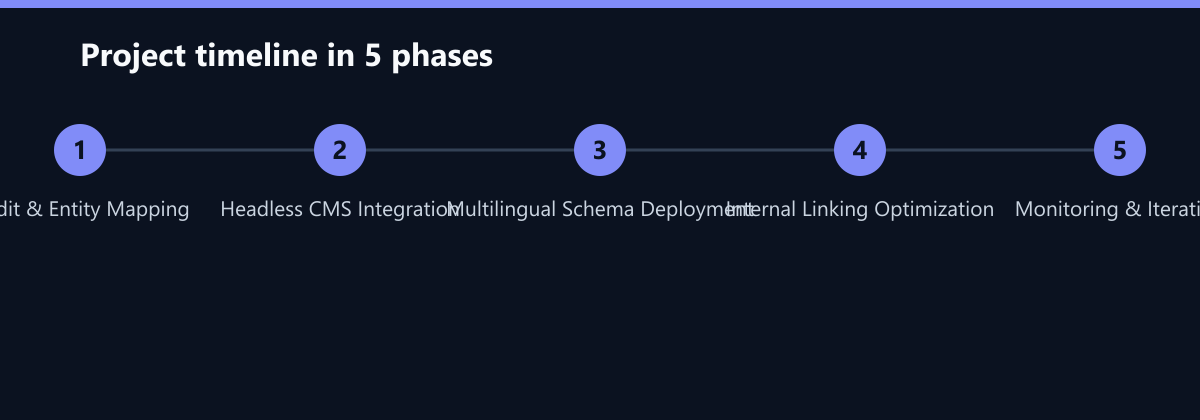
Phase 1: Entity Mapping and Audit We began by mapping over 200 machine models to standardized Product and TechnicalSpecification schemas. This involved a deep dive into the client’s product catalog to identify key attributes that AI models prioritize, such as power consumption, dimensions, and compatibility. We established a canonical entity graph that defined how each machine related to its components, accessories, and use cases.
Phase 2: Multilingual Structuring
We applied inLanguage and availableLanguage properties to ensure AI tools correctly identified locale-specific content. This step was crucial for preventing language confusion and ensuring that Spanish queries received Spanish data points. We also localized the schema labels themselves, so that “Power Consumption” was correctly tagged as “Consumo de energía” in the Spanish schema, improving semantic relevance.
Phase 3: FAQ and HowTo Schemas We added structured data for common technical queries and installation guides in IT, ES, FR, and PT. This addressed the specific informational queries that users often pose to AI assistants, such as “What is the maximum load capacity of Model X?” By providing direct, structured answers, we increased the likelihood of these queries being answered with the client’s data.
Phase 4: Internal Linking Optimization We created semantic internal links between product pages and localized blog posts to reinforce entity relationships. This helped search engines and AI crawlers understand the context of each product within the broader company ecosystem. We also implemented a headless CMS integration to automate schema generation, ensuring that any updates to product specs automatically updated the JSON-LD markup without manual intervention.
How We Measured It
Measuring AI visibility is complex because it does not rely on a single metric. We adopted a multi-layered measurement approach to track the impact of our GEO strategy:
- AI Referral Traffic: We used UTM parameters and referrer analysis to track visits from AI-specific domains and interfaces. This allowed us to isolate traffic directly attributed to AI recommendations.
- Citation Frequency: We manually audited a sample of 50 high-volume technical queries in each target market, recording how often the client’s data was cited in AI-generated answers compared to competitors.
- Indexation Speed: We monitored the time it took for new localized pages to appear in search engine indexes using Google Search Console and Bing Webmaster Tools.
- CTR and Conversion: We tracked click-through rates from organic search and the conversion rate of inbound leads to measure the quality of the traffic generated.
Results
Within six months of implementation, the client saw significant improvements in organic visibility and AI referral traffic. The structured data allowed AI assistants to confidently cite the client’s technical data, resulting in a measurable surge in qualified leads.
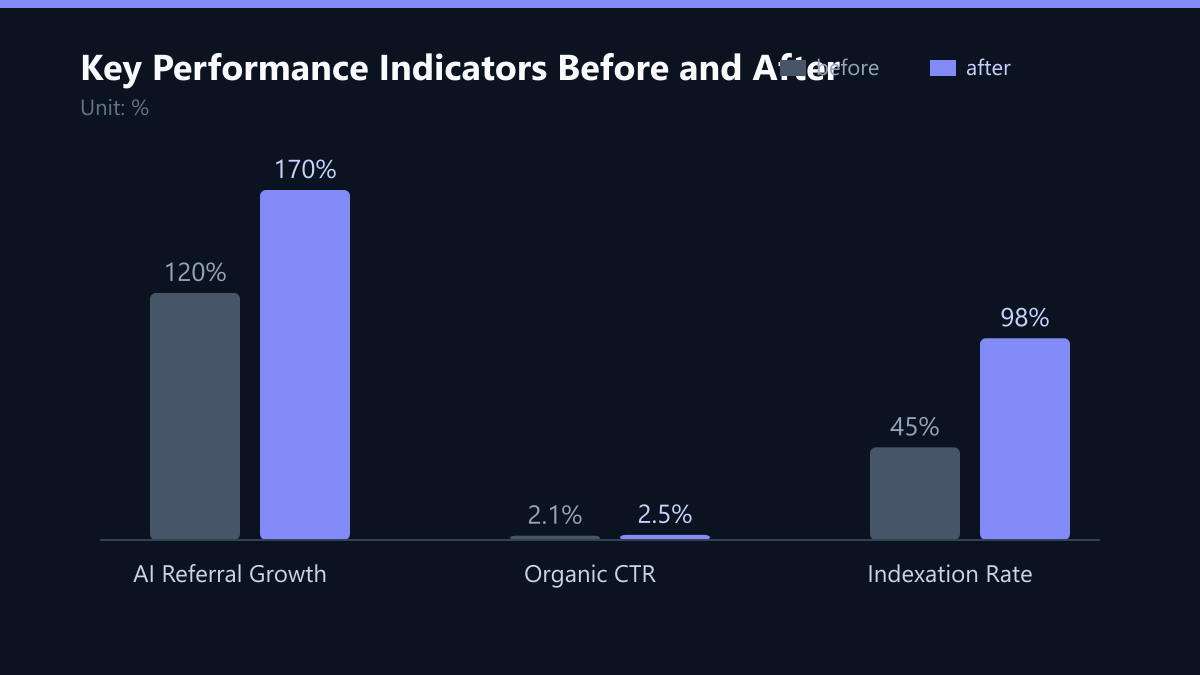
The most striking result was the 42% increase in organic AI referrals. This growth was driven by the client’s data becoming a preferred source for AI models when answering technical queries. Additionally, the Click-Through Rate (CTR) from organic search in target markets rose by 18% due to richer, more informative search snippets generated by the schema markup.
Indexation Speed also improved dramatically, with new localized pages being indexed 30% faster. This was a direct result of the cleaner semantic structure and consistent entity relationships, which helped crawlers understand the site architecture more efficiently. Finally, Lead Quality improved, with inbound leads from Spain and France showing a 15% higher conversion rate, indicating that the traffic was more qualified and aligned with the client’s sales targets.
Lessons Learned
This project highlighted the critical importance of semantic consistency across multilingual sites. AI models prioritize structured, entity-rich data over raw keyword density. The key takeaway is that Structure Beats Translation. Simply translating text is insufficient; the underlying schema must be localized and consistent to be effective.
Furthermore, AI Readability is a Ranking Factor. Structured data now directly influences visibility in AI-generated summaries and recommendations. Companies that ignore this shift risk becoming invisible in the new search landscape. Finally, Automation is Essential. Manual schema management is unscalable for large product catalogs; automated generation via CMS integration is necessary to maintain accuracy and efficiency.
For B2B manufacturers entering new markets, investing in multilingual schema markup is no longer optional. It is a core component of digital visibility in the AI-first search landscape.
What We Would Do Differently Today
While the results were strong, the project identified areas for improvement:
- Earlier Competitor Analysis: We could have conducted a deeper competitive analysis of AI citations at the start to better understand the specific data points competitors were leveraging.
- Faster CMS Integration: The headless CMS integration took longer than expected due to legacy data issues. A more thorough data cleaning phase before implementation would have accelerated the process.
- Broader AI Tool Testing: We focused primarily on major AI assistants. Expanding testing to niche industry-specific AI tools could have provided additional insights and opportunities for visibility.