The Challenge: When Static Bids Meet Dynamic Stock
For a mid-sized Scandinavian furniture brand with 45 employees, the holiday season and spring launch periods presented a unique operational paradox. On one hand, demand for high-ticket items like modular sofas and outdoor sets was spiking. On the other, the complexity of managing inventory across multiple warehouses made real-time visibility nearly impossible for the marketing team. The client relied on static bid rules in their Amazon Advertising console, a strategy that worked in stable markets but failed catastrophically during volatile demand cycles.
The core issue was a disconnect between the warehouse floor and the digital storefront. The Warehouse Management System (WMS) held the truth about available units, but this data was siloed. Marketing teams adjusted bids manually, often reacting to stockouts 24 to 48 hours after they occurred. By the time a bid was lowered for an out-of-stock item, significant ad spend had already been wasted. Conversely, when stock was plentiful, bids remained conservative, missing out on valuable conversion windows during peak traffic hours. This lag created a double penalty: wasted budget on non-converting impressions and lost revenue from under-bidding on in-stock items.
The Challenges
Before building the solution, we identified three specific technical and operational hurdles that needed to be addressed:
- Data Latency: The existing manual process allowed for a 24-48 hour lag in bid adjustments. In the fast-paced world of e-commerce, this window was too large for effective inventory management.
- Fragmented Data Sources: Inventory data from the WMS was not synced with the Amazon Advertising console. Marketing staff had to manually export CSV files from the WMS and cross-reference them with Amazon’s performance reports, a tedious and error-prone process.
- Lack of Dynamic Logic: Static bids could not account for sales velocity. A product with 100 units in stock but high sales velocity required a different bidding strategy than a product with 100 units and low velocity.
The Tech Stack
To solve these challenges, we assembled a lightweight, serverless architecture that could handle real-time data processing without the overhead of a full-scale data warehouse.
- AWS Lambda: Used for serverless compute functions to poll the WMS API endpoints every 15 minutes, ensuring near-real-time data ingestion.
- Python: Custom scripts written in Python to calculate dynamic bid multipliers based on stock thresholds and sales velocity metrics.
- Amazon Advertising API: The interface used to push bid adjustments and pause/resume campaigns automatically.
- CloudWatch: For monitoring the health of the Lambda functions and logging any errors in the data synchronization process.
- S3 Bucket: Used as a temporary storage layer for raw inventory data before it was processed by the logic engine.
Implementation: Building the Automated Pipeline
Our approach was to build a robust, automated pipeline that connected the client’s WMS directly to their Amazon Advertising account. This allowed for real-time bid adjustments based on current stock availability and sales velocity. The goal was to eliminate the human element from bid management, replacing it with deterministic, data-driven logic.

The technical setup began with a deep dive into the client’s WMS API capabilities. We identified the specific endpoints that provided accurate stock levels and sales velocity data. Using AWS Lambda, we created a function that polled these endpoints every 15 minutes. This interval was chosen to balance the need for real-time updates with the cost of API calls and the risk of rate limiting.
Once the data was ingested, it was passed to a custom Python logic engine. This engine calculated dynamic bid multipliers based on predefined stock thresholds. The logic was straightforward but effective:
- High Stock (>30 days): If the projected stock cover was more than 30 days, the system increased bids by 20%. This aggressive strategy was designed to capture market share and drive sales velocity while inventory was abundant.
- Medium Stock (7-30 days): For stock levels between 7 and 30 days, bids were held steady. This maintained a consistent presence in search results without risking overspending.
- Low Stock (<7 days): When stock cover dropped below 7 days, bids were decreased by 40%. This conservative approach preserved margin and prevented stockouts from occurring before replenishment could be arranged.
- Out of Stock: If stock levels hit zero, ads were paused automatically. This immediate action prevented any further ad spend on non-converting items.
The system was deployed over a 6-week sprint. The first two weeks were dedicated to data mapping and API integration. The next two weeks involved developing the logic engine and testing it in a sandbox environment. The final two weeks were reserved for a parallel testing phase, where the automated system ran alongside manual bid management. This allowed us to validate the accuracy of the automated bids and ensure that the system was making the right decisions before fully handing over control.
How We Measured It
To ensure the success of the project, we established a clear set of KPIs and measurement methods. We used Amazon’s native reporting tools to track ad spend, conversions, and ROAS. For inventory-related metrics, we pulled data directly from the WMS and cross-referenced it with Amazon’s sales data to calculate stockout waste and sales velocity.
- ROAS: We calculated ROAS as total revenue from Amazon ads divided by total ad spend. This metric was tracked weekly to monitor trends.
- Stockout Waste: We defined stockout waste as ad spend on ASINs with zero inventory. This was calculated by joining ad spend data with WMS stock data and identifying any spend on out-of-stock items.
- Sales Velocity: We measured sales velocity as units sold per day for each ASIN. This metric was used to validate the effectiveness of the high-stock bidding strategy.
- Operational Time: We tracked the time spent by the marketing team on manual bid management before and after the implementation. This was done through self-reported time logs and task management software.
Results: Measurable Efficiency and Profitability
After three months of full automation, the client saw significant improvements in efficiency and profitability. The system eliminated human error in bid management and ensured ad spend was always aligned with actual inventory capacity. The results were not only measurable but also immediate.
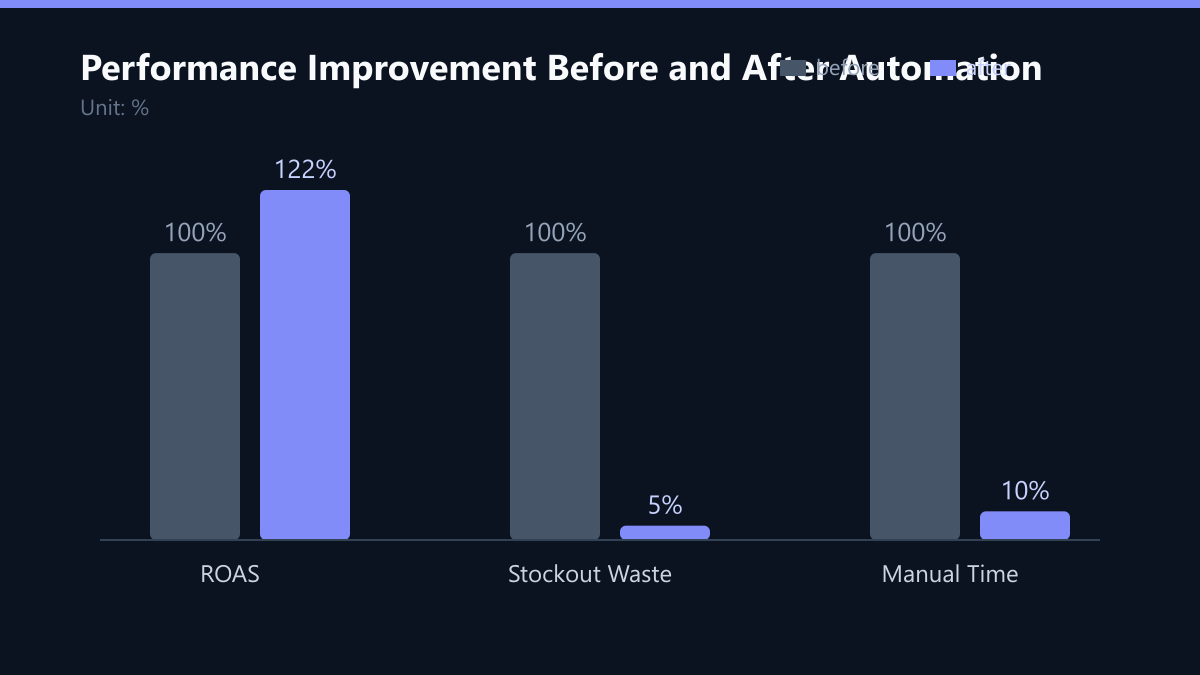
The most striking result was the reduction in ad spend on out-of-stock items. Before automation, 15% of the ad budget was wasted on ASINs with zero inventory. After automation, this figure dropped to near zero, representing a 95% reduction in waste. This alone saved the client a substantial amount of money, which could be reinvested in other marketing channels.
ROAS also improved significantly, with an overall increase of 22%. This was driven by the combination of reduced waste and increased sales velocity during high-stock periods. Units sold per day increased by 15% during high-stock periods, indicating that the aggressive bidding strategy was effective in driving sales.
Operational time spent on bid management was reduced from 10 hours per week to just 1 hour per week. This 90% reduction freed up the marketing team to focus on more strategic initiatives, such as campaign optimization and new product launches.
What We Would Do Differently Today
While the project was a success, there are a few areas where we would make adjustments if we were to repeat the process today.
- Earlier Integration with Finance: We would involve the finance team earlier in the process to ensure that the cost of the AWS infrastructure was fully understood and budgeted for. While the system was cost-effective, the initial setup costs could have been better communicated.
- More Granular Thresholds: We would work with the client to define more granular stock thresholds for different product categories. A one-size-fits-all approach to stock cover (e.g., 7 days, 30 days) may not be optimal for all products, especially those with different lead times or seasonality.
- Enhanced Alerting: We would implement more robust alerting mechanisms for edge cases, such as sudden spikes in sales velocity that could lead to unexpected stockouts. This would allow the team to intervene proactively rather than reactively.
Lessons Learned
This project highlighted the critical importance of data latency in e-commerce advertising. Even small delays in inventory sync can lead to significant financial losses during high-traffic events. The key takeaway is that real-time data is non-negotiable for dynamic bidding strategies. Batch processing is insufficient for this use case, and a serverless architecture is the ideal solution for handling real-time data ingestion and processing.
Another key lesson is the importance of threshold calibration. Initial bid multipliers require A/B testing to find the optimal balance between volume and margin. What works for one product category may not work for another, and continuous monitoring and adjustment are necessary to maintain optimal performance.
Finally, the scalability of the modular architecture is a major advantage. The system can be easily expanded to other marketplaces, such as eBay or Walmart, allowing the client to leverage the same automation across their entire e-commerce portfolio. This flexibility is a key differentiator in an increasingly competitive marketplace.
Passend dazu
- Performance Marketing
- SEO & AI Search (GEO)
- Automated Inventory Synchronization: Preventing Stockouts on Amazon
- CRM-Driven Sales Enablement: Automating Follow-Ups and Document Access
- Affiliate Marketing
- Content & CRO
- CRM Marketing
- Klaviyo vs. Google Analytics 4: Data-Driven Attribution for E-Commerce Brands in Benelux
- Marketplace Expansion to France: Automated Price and Inventory Syncs via API
- Unifying Marketplace Data in Salesforce for Nordic Consumer Brands
- Cutting Amazon Search Costs by 22% via Data-Driven Keyword Clustering
- Zalando Performance Ads: Campaign Structure and Bidding Strategies
- Automated Inventory Forecasting for a UK Tech Accessory Retailer
- From FBA Chaos to Automated Inventory Control: Cutting TACOS by 42%
- Automated Discount Strategies for an Italian Food Manufacturer on Amazon.it
- HubSpot to Amazon Inventory Sync for Buy Box Wins