The Rising Cost of Fragmentation
For many mid-sized e-commerce brands, scaling Amazon advertising is a double-edged sword. As sales volume grows, so does the complexity of the ad account. Our client, a mid-sized beauty brand with 45 employees based in the DACH region, experienced this firsthand. Despite stable sales volumes, their Advertising Cost of Sales (ACOS) had climbed to 34% over a six-month period. This was significantly above their internal target of 25%, eroding margins and making the channel less predictable.
The root cause was not a lack of budget or poor product-market fit, but rather a fragmented keyword management strategy. The team was managing over 1,500 active keywords across multiple campaigns. Many of these keywords were duplicated or poorly grouped, leading to intense internal competition where the brand was essentially bidding against itself. This inefficiency resulted in wasted spend and a heavy operational burden, with the marketing team spending 12 hours weekly on manual bid adjustments that yielded diminishing returns.
The Challenges
Before diving into the solution, we identified three specific hurdles that needed to be addressed to achieve the goal of reducing search costs by at least 20% without sacrificing visibility.
- Data Silos: Amazon Brand Analytics (ABA) data was available but not linked to performance metrics. The team could see what customers searched for, but not how those searches performed in their specific ad account.
- Manual Scalability Limits: The manual approach to bid management was unsustainable. With 1,500+ keywords, the team could not react quickly enough to market changes, leading to stale bids and missed opportunities.
- Internal Competition: Without structured grouping, similar keywords were competing for the same inventory, driving up CPCs unnecessarily.
How We Measured It
To ensure the project’s success was objective and reproducible, we established a rigorous measurement framework before making any changes. We defined the baseline using a 90-day lookback period from the start of the project. The primary KPIs were Cost per Click (CPC), ACOS, and Return on Ad Spend (ROAS). We also tracked operational efficiency by logging the hours spent on manual bid adjustments via the team’s time-tracking software. This baseline allowed us to isolate the impact of the clustering strategy from broader market fluctuations, ensuring that the reported improvements were directly attributable to the structural changes in the ad account.
The Tech Stack
We utilized a focused set of tools to execute this data-driven strategy:
- Amazon Brand Analytics (ABA): The primary source for search frequency rank, click share, and conversion share data.
- Python (Pandas & Scikit-learn): Used for data cleaning, semantic similarity scoring, and clustering algorithms.
- Amazon Advertising Console: The platform for executing campaign restructures and bid adjustments.
- Excel/Sheets: For final data visualization and client reporting.
Implementation: A Data-Driven Approach
We implemented a data-driven keyword clustering strategy over an eight-week period. The process relied heavily on Amazon Brand Analytics reports to move away from guesswork and toward intent-based grouping.
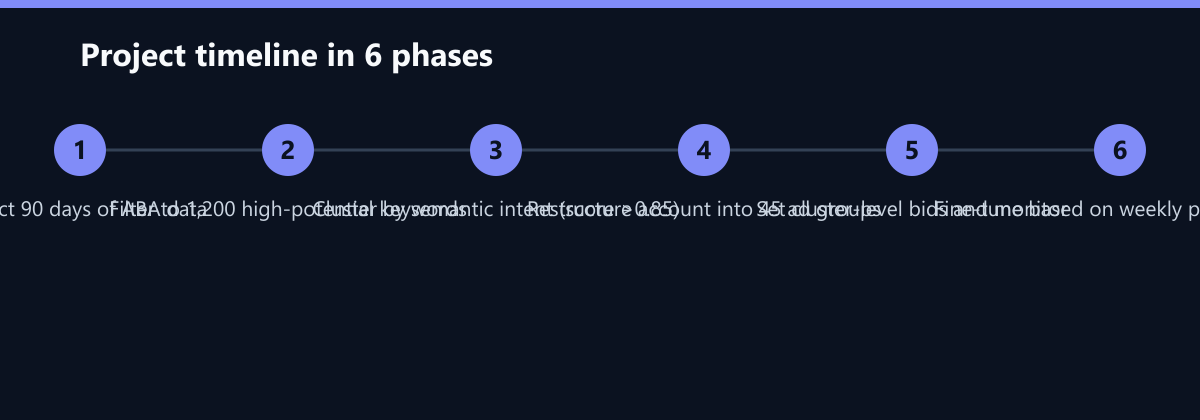
Phase 1: Data Extraction and Cleaning (Weeks 1-2) We began by pulling 90 days of ABA data for the top 5,000 relevant search terms in the beauty category. This raw dataset was noisy, containing irrelevant or low-volume queries that did not contribute to meaningful sales. We applied strict filters to remove terms with insufficient search volume or low conversion potential. This process reduced the dataset from 5,000 terms to a clean list of 1,200 high-potential keywords that represented the core of the brand’s search traffic.
Phase 2: Semantic Clustering (Weeks 3-4) Instead of grouping keywords by simple text similarity, we focused on user intent. We used a semantic clustering algorithm with a similarity score threshold of 0.85 or higher. This allowed us to group keywords that served the same underlying customer need, even if the phrasing was different. For example, “anti-aging serum” and “wrinkle reducer” were grouped into a single “Anti-Aging Intent” cluster. This step reduced the 1,200 keywords into 45 distinct, high-intent clusters.
Phase 3: Campaign Restructuring (Weeks 5-6) With the clusters defined, we rebuilt the ad account structure. Each of the 45 clusters became its own ad group. This was a critical shift: bids were no longer set at the individual keyword level but at the cluster level. This allowed for more stable and accurate bidding, as the system could learn from the collective performance of the cluster rather than struggling with sparse data from single keywords.
Phase 4: Monitoring and Fine-Tuning (Weeks 7-8) The new structure was launched with a phased budget allocation. We monitored performance closely for two weeks, making minor adjustments to bids where clusters underperformed. This fine-tuning phase ensured that the new structure was stable before handing it back to the client team.
The Results
The restructuring delivered significant cost efficiencies within the first month of launch. The new structure eliminated internal keyword competition, allowing bids to become more precise and efficient. By focusing the budget on high-intent clusters, the algorithm could optimize delivery more effectively.
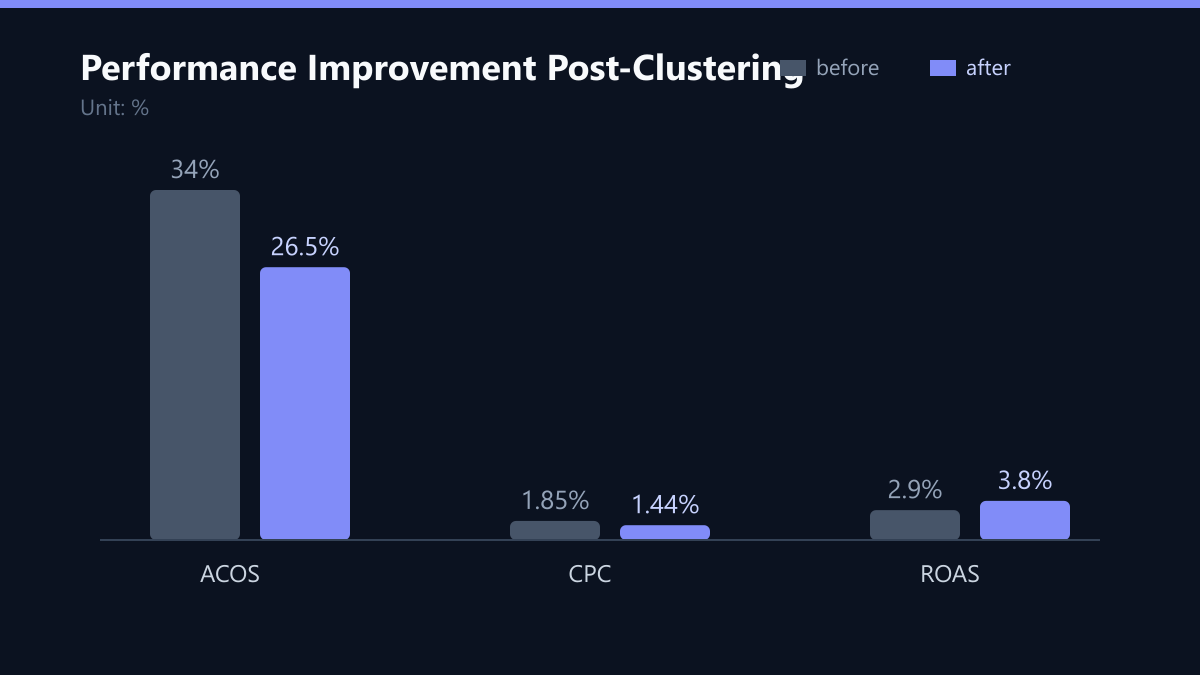
The impact on key performance metrics was immediate and substantial:
- Search Cost Reduction: The average Cost per Click (CPC) dropped by 22%, from €1.85 to €1.44.
- ACOS Improvement: The overall ACOS fell from 34% to 26.5%, bringing the account back in line with the client’s target margin.
- ROAS Increase: Return on Ad Spend rose from 2.9x to 3.8x, a 31% improvement in efficiency.
- Operational Efficiency: The time spent on manual bid management was reduced by 80%, freeing up the team to focus on strategy rather than administration.
Furthermore, the client saw a 15% increase in sales volume from the top 10 clusters. These clusters represented only 20% of the total keyword count, validating the power of focusing on high-intent groups rather than spreading resources thin across long-tail terms.
| Metric | Before | After | Change |
|---|---|---|---|
| ACOS | 34% | 26.5% | -22% |
| CPC | €1.85 | €1.44 | -22% |
| ROAS | 2.9x | 3.8x | +31% |
| Active Clusters | 1,500+ | 45 | -97% |
What We Would Do Differently Today
While the project was a success, there are areas where we would refine the approach if we were to run it again today. First, we would involve the creative team earlier in the process. Aligning ad copy and landing pages with the specific intent of each cluster could have further improved conversion rates. Second, we would have implemented a more automated data pipeline for the quarterly updates. While the manual extraction worked for the initial build, automating this process would reduce the time required for ongoing maintenance and ensure faster reaction times to market shifts.
Lessons Learned
This project highlighted the critical value of structured data analysis in Amazon advertising. Manual keyword management does not scale for mid-market brands seeking efficiency. The key takeaway is that Amazon Brand Analytics is not just a reporting tool but a strategic asset. By linking ABA data to performance metrics, brands can uncover hidden opportunities and eliminate waste.
Another important lesson is that intent matters more than similarity. Grouping keywords by user intent, rather than just text overlap, leads to more accurate bid adjustments and better customer targeting. Finally, less is more. Reducing active keywords from 1,500 to 45 clusters improved focus and allowed the algorithm to work more effectively. The client now uses this clustering model quarterly, updating clusters based on new ABA data to ensure their ad structure stays aligned with evolving market trends. This approach is now a standard part of their digital marketing playbook, providing a sustainable foundation for future growth.