The High Stakes of Affiliate Compliance in Germany
Germany’s regulatory environment for digital marketing is among the strictest in Europe. For businesses running affiliate marketing programs, this creates a unique challenge: the very tools that drive performance, such as tracking pixels and attribution cookies, are often the first point of legal failure. The General Data Protection Regulation (GDPR) and the German Telemedia Act (TMG) are clear: explicit user consent is required before any non-essential data processing occurs.
Many companies operate under the misconception that affiliate tracking is a “marketing necessity” that bypasses standard privacy rules. This is a dangerous error. The Federal Court of Justice has consistently ruled that implied consent, pre-ticked boxes, or “passive” consent (doing nothing) are invalid. If your affiliate tracking script fires before the user interacts with a consent banner, you are processing personal data without a legal basis. The consequences are not just theoretical; they include significant fines, cease-and-desist letters from competitors, and a loss of consumer trust that is difficult to recover.
Why Standard Tracking Methods Are Non-Compliant
Most legacy affiliate platforms rely on immediate script execution. When a user lands on a page, the affiliate tag fires, a cookie is set, and the IP address is logged. In a GDPR context, this sequence is fundamentally flawed. The data processing begins before the legal authorization is granted.
There are three specific pitfalls that make standard setups vulnerable:
- Immediate Script Loading: The tracking code is embedded in the header or footer and executes upon page load, ignoring the state of the consent banner.
- IP Address Logging: IP addresses are considered personal data in the EU. Storing them without a specific legal basis (such as consent or legitimate interest for security) is prohibited.
- Cross-Domain Data Sharing: Affiliate networks often share data with sub-affiliates or third-party analytics tools. Without a valid Data Processing Agreement (DPA) covering this entire chain, you are outsourcing your compliance risk to third parties who may not meet your standards.
The Consent-First Architecture
To solve this, you must shift from a “track-first” to a “consent-first” architecture. This approach ensures that no personal data is touched until the user explicitly says yes. The core component here is a Consent Management Platform (CMP) that integrates directly with your affiliate tracking provider.
The workflow is straightforward but technically demanding. The CMP holds the state of user consent (accepted, rejected, or pending). The affiliate script is configured to listen for this state. It remains dormant until the specific consent category for “Affiliate Tracking” is accepted. Only then does the script initialize, set cookies, and begin attribution.
Implementation Steps
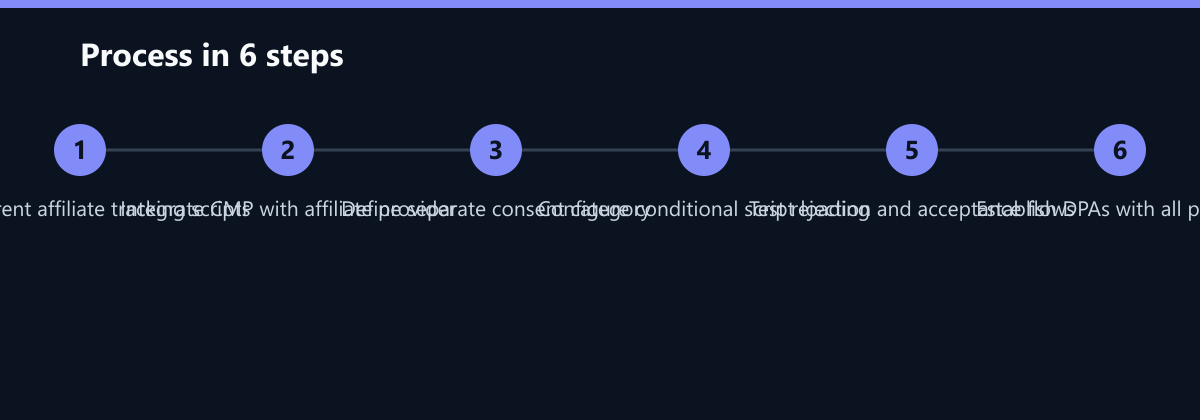
- Audit Current Setup: Identify all affiliate scripts and determine if they are currently firing before consent.
- CMP Integration: Connect your affiliate provider’s API or script to your CMP. Most major platforms now offer native integrations.
- Category Definition: Create a distinct consent category for affiliate tracking. Do not bundle this with general analytics or marketing cookies, as users may accept one but reject the other.
- Conditional Loading: Configure the script to check the consent state before execution. Use a wrapper function that only calls the affiliate tracker if
consentStatus === 'accepted'. - Flow Testing: Manually test the user journey. Verify that if a user rejects consent, no affiliate cookies are set and no data is sent to the network.
Handling Non-Consenting Users
A critical question for performance marketers is: “What happens when users reject consent?” If you rely solely on standard cookies, you lose visibility into a significant portion of your traffic. However, compliance does not require you to go blind. You can maintain performance visibility through alternative methods, though they come with trade-offs.
Server-side tracking is a robust alternative. By processing data on your own servers, you reduce reliance on browser cookies. However, note that server-side tracking still processes personal data. Therefore, it still requires a legal basis. You cannot use server-side tracking to bypass consent requirements; it merely changes the location of processing.
Probabilistic matching offers a solution for non-consenting users. This method uses non-personal data (such as device type, location, or time of day) to estimate conversions. While the compliance risk is low, the accuracy is significantly lower than first-party tracking. It is useful for high-level reporting but insufficient for precise partner payouts.
The table below compares these methods in terms of compliance risk and accuracy:
| Method | Consent Required | Accuracy | Compliance Risk |
|---|---|---|---|
| Standard Cookie | Yes | High | High if no consent |
| Server-Side | Yes | High | Medium if no legal basis |
| Probabilistic | No | Low | Low |
| First-Party Data | Yes | High | Low if managed correctly |
The strategic implication is clear: you must prioritize first-party data strategies. By building direct relationships with customers and encouraging them to opt-in, you create a pool of high-quality, compliant data. This reduces your dependency on third-party cookies and probabilistic estimates, leading to more stable and legally secure performance metrics.
Technical Requirements for Partner Programs
Beyond the frontend implementation, the backend architecture must support granular control. Your affiliate network must be able to respect the Do Not Track signal where applicable and support delayed initialization. More importantly, you need robust data governance.
Key technical requirements include:
- Delayed Initialization: The tracker must wait for the consent signal. This requires a JavaScript snippet that checks the CMP state before loading the affiliate script.
- Data Deletion Mechanisms: Users have the right to erasure. You must have a process to delete affiliate data associated with a user upon request. This often requires a ticketing system that triggers API calls to the affiliate network.
- Access Control: Restrict access to affiliate data to authorized personnel only. Use role-based access controls (RBAC) to ensure that only marketing and legal teams can view detailed partner data.
- Audit Logs: Maintain detailed records of consent and data processing activities. In the event of a regulatory inquiry, these logs are your primary evidence of compliance.
Typical Mistakes to Avoid
Even with a solid strategy, implementation errors can lead to non-compliance. Here are the most common mistakes we see:
- Bundling Consent Categories: Placing affiliate tracking under a general “Marketing” category. Users may reject marketing cookies but accept analytics. If you bundle them, you are either over-collecting data (if they accept) or under-collecting (if they reject), both of which are problematic.
- Ignoring Sub-Affiliates: Focusing only on the primary affiliate network. If your partners use sub-affiliates or tracking tools that are not covered by your DPA, you are still liable for their data processing.
- Lack of Testing: Assuming that the CMP integration works without testing edge cases. Always test the “reject” flow to ensure no cookies are set. A single non-compliant cookie can trigger a cease-and-desist order.
How You Measure Success
Compliance is often viewed as a cost center, but it is actually a performance driver. Here is how you measure the success of your compliant affiliate program:
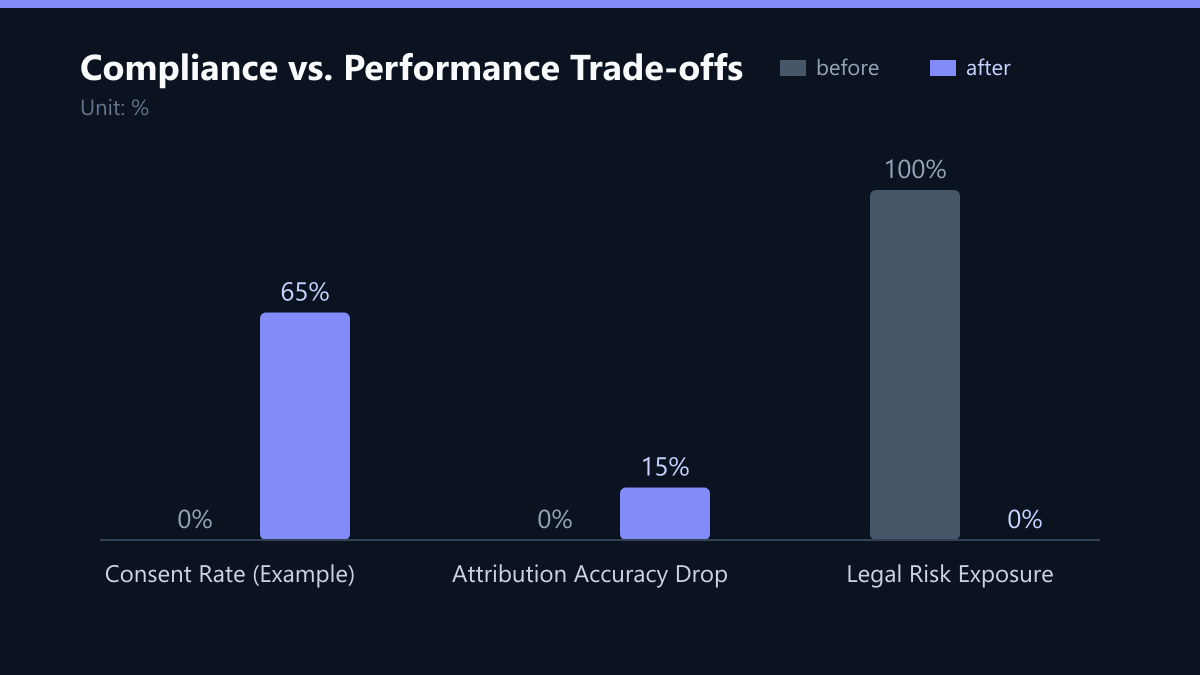
- Consent Rate: Track the percentage of users who accept affiliate tracking. A high consent rate (e.g., 60-70%) indicates trust and transparency. If your rate is low, review your consent banner copy and placement.
- Attribution Accuracy Drop: Compare your conversion data before and after implementing consent-first tracking. You will likely see a drop in total tracked conversions (due to non-consenting users). The key metric is the quality of the remaining data. If your cost-per-acquisition (CPA) remains stable or improves, your compliant setup is working.
- Legal Risk Exposure: This is a binary metric. If you have zero cease-and-desist letters and zero regulatory inquiries, your risk exposure is minimized. Regularly audit your setup to ensure ongoing compliance.
Checklist for Compliance
Before launching your affiliate program, ensure you have completed the following:
- Audited all affiliate scripts for immediate execution.
- Integrated CMP with affiliate provider.
- Created a distinct consent category for affiliate tracking.
- Configured conditional loading of affiliate scripts.
- Tested rejection and acceptance flows.
- Established DPAs with all affiliate partners and sub-affiliates.
- Implemented data deletion mechanisms.
- Set up audit logs for consent and data processing.
By following these steps, you can build an affiliate program that is not only compliant with German law but also more transparent and trustworthy for your users. Compliance is not a barrier to performance; it is the foundation for sustainable growth in a privacy-conscious market.