The Stagnant Pipeline
The client, an Italian provider of IoT software for manufacturing, was experiencing a severe bottleneck in their sales pipeline. Despite a strong product and a growing market demand for Industry 4.0 solutions, organic lead generation had become prohibitively expensive. The website conversion rate had dropped below 1.5 %, and the sales team was drowning in low-quality inquiries. Many of these leads came from end customers or small businesses that did not fit the target profile of mid-sized manufacturers. The core problem was a lack of qualification. Marketing and sales had no shared definition of what constituted a “qualified” lead, resulting in a high volume of unproductive conversations and a low close rate. The objective was clear: generate 200 qualified demos within 90 days, focusing specifically on decision-makers in the manufacturing sector in Italy and Spain.
The Challenges
Several structural issues hindered previous marketing efforts. First, the target audience was too broad. Previous campaigns targeted generic “manufacturing” keywords without filtering for company size or specific job titles, leading to a high cost per click (CPC) and low relevance. Second, there was no effective lead nurturing mechanism. Once a lead downloaded a whitepaper, there was no automated follow-up, leaving potential customers to go cold. Third, the lead scoring model was static. It relied solely on demographic data, failing to capture intent signals such as content engagement or product page visits. Finally, regional nuances were ignored. The campaign used generic English-language messaging, which failed to resonate with local decision-makers in Italy and Spain who preferred personalized, locally relevant content.
The Tech Stack
- LinkedIn Ads: Used for precise B2B targeting based on job titles, company size, and industry.
- CRM Platform: HubSpot (or equivalent) for lead management and automated journey orchestration.
- Marketing Automation: Integrated with the CRM to trigger emails and tasks based on lead scores.
- UTM Tracking & GA4: For accurate attribution of traffic sources and conversion events.
- Custom Lead Scoring Model: A dynamic algorithm implemented within the CRM to assign scores based on behavioral data.
Implementation
We began by defining the Ideal Customer Profile (ICP) in detail. The target audience was narrowed down to CTOs, Ops Managers, and Digitalization Leads at companies with 50 to 500 employees in the manufacturing industry. This precision allowed us to reduce wasted ad spend and increase relevance. We then built a multi-stage LinkedIn campaign structure, moving away from single-funnel ads to a cohesive journey.
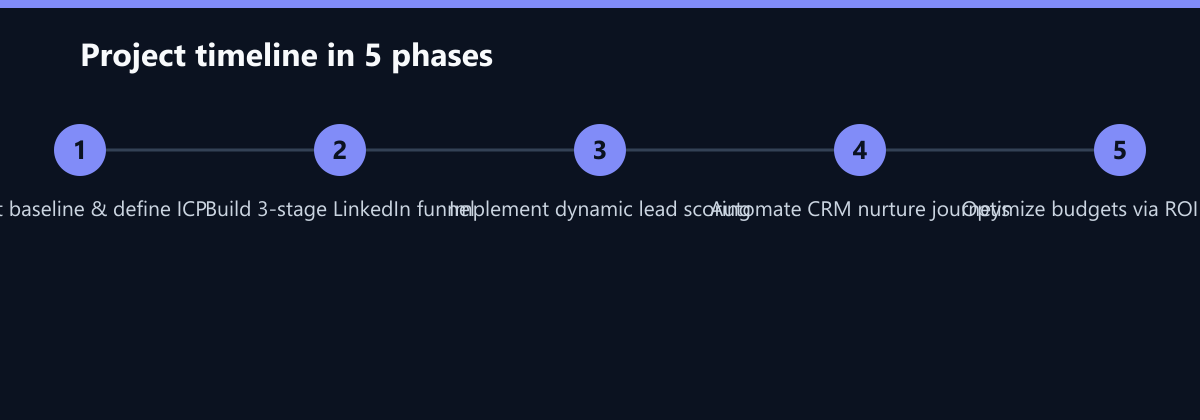
The first stage, Awareness, utilized video ads featuring case studies from the manufacturing industry. These videos highlighted specific pain points and solutions, designed to stop the scroll and establish credibility. The second stage, Consideration, employed document ads offering whitepapers and technical guides. These assets served as lead magnets, requiring users to provide their contact information in exchange for valuable content. The third stage, Conversion, focused on retargeting. Users who had downloaded content or engaged with the website were shown retargeting ads encouraging them to book a demo. This sequence ensured that prospects were nurtured through the buyer’s journey rather than being bombarded with a single call to action.
Parallel to the ad campaign, we implemented a dynamic lead scoring model. This was a critical shift from previous approaches. Instead of scoring leads based solely on demographics or clicks, the model evaluated interaction behavior. High scores were awarded to users who consumed three or more pieces of content, visited product pages, and engaged with pricing information. This behavioral data provided a much clearer picture of intent. Automated journeys in the CRM platform were then set up to nurture leads based on their score. High scorers received an immediate, personalized email from a sales representative, ensuring quick follow-up. Low scorers entered a 30-day nurturing series with technical details and educational content, designed to move them up the funnel over time.
How We Measured It
To ensure transparency and accuracy, we established a robust measurement framework before the campaign launched. We defined “qualified demo” as a meeting booked with a decision-maker who met the ICP criteria and expressed interest in a solution. Cost per lead (CPL) was calculated as total ad spend divided by the number of qualified leads. The qualification rate was measured as the percentage of leads that met the sales criteria out of all leads generated. Website conversion rate was tracked using GA4, measuring the percentage of visitors who completed a desired action, such as booking a demo or downloading a whitepaper. We also monitored pipeline generation by tracking the value of opportunities created in the CRM that were directly attributed to the campaign. This data was reviewed weekly, allowing us to make data-driven adjustments to targeting, messaging, and budget allocation.
Results
After 90 days, the campaign achieved its primary goal of 200 qualified demos. The cost per lead was 45 €, which was 30 % below the previous average of 65 €. This significant reduction in cost was driven by the improved targeting and the higher conversion rate. The qualification rate increased from 20 % to 65 %, indicating that the leads were much more aligned with the target profile. The sales team reported that 80 % of leads were already informed about the solution before the first contact, thanks to the effective nurturing journeys. This pre-education saved significant time in the sales process and increased the likelihood of closing deals. The website conversion rate also improved from 1.2 % to 4.8 %, reflecting the higher quality of traffic and the effectiveness of the landing pages. Pipeline generation tripled within the quarter, demonstrating the direct impact of the campaign on revenue. The combination of precise LinkedIn targeting and dynamic lead scoring was crucial for this efficiency.
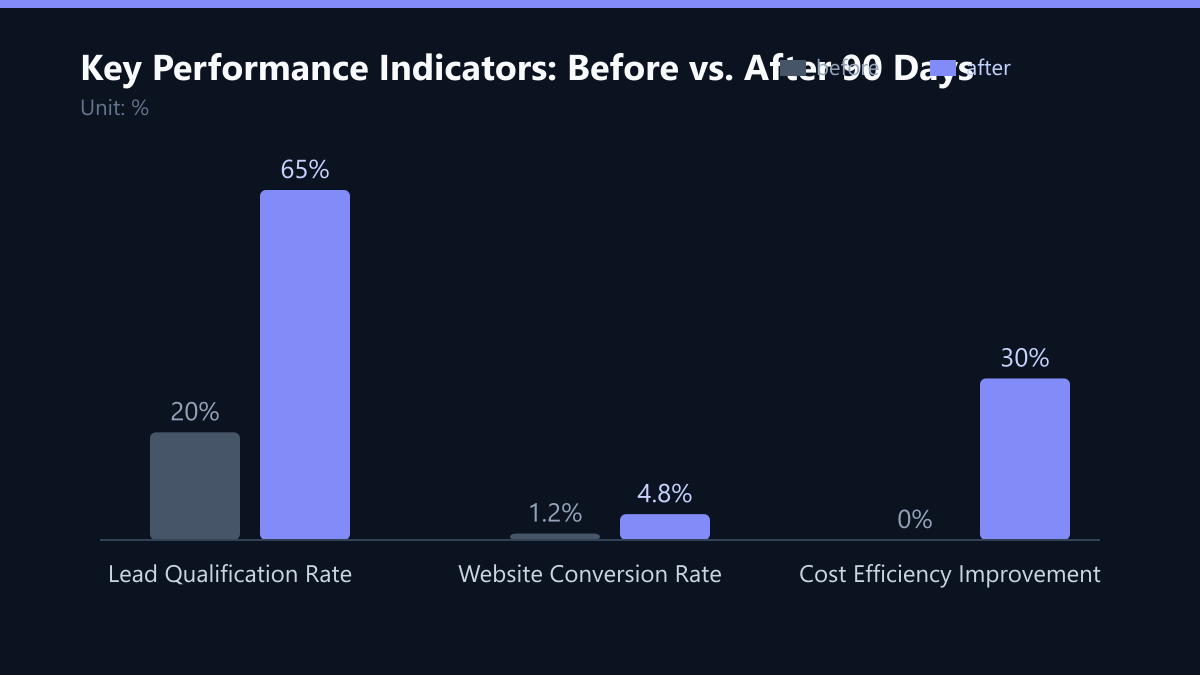
| Metric | Before | After 90 Days |
|---|---|---|
| Qualified Demos | 45 | 200 |
| Cost per Lead | 65 € | 45 € |
| Conversion Rate | 1.2 % | 4.8 % |
| Qualification Rate | 20 % | 65 % |
Lessons Learned
The success of this campaign highlighted several key takeaways. First, linked campaigns only work with clear stages. Without a distinct separation between awareness, consideration, and conversion, budget is wasted on users who are not ready to buy. Each stage requires specific messaging and assets to guide the prospect effectively. Second, lead scoring must be sales-aligned. The criteria for qualification were defined jointly with the sales team, ensuring that “qualified” held the same value for both marketing and sales. This alignment prevented friction and ensured that the sales team was working with high-intent leads. Third, regional adaptation is mandatory. In Southern Europe, decision-makers respond more strongly to personalized outreach and local case studies than to generic messages. The campaign was localized, and regional references were included, which significantly improved engagement. Finally, measurability beats intuition. By tightly coupling LinkedIn events and CRM data, we were able to track ROI development per target group in real time. This allowed us to dynamically shift budgets to the most performing segments, maximizing efficiency and return on investment.
What We Would Do Differently Today
Reflecting on the campaign, there are a few areas where we could improve. First, we would have implemented more advanced lookalike audiences earlier in the process. While the initial targeting was precise, expanding into lookalike audiences based on high-performing segments could have further increased reach and potentially lowered CPL even more. Second, we would have invested more in A/B testing of video ads. While the video ads performed well, testing different lengths, formats, and hooks could have provided deeper insights into what resonates best with the target audience. Third, we would have integrated more social proof elements, such as customer testimonials and reviews, into the consideration stage. This could have further built trust and reduced the sales cycle for hesitant prospects.
Passend dazu
- Performance Marketing
- SEO & AI Search (GEO)
- Affiliate Marketing
- Content & CRO
- CRM Marketing
- B2B Industry: 34% CPA Reduction Through Dynamic Google Ads Campaigns and HubSpot Attribution in the DACH Region
- Automated Campaign Management: 40% ROAS Increase for a DACH Industry Supplier Through Dynamic Budget Allocation in Amazon DSP