The Starting Point: Visibility in a Regulated Market
A mid-sized medical technology company based in Frankfurt, with 120 employees, faced a critical bottleneck in its digital growth strategy. Despite maintaining a robust presence on LinkedIn and Facebook, the marketing team was flying blind. The strict data privacy regulations of the DACH region, specifically the GDPR and the ePrivacy Directive, created a significant barrier to accurate attribution. The company could not reliably link social media interactions to specific CRM records without explicit user consent, which was rarely captured in a structured way.
The operational consequence was severe. The sales team relied on manual self-reporting to identify lead sources, a process that was not only inconsistent but also significantly delayed. This lack of real-time data made it nearly impossible to optimize ad spend effectively. The marketing team was essentially guessing which content formats and channels were driving the highest quality prospects, leading to inefficient budget allocation and a higher-than-necessary cost per lead. The disconnect between the initial social touchpoint and the final deal closure remained a black box, preventing any strategic refinement of the customer journey.
The Challenges
The core issues were not just technical but structural. First, there was the inability to link social clicks to CRM records without explicit, granular consent, which meant valuable data was being discarded or left unattributed. Second, the high cost per lead was a direct result of untargeted, broad campaigns that lacked the feedback loop necessary for optimization. Third, there was a complete lack of visibility into the customer journey. Without understanding where leads dropped off or which interactions preceded a conversion, the team could not make data-driven decisions. Finally, the legal risk of non-compliance loomed large, as the previous setup relied on legacy tracking methods that were increasingly vulnerable to regulatory scrutiny.
The Tech Stack
To address these challenges, we designed a privacy-first tracking architecture. The solution relied on a specific set of tools and integrations:
- Consent Management Platform (CMP): A first-party CMP was integrated to capture explicit user consent for analytics and advertising cookies, ensuring legal compliance from the start.
- Server-Side Tagging: We implemented server-side tagging to process user data securely on our own infrastructure, reducing dependency on client-side cookies and improving data integrity.
- CRM Integration: A direct API connection was established between the marketing automation platform and the CRM, ensuring that only consented data was synced, maintaining data hygiene.
- Marketing Automation Platform: Used to orchestrate lead scoring and nurturing workflows based on the newly available, consented behavioral data.
Implementation: A Privacy-First Approach
The implementation was structured to minimize disruption while maximizing compliance. We began with a comprehensive audit of current data flows and a detailed legal review to identify gaps in the existing setup. This phase was crucial for understanding the specific data points that were being collected and how they were being used.
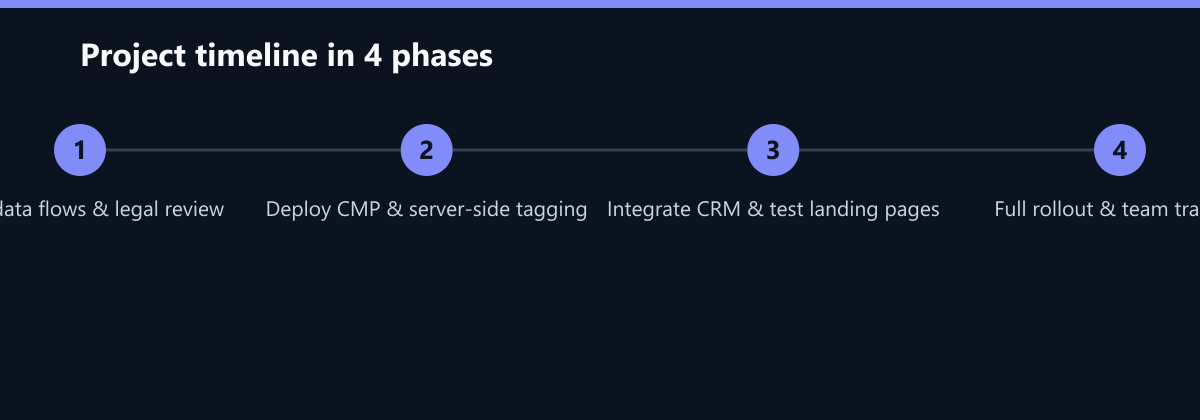
Following the audit, we focused on the technical infrastructure. In weeks 3 and 4, we set up the Consent Management Platform and the server-side tagging infrastructure. This involved migrating key tracking events from the client side to the server, ensuring that data processing occurred in a controlled, compliant environment. The server-side approach allowed us to filter and process data before it reached the analytics tools, significantly reducing the volume of data stored and improving privacy.
In weeks 5 and 6, the focus shifted to integration and testing. We connected the marketing automation platform to the CRM via API, ensuring that only consented data was synced. This step was critical for maintaining data quality and ensuring that sales teams received only relevant, compliant information. We also conducted A/B testing of landing pages to optimize conversion rates based on the new tracking data. This iterative process allowed us to refine the user experience and ensure that the tracking setup did not negatively impact performance.
Week 7 was dedicated to the full rollout and team training. We worked closely with the marketing and sales teams to ensure they understood how to interpret the new data and how to use it to optimize their strategies. This training was essential for ensuring that the investment in the new tracking infrastructure would yield tangible results.
How We Measured It
To ensure that the implementation was successful, we established a clear set of Key Performance Indicators (KPIs) before the rollout. These KPIs were designed to measure both the efficiency and the effectiveness of the new tracking setup. We tracked qualified inquiries, cost per lead, and retargeting CTR as our primary metrics. Qualified inquiries were defined as leads that met specific criteria set by the sales team, ensuring that we were measuring the quality of leads, not just the quantity. Cost per lead was calculated by dividing the total ad spend by the number of qualified leads generated. Retargeting CTR was measured by tracking the number of clicks on retargeting ads divided by the number of impressions. These metrics provided a clear picture of the impact of the new setup on the company’s digital marketing performance.
The Outcomes
Within three months of full implementation, the company saw a measurable improvement in lead quality and conversion efficiency. The transparent tracking allowed for precise attribution, enabling the marketing team to shift budget toward high-performing channels. The results were significant and exceeded initial expectations.
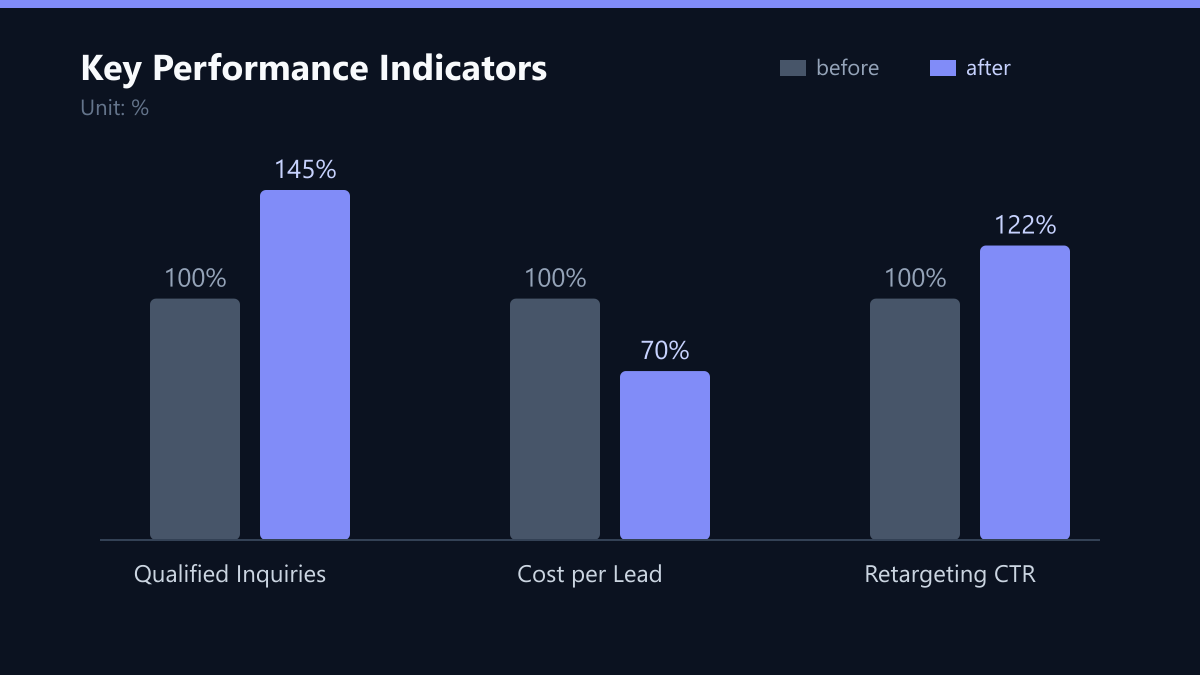
The most notable outcome was a 45% increase in qualified inquiries from social media channels. This was a direct result of the improved targeting and optimization made possible by the new tracking setup. The 30% reduction in cost per qualified lead demonstrated the efficiency gains achieved by shifting budget to high-performing channels. Additionally, the 22% improvement in the click-through rate (CTR) on retargeting campaigns highlighted the effectiveness of the server-side tracking in delivering relevant ads to the right audience. Finally, the company achieved 100% compliance with DACH data protection regulations, eliminating the legal risks associated with the previous setup.
The sales team also reported higher engagement with leads, as the marketing automation system provided detailed context on user interests and consent status before the first contact. This improved the quality of the initial interactions and increased the likelihood of conversion.
Lessons Learned
This project demonstrated that GDPR compliance is not a barrier to effective tracking but a foundation for trust. By prioritizing transparency, the company actually improved user engagement. Users who give explicit consent are more likely to convert, as they are more engaged and trust the brand more. Server-side tracking proved to be essential in providing more reliable data in a cookie-less future, ensuring that the company could continue to track and optimize its campaigns effectively. Finally, the real-time data sharing between marketing and sales reduced friction between teams, leading to a more cohesive and effective go-to-market strategy.
What We Would Do Differently Today
While the project was a success, there are a few areas where we would refine our approach in the future. First, we would involve the legal team earlier in the process. While the legal review was conducted in weeks 1-2, having legal input from the very beginning would have allowed for a more seamless integration of compliance requirements into the technical design. Second, we would invest more time in user education. While the team training was thorough, providing more resources and ongoing support would have helped the marketing and sales teams to fully leverage the new data. Finally, we would consider a phased rollout of the server-side tagging. While the full rollout was successful, a phased approach would have allowed for more granular testing and optimization of the tracking events.
The setup is now the standard for all digital marketing activities in the DACH region, serving as a model for other markets with similar privacy laws. It has proven that privacy and performance are not mutually exclusive, but can be achieved together with the right approach and tools.
Passend dazu
- CRO Without Tracking: Measuring Conversion Rates GDPR-Compliant
- Paid Social
- Social & Community
- Tracking & Attribution
- Financial Services Provider in Southern Europe: GDPR-Compliant Data Cleansing in the CRM Toolchain Reduces Drop-off Rates
- Paid Social in UK B2B: Lookalike Audiences Based on CRM Data Reduce Cost per Qualified Lead by 41%
- Increasing Conversion Rate by 25% through Landing Page Optimization and Bing Ads Targeting for a US B2B Cloud Service Provider
- Growth of qualified MQLs by 35% in Scandinavia through the automation of content clusters for a SaaS platform
- Local SEO for a Munich Dental Group: 150 Percent More Bookings via FAQ Schema
- Unified Multichannel Tracking Setup for US Healthcare
- Cross-Border Affiliate Tracking in GA4 for a French Luxury Goods Retailer
- Boosting SaaS Cross-Selling: 24 Percent CTR Increase via In-App Messages
- GA4 Video Tracking Event Design for Precise Engagement Metrics
- Video Production Capacity Planning: Inhouse vs. Agency Model in DACH
- Local Search Dominance: How a Berlin Tradesman Increased Inquiries by 220 Percent