The Contextual Shift in Search
Search engines are moving beyond simple keyword matching. Generative AI models now parse semantic meaning to generate direct answers. This shift changes how visibility is achieved in search results. Traditional SEO focused on ranking for specific terms. AI-Overviews require your content to be understood as a factual entity. Without structured data, algorithms guess your intent. This leads to lower inclusion rates in AI-generated summaries.
Key Insight: Your content must be machine-readable, not just human-readable. Schema Markup bridges this gap by explicitly defining entities, relationships, and actions. For B2B SaaS and mid-market teams, this is no longer optional. It is the primary mechanism for ensuring your product is recognized as a distinct, citable entity in the eyes of large language models.
Why LLMs Demand Structured Data
Large Language Models (LLMs) rely on high-confidence signals to cite sources. Unstructured text creates ambiguity. Schema Markup removes this ambiguity by providing a standardized vocabulary. When an AI model encounters a product or service, it looks for specific properties. These include pricing, availability, and specifications. If these fields are missing, the model may exclude your page from the answer.
- Entity Recognition: Clearly defines what your product or service is.
- Relationship Mapping: Shows how your offering connects to other entities.
- Fact Verification: Provides verifiable data points for AI citation.
Action Item: Audit your current schema implementation. Ensure it covers all core entities mentioned in your top-performing pages. Do not rely on auto-generated meta tags. They often lack the granularity required for AI comprehension.
Core Schema Types for B2B and SaaS
Not all schema types are equally relevant for B2B contexts. Focus on types that describe business logic and technical capabilities. Avoid generic tags that do not add semantic value.
SoftwareApplication: Essential for SaaS products. Include features, operating systems, and user interactions. This is the primary key for SaaS visibility.
Product: Use for tangible goods or specific service packages. Define offers, pricing, and aggregate ratings. Ensure prices match your checkout page exactly.
Organization: Establishes your brand authority. Include contact points, sameAs links, and logo URLs. This helps AI understand who you are beyond just what you sell.
FAQPage: Directly feeds into AI-Overviews for common questions. Ensure questions are unique and answers are concise. Avoid duplicating questions across multiple pages.
| Schema Type | Primary Use | Key Properties |
|---|---|---|
| SoftwareApplication | SaaS Platforms | featureList, operatingSystem, offer |
| Product | Service Packages | name, description, offers, aggregateRating |
| Organization | Brand Authority | name, logo, sameAs, contactPoint |
| Article | Thought Leadership | headline, author, datePublished, publisher |
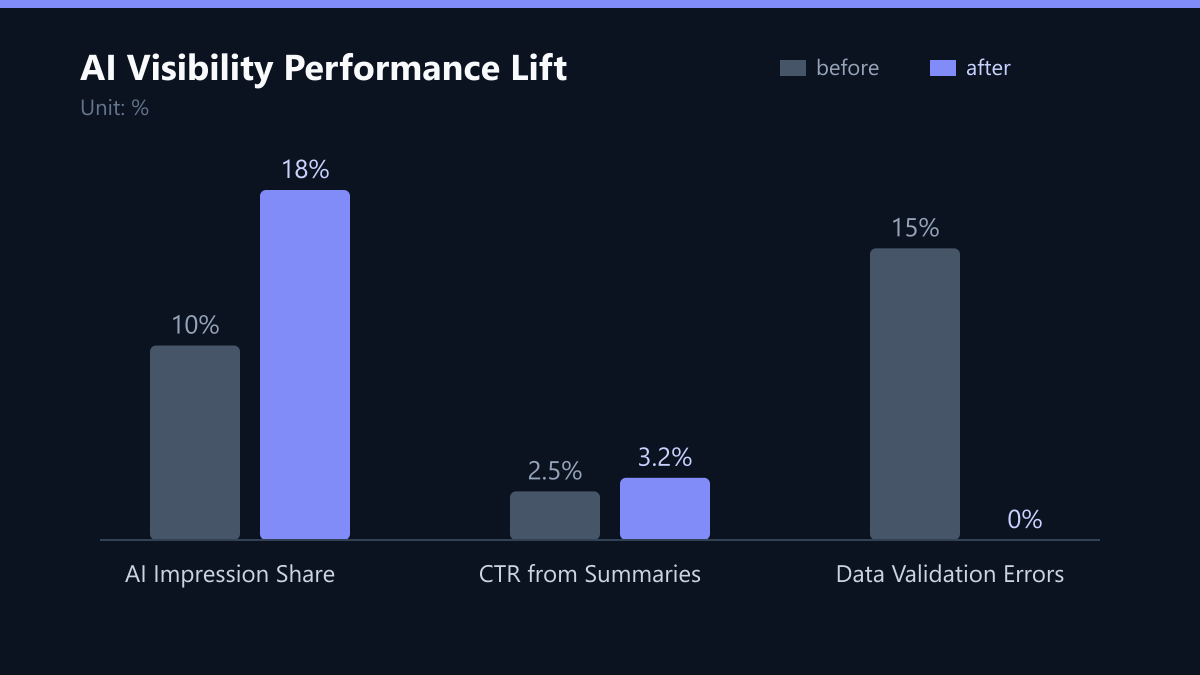
Note: Avoid over-using generic types. Specificity improves AI comprehension. A vague ‘Service’ tag is less effective than a specific ‘SoftwareApplication’ tag with defined features.
Implementation Best Practices
Correct implementation is critical for validation. Use JSON-LD format for easy integration and parsing. It is the most robust format for dynamic content and server-side rendering.
- Place in Head: Insert JSON-LD scripts in the HTML head section.
- Validate First: Use Google’s Rich Results Test and Schema.org validators.
- Keep it Clean: Remove unused properties. Redundant data confuses models and can lead to lower confidence scores.
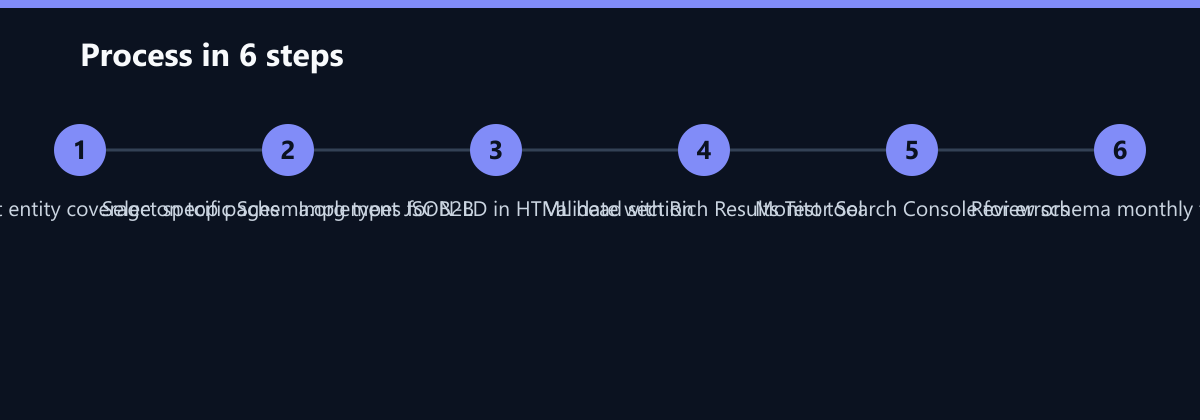
Step-by-Step Process:
- Identify the primary entity on the page.
- Select the appropriate Schema.org type.
- Populate required and recommended properties.
- Add JSON-LD to the page head.
- Validate with testing tools.
- Monitor search console for errors.
Warning: Do not use schema to misrepresent content. Inconsistencies between visible text and structured data can lead to manual penalties. Always ensure that the data in your schema matches what the user sees on the page.
Typical Mistakes to Avoid
Many teams make critical errors in schema implementation. These errors reduce trust and visibility.
- Inconsistent Data: Mismatched prices or availability between schema and page content. This is the most common error. If your schema says ‘In Stock’ but the page says ‘Out of Stock’, AI models will flag this as low-confidence data.
- Missing Required Properties: Incomplete schemas fail validation and are ignored. Ensure all required fields for your chosen schema type are populated.
- Over-Optimization: Adding excessive schema tags without relevance. Do not add schema for entities that are not the primary focus of the page.
- Ignoring Updates: Failing to update schema when content changes. If you change your pricing model, you must update your schema immediately.
Solution: Implement a QA process for schema updates. Assign ownership to content teams. Review schema alongside page content during updates. Use automated tools to detect schema drift. Set up alerts for validation errors in your CMS.
How You Measure Success
Tracking AI-Overview performance requires new metrics. Traditional rankings are no longer sufficient. You need to look at how often your site is cited in generative answers.
Metrics to Monitor:
- Impression Share in AI Overviews: Track how often your site is cited. This is your primary KPI. Aim for a 15-20% increase in impressions from non-traditional search results within six months of optimization.
- Click-Through Rate (CTR): Measure clicks from AI-generated summaries. This indicates user intent and satisfaction with the answer.
- Brand Mentions: Monitor unbranded queries where your brand appears. This shows how well AI associates your brand with specific topics.
Tools like Semrush, Ahrefs, and specialized AI SEO platforms provide insights into generative search performance. Compare data monthly to identify trends. Do not rely on a single tool. Cross-reference data from at least two sources to ensure accuracy.
Benchmark: Aim for a 15-20% increase in impressions from non-traditional search results within six months of optimization. If you do not see this lift, revisit your entity coverage and data consistency.
Checklist for Implementation
- Audit: Review all top 20 landing pages for existing schema.
- Map: Define the primary entity for each page.
- Implement: Add JSON-LD scripts with required properties.
- Validate: Run all pages through Google’s Rich Results Test.
- Monitor: Set up Search Console alerts for schema errors.
- Review: Schedule monthly schema reviews with content teams.
By following this structured approach, you ensure that your content is not just visible, but verifiable. In the age of AI search, verifiability is the new ranking factor.