The Legal Reality of Exit-Intent in the DACH Region
Exit-intent technology operates on a simple premise: detecting when a user moves their cursor towards the browser’s close button. This micro-interaction triggers a modal window before the user leaves. While effective for capturing departing traffic, this specific mechanism carries significant legal weight in the DACH region. The core risk is not the popup itself, but the data processing that enables it. Under GDPR, the timing of consent and the nature of the data collected are critical. Many organizations assume that ‘non-identifiable’ behavioral data is safe. This is a dangerous misconception. Combining exit-intent signals with IP addresses or browser fingerprints creates a profile, which constitutes personal data. Therefore, the implementation must be technically separated from data collection until explicit consent is given. The legal baseline requires prior consent for tracking scripts, strict data minimization, and full transparency in privacy policies. You cannot deploy scripts that analyze user behavior without explicit permission. The solution is not to avoid exit-intent, but to engineer it with privacy by design.
Decoupling Detection from Data Processing
To remain compliant, you must decouple the detection mechanism from the data processing logic. The standard compliant approach involves a two-stage technical workflow. First, a lightweight, consent-free script monitors cursor movement. Second, only after the user provides consent, the full popup and data collection functionality activate. This separation ensures that no personal data is processed without permission.
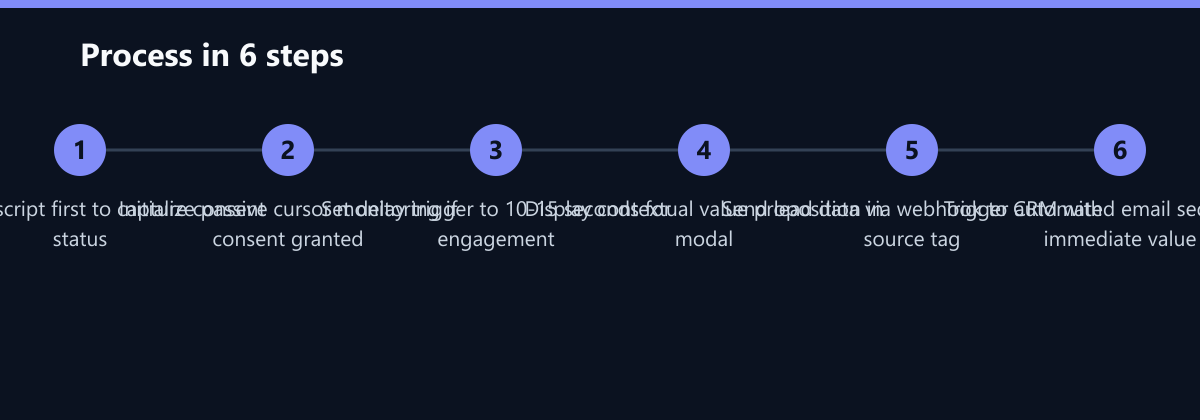
The Compliant Technical Workflow:
- Load Consent Management Platform (CMP) First: Ensure your CMP (e.g., Cookiebot, OneTrust) is the first script to load. It must establish the consent status before any other marketing scripts initialize.
- Passive Monitoring: If consent is denied, do not load the exit-intent library. If consent is granted, initialize the library in a passive mode that only monitors cursor position without storing data.
- Delayed Execution: The exit-intent trigger should only fire if the user has already interacted with the consent banner or if the CMP confirms valid consent for marketing analytics. This prevents any data processing before the legal basis is established.
Critical Configuration Parameters:
- No IP Logging: Ensure your marketing automation tool does not log IP addresses for exit-intent events if the user has not consented to profiling. Disable IP logging in your server settings for these specific events.
- Session Data Only: Use session-based data that expires immediately after the browser is closed. This reduces long-term data retention risks and aligns with data minimization principles.
- Server-Side Validation: Validate that the consent flag is true on the server side before triggering the popup API call. Client-side checks can be bypassed; server-side validation ensures integrity.
This setup ensures that you are not tracking user behavior for marketing purposes without permission. It aligns with the principle of ‘privacy by design’ mandated by the GDPR. By implementing these technical safeguards, you mitigate legal risk while maintaining the effectiveness of your lead generation strategy.
B2B Context: Value Over Interruption
In B2B SaaS, the sales cycle is longer and the decision-making process involves multiple stakeholders. Exit-intent popups must respect this context. Aggressive, consumer-style popups often lead to negative brand perception in professional environments. The goal is to provide value, not to interrupt. B2B buyers are rational decision-makers who prioritize insight and proof over discounts. Your popup content must reflect this mindset.
Best Practices for B2B Content Strategy:
- Lead Magnets Over Discounts: Offer a whitepaper, case study, or technical guide instead of a 20% discount. B2B buyers respond to insight and proof. A discount implies a commodity; a whitepaper implies expertise.
- Contextual Relevance: If the user is on the pricing page, offer a comparison sheet. If they are on a blog post about ‘CRM Integration,’ offer a technical implementation guide. Contextual relevance increases the perceived value of the offer.
- Clear Value Proposition: The headline must state the benefit clearly. Example: ‘Get the 2024 Benchmark Report for SaaS Metrics’ rather than ‘Wait, don’t go!’. Specificity builds trust.
Timing and Frequency Controls:
- Delay Trigger: Do not show the popup immediately when the cursor moves. Wait for 10-15 seconds of dwell time to ensure the user has engaged with the content. This signal indicates intent rather than accidental mouse movement.
- Frequency Capping: Show the popup only once per session. Repeated interruptions increase bounce rates and frustrate potential clients. Use a local storage flag to track session interactions.
- Mobile Adaptation: On mobile devices, exit-intent is less reliable due to lack of cursor data. Use scroll depth or time-on-page as alternative triggers for mobile popups. For example, trigger the popup when a user reaches 70% scroll depth or stays on the page for 60 seconds.
Integrating Leads into Your CRM Workflow
Capturing the lead is only the first step. The real value lies in integrating this event into your CRM and marketing automation workflows. This allows for immediate, personalized follow-up. Without integration, the lead data remains an isolated data point with low conversion potential. A closed-loop system ensures that every lead receives the promised content and enters a nurturing journey.
Workflow Integration Steps:
- Form Submission: The popup contains a short form (Name, Company, Email). Keep fields minimal to reduce friction. Each additional field reduces conversion rates by approximately 10-15%.
- Webhook Trigger: Upon submission, send the data via webhook to your CRM (e.g., HubSpot, Salesforce). This ensures real-time data transfer without manual intervention.
- Lead Scoring Update: Increment the lead score based on the source. An exit-intent lead who downloaded a whitepaper is often hotter than a passive newsletter subscriber. Adjust your scoring model to reflect this higher intent.
- Automated Journey: Trigger an email sequence that delivers the promised content immediately, followed by a soft sales pitch after 3 days. This timing respects the user’s decision-making process while maintaining engagement.
Data Hygiene and Deduplication:
- Deduplication: Ensure the CRM checks for existing contacts before creating new ones. If the email exists, update the ‘last interaction’ field instead of duplicating the record. Duplicates pollute your data and complicate reporting.
- Source Tagging: Tag the lead source as ‘Exit-Intent-[Page Name]’ to measure ROI accurately. This helps you identify which pages generate the highest quality leads. For example, ‘Exit-Intent-Pricing’ may yield different quality than ‘Exit-Intent-Blog-CRM’.
- Consent Status: Store the consent status from the CMP alongside the lead data. This ensures that future email campaigns are only sent to users who have opted in. Non-compliant email sending is a major GDPR violation.
This closed-loop system allows you to measure the true impact of your exit-intent strategy on pipeline generation. It transforms a simple popup into a strategic lead generation asset.
Typical Mistakes That Kill Conversion
Many companies fail to see results from exit-intent popups due to implementation errors or poor UX design. Understanding these common mistakes helps you avoid wasting resources. Here are the most frequent errors we see in DACH B2B environments:
- Ignoring Mobile Users: Relying solely on cursor movement ignores 50-70% of traffic on mobile. Implement alternative triggers for mobile devices. If your mobile traffic is significant, a cursor-only approach will miss the majority of your potential leads.
- Blocking Content: Designing popups that cover the entire screen or prevent scrolling frustrates users. Use side panels or bottom bars that do not obstruct the main content. Users should be able to close the popup and continue browsing without friction.
- Vague CTAs: Buttons like ‘Submit’ or ‘OK’ are weak. Use action-oriented text like ‘Send Me the Guide’ or ‘Start Free Trial.’ The CTA should reflect the value proposition. A vague CTA reduces click-through rates by up to 30%.
- Lack of Contextual Relevance: Showing the same generic popup on every page reduces relevance. Tailor the offer to the page context. A user on a pricing page has different needs than a user on a blog post. Generic offers are ignored.
How You Measure Success
To justify the investment in exit-intent technology, you must track specific KPIs. General website metrics are not enough. You need to isolate the impact of the popups on lead quality and revenue. Here are the concrete KPIs and methods to measure success:
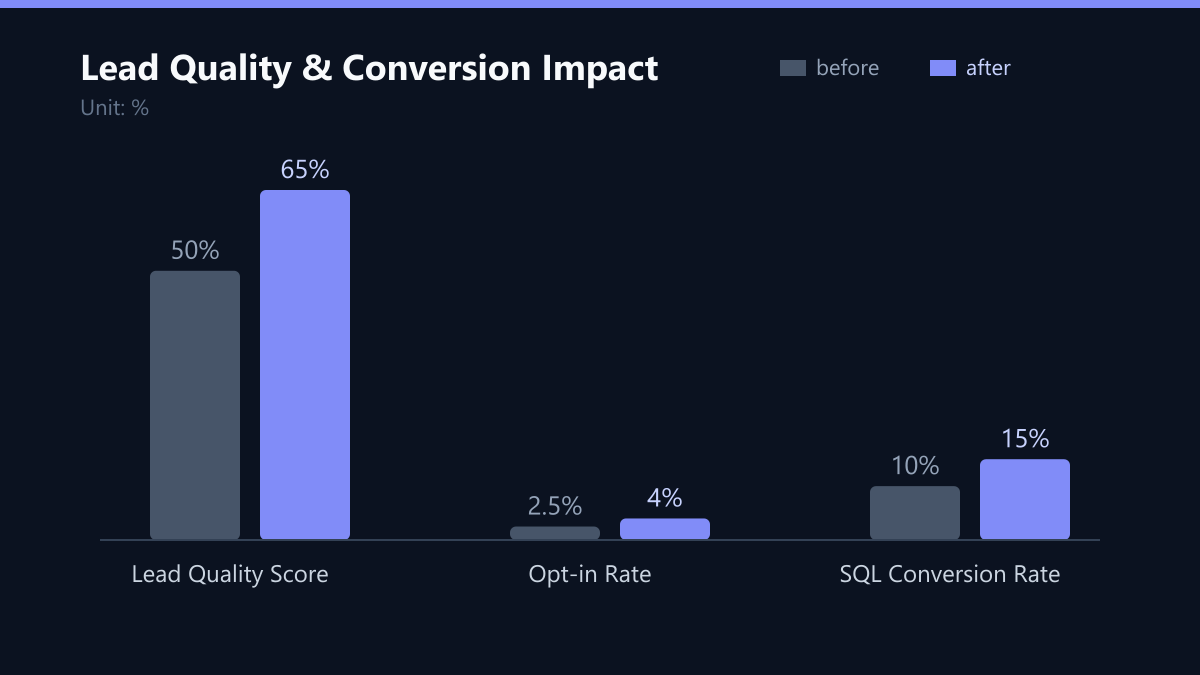
- Opt-in Rate: Percentage of visitors who interact with the popup and submit their data. Method: Track popup impressions and form submissions. Calculate as (Submissions / Impressions) * 100. A baseline for B2B SaaS is 2-4%. If your rate is below 1%, review your content and timing.
- Lead Quality Score: Compare the average lead score of exit-intent leads against other channels (e.g., organic search, paid ads). Method: Use your CRM’s lead scoring model. Calculate the average score for exit-intent leads and compare it to the average for other channels. Exit-intent leads should score 10-20% higher due to higher intent.
- Conversion Rate to SQL: Track how many exit-intent leads become Sales Qualified Leads (SQLs). Method: Track the status change from ‘Lead’ to ‘SQL’ in your CRM. Calculate as (SQLs from Exit-Intent / Total Exit-Intent Leads) * 100. A baseline for B2B SaaS is 10-15%.
- Customer Lifetime Value (CLV): Analyze the CLV of customers acquired via exit-intent popups over time. Method: Track revenue generated by customers who originated from exit-intent leads. Compare the CLV to other acquisition channels. This metric proves long-term value.
Reporting Best Practices:
- Attribution Model: Use a multi-touch attribution model to understand the role of the exit-intent popup in the customer journey. It may not be the first touch, but it could be the closing touch.
- Segment Analysis: Break down performance by page, industry, and device type. This helps you refine your targeting and content strategy.
- Quarterly Reviews: Review the performance quarterly to adjust your strategy based on seasonal trends and business goals.
By focusing on these metrics, you can demonstrate the tangible value of your exit-intent strategy to stakeholders and ensure continuous improvement.
Implementation Checklist
Use this checklist to ensure your exit-intent implementation is compliant and effective:
- Consent Management Platform (CMP) is loaded first.
- Exit-intent script is only initialized after consent is granted.
- IP logging is disabled for exit-intent events.
- Session data expires immediately after browser closure.
- Server-side validation of consent flag is implemented.
- Popup delay is set to 10-15 seconds.
- Frequency cap is set to once per session.
- Mobile triggers (scroll depth/time-on-page) are configured.
- Content is contextual and value-driven.
- Form fields are minimal (Name, Company, Email).
- Webhook integration to CRM is tested.
- Lead source is tagged as ‘Exit-Intent-[Page Name]’.
- Automated email sequence is triggered upon submission.
- Deduplication logic is verified in CRM.
- KPIs (Opt-in Rate, Lead Quality, SQL Conversion) are tracked.
Regular testing and monitoring ensure that your popups remain effective as user behavior and expectations change. Data-driven optimization is key to long-term success. By following these guidelines, you can implement exit-intent popups that are legally compliant, user-friendly, and highly effective for B2B lead generation.