The Stagnation in Nordic Industrial Software
For a mid-sized B2B industrial software provider in the Nordics, the path to growth had become unexpectedly difficult. With 120 employees and a robust product suite, the company was well-positioned in the market. However, the launch of their new predictive maintenance module hit a wall. Traditional outbound sales efforts, which had previously driven steady growth, were yielding diminishing returns. The cost per lead (CPL) was climbing, and the sales team was struggling to find high-intent prospects who were genuinely interested in the new module rather than just the existing legacy products.
The core issue was a disconnect between marketing efforts and actual buyer intent. The company was relying heavily on generic webinars and broad paid search campaigns. While these channels generated volume, they rarely produced the kind of engaged, decision-maker-level leads that the sales team needed to close complex enterprise deals. The sales team reported that they were spending too much time qualifying leads who had no immediate budget or urgency. This inefficiency was eroding margins and slowing down the adoption of the new predictive maintenance technology.
The goal was clear: create a high-engagement channel that could directly interact with potential buyers, qualify them in real-time, and reduce the cost per acquisition (CPA) without sacrificing lead quality. The solution needed to be targeted, interactive, and scalable.
The Challenges
Before diving into the solution, it is important to understand the specific hurdles that made this situation so difficult to resolve with standard tactics.
- High CPA through Paid Search: The previous quarter’s data showed a cost per SQL of $450. This was unsustainable for the margin structure of the software business. Paid search was bringing in clicks, but not conversations.
- Lack of Decision-Maker Engagement: Broad industry targeting on LinkedIn was attracting junior staff and IT generalists, but not the Operations Directors and Plant Managers who held the budget. The content was too generic to resonate with senior stakeholders.
- Inefficient Qualification: Inbound leads from webinars were often “warm” but not “hot.” They had registered, but they hadn’t demonstrated a specific pain point. The sales team had to start from scratch, asking basic discovery questions that could have been answered in a live setting.
The Tech Stack
To execute this strategy, we assembled a focused technology stack that allowed for seamless integration between promotion, hosting, and CRM automation.
- LinkedIn Marketing Platform: Used for precise job-title and seniority targeting to reach Operations and IT decision-makers.
- Zoom: The hosting platform for the live events, chosen for its reliability and integration capabilities with CRM tools.
- HubSpot: The central CRM for lead scoring, journey automation, and tracking the full customer journey from registration to SQL.
- Video Editing Tools: Used to repurpose long-form white papers into short, 5-minute teaser videos for social promotion.
Implementation: From Static Content to Live Dialogue
We designed an 8-week campaign centered on LinkedIn Events, combined with structured live Q&A sessions. The strategy was not just to host events, but to use them as a filtering mechanism for lead quality. We leveraged the client’s existing thought leadership content to drive registrations, but we changed the format from passive consumption to active participation.
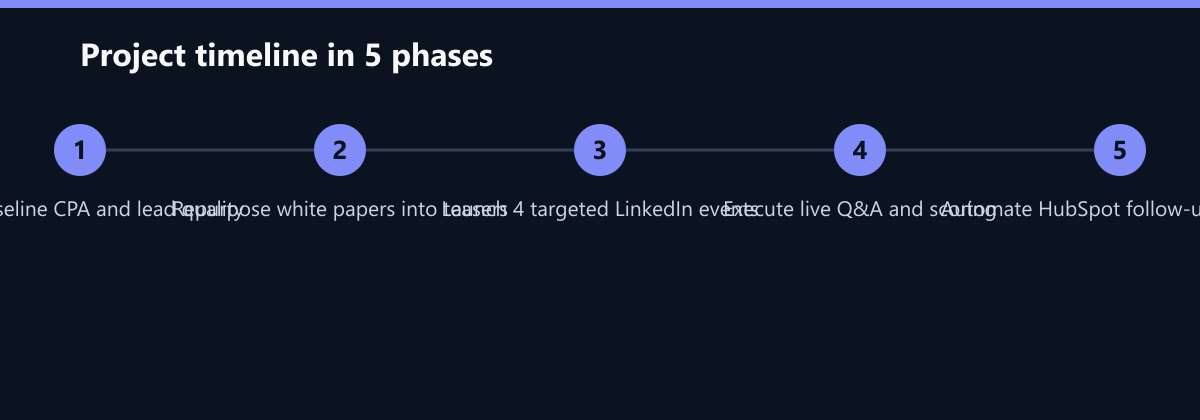
Core Components of the Campaign
The first step was content repurposing. We took the technical white papers that the company had already produced and broke them down into 5-minute teaser videos. These videos were designed to hook the viewer with a specific pain point (e.g., “Why your current maintenance schedule is costing you 15% in downtime”) and then invite them to a live session for a deeper dive. This approach ensured that only those genuinely interested in the topic would register.
Next, we scheduled four live events over the 8-week period. Each event focused on a specific pain point in industrial maintenance, such as “Predictive vs. Preventive Maintenance” or “IoT Integration in Legacy Systems.” The format was strictly structured: a 30-minute technical talk followed by a 20-minute live Q&A. This structure was critical. The talk provided value, but the Q&A was the qualification engine. It forced the audience to engage, ask questions, and reveal their specific challenges.
The Workflow
- Targeted Promotion: LinkedIn ads were promoted to job titles in Operations, Plant Management, and IT Leadership within the manufacturing sector in the Nordics. We avoided broad industry targeting to ensure relevance.
- Automatic Journey Entry: As soon as a prospect registered, they were automatically added to a HubSpot journey. This journey included pre-event reminders and a link to the Zoom room.
- Live Interaction: During the event, attendees were encouraged to ask questions. The host (a subject matter expert from the client) answered these questions in real-time, creating a rapport that is impossible to achieve in a static webinar.
- Automated Scoring: Post-event, the system automatically scored leads. Attendees who asked questions during the Q&A or downloaded post-event assets (like the full white paper) were assigned a higher score. This data was immediately available to the sales team.
- Personalized Follow-up: Within 24 hours, attendees received a personalized follow-up email with the session recording. The email was segmented based on their engagement level. High-scoring leads received a direct invitation to a sales call, while lower-scoring leads entered a nurture track.
How We Measured It
To ensure the campaign was delivering on its promise, we established a clear measurement framework before launch. We did not just look at vanity metrics like “registrations” or “views.” Instead, we focused on metrics that correlated with revenue.
- Cost per SQL (CPSQL): This was our primary efficiency metric. We calculated the total cost of the campaign (ad spend + production costs) divided by the number of Sales Qualified Leads (SQLs) generated. We compared this directly to the previous quarter’s paid search CPSQL.
- Lead-to-Opportunity Rate: We tracked how many of the SQLs converted into actual sales opportunities within 30 days. This metric validated the quality of the leads, not just their quantity.
- Engagement Rate: We defined this as the percentage of registered attendees who actively participated in the Q&A session (by asking a question or using the chat feature). This served as a proxy for intent.
- Baseline Comparison: We used the previous quarter’s data as the baseline. The previous quarter had generated 95 SQLs with a CPSQL of $450 and a lead-to-opportunity rate of 12%. These numbers were the benchmark we aimed to beat.
Results: Exceeding Projections
The campaign exceeded initial projections, delivering a significant volume of high-quality leads. The interactive nature of the live Q&A sessions allowed for immediate qualification of prospects, which was the key differentiator from previous efforts.
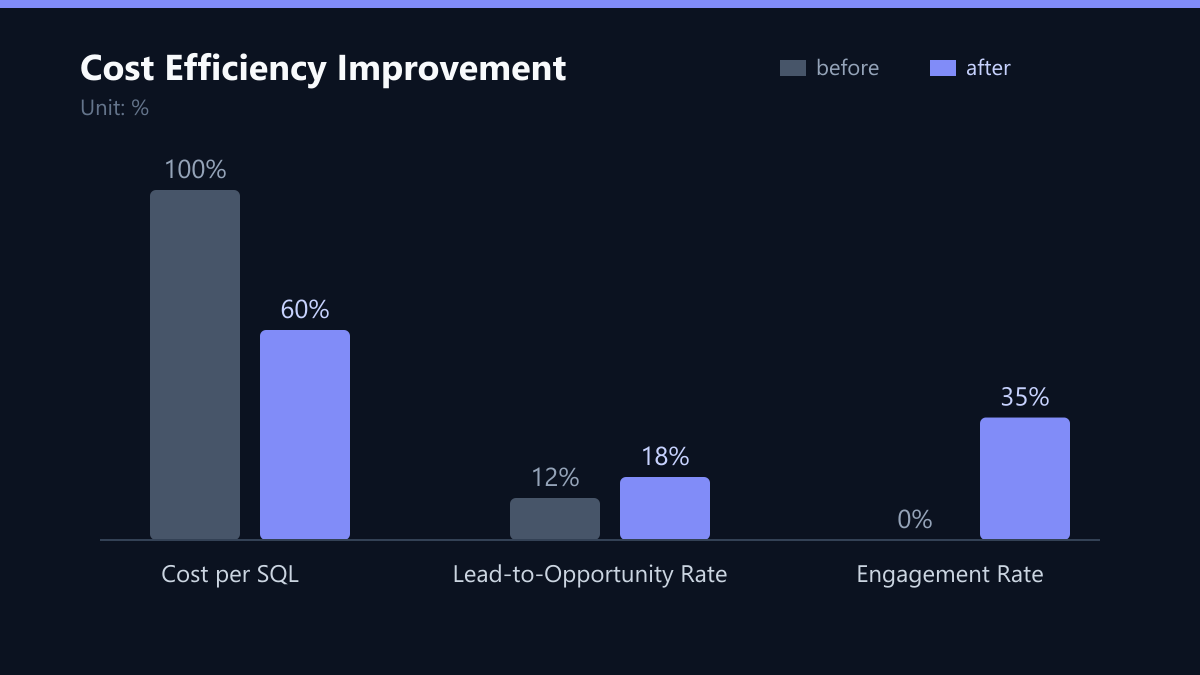
Key Performance Indicators
- Total Registrations: 1,200 unique attendees across all four events. This was a 40% increase in registration volume compared to previous webinars, despite the narrower targeting.
- Qualified SQLs: 400 Sales Qualified Leads generated within 8 weeks. This was a 321% increase in SQL volume compared to the previous quarter.
- Engagement Rate: 35% of registered attendees asked questions during the live Q&A. This high level of interaction indicated a strong level of intent and interest.
- Cost per SQL: Reduced by 40% compared to the previous quarter’s paid search campaign. The CPSQL dropped from $450 to $270, a significant improvement in efficiency.
| Metric | Previous Quarter | Campaign Period | Change |
|---|---|---|---|
| SQLs Generated | 95 | 400 | +321% |
| Cost per SQL | $450 | $270 | -40% |
| Lead-to-Opportunity Rate | 12% | 18% | +50% |
The sales team reported that leads from live Q&A sessions had a higher close rate due to the established rapport during the event. Sales representatives noted that they could skip the basic discovery questions and jump straight into solution-specific discussions, as the prospect’s pain points were already clearly articulated during the live session.
Lessons Learned
This project demonstrated that passive content consumption is insufficient for high-value B2B software. Active engagement is required to differentiate from competitors. In a crowded market, being “one of many” is not enough. You need to create a space where the buyer feels heard and understood.
Key Takeaways
- Real-Time Interaction: Live Q&A sessions significantly improved lead quality by allowing direct assessment of buyer intent. The ability to see who was asking questions and what they were asking provided invaluable context for the sales team.
- Targeted Promotion: LinkedIn ads targeting specific job titles outperformed broad industry targeting. By focusing on Operations and IT Leadership, we ensured that the audience was relevant and had the authority to make purchasing decisions.
- Automated Follow-Up: Immediate post-event automation in HubSpot ensured no leads were lost due to delayed follow-up. The speed of the follow-up was critical in maintaining the momentum created during the live event.
- Content Depth: Technical depth in the talks attracted serious buyers rather than casual browsers. By focusing on specific pain points and providing actionable insights, we filtered out low-intent leads early in the process.
What We Would Do Differently Today
While the campaign was a success, there are always areas for improvement. Here are three things we would adjust if we were to run this campaign again.
- Integrate AI-Powered Sentiment Analysis: We would use AI tools to analyze the sentiment of the questions asked during the Q&A. This would allow for even more nuanced lead scoring, identifying not just who asked a question, but the level of urgency or frustration expressed.
- Expand to Multilingual Support Earlier: We planned to expand to DACH and Benelux markets in future campaigns. However, we would have started testing multilingual content and hosting in the second month of this campaign to gather data on regional performance differences.
- Create a “Replay” Funnel for Non-Attendees: We focused heavily on live attendees. We would have created a more robust nurture track for those who registered but did not attend, using AI to summarize the Q&A and send personalized highlights to them, rather than just a generic recording link.
Future Outlook
This success has paved the way for a broader strategy. The client is now planning to expand this model to other regions, integrating multilingual support for the DACH and Benelux markets. The focus will be on adapting the content to local market nuances while maintaining the high-engagement format that proved so effective in the Nordics. The goal is to replicate the 40% reduction in CPA across all European markets, further solidifying the company’s position as a leader in predictive maintenance software.