The Starting Point: A Growing Bottleneck in Finance
Our client, a B2B logistics SaaS provider with 120 employees based in the UK, faced a critical operational challenge as they scaled. Managing complex recurring billing for over 4,000 B2B clients across the UK and Europe had outgrown their manual processes. The finance department, consisting of a small core team, was spending an estimated 18 hours per week simply cross-referencing invoices with CRM data. This manual verification created a significant bottleneck, leading to delayed payments and a surge in customer support tickets related to billing discrepancies. The team lacked a unified view of payment status, relying instead on scattered spreadsheets that were often out of sync with the actual billing system. This lack of visibility not only slowed down operations but also increased the risk of human error, which directly impacted customer satisfaction and revenue recognition.
The Challenges
The primary obstacles to automation were data fragmentation and the complexity of the billing logic. The client’s CRM records contained inconsistent data formats, which would have caused immediate workflow failures if not addressed. Additionally, the billing system (Stripe) and the CRM (HubSpot) had different data structures for transaction statuses, requiring a robust mapping layer. Another challenge was the need for nuanced dunning sequences; a one-size-fits-all email approach was ineffective, and the client required conditional logic that could adapt to the specific failure history of each account. Finally, there was a cultural resistance to change within the finance team, who were accustomed to manual control and skeptical of automated systems replacing their oversight.
How We Measured It
To ensure the automation delivered tangible value, we established a baseline before any changes were made. We tracked the average time from invoice issuance to successful payment verification, the total hours spent on manual reconciliation, and the volume of support tickets tagged with “billing” or “payment”. These metrics were recorded over a four-week period to establish a stable baseline. After go-live, we continued to measure these KPIs weekly for the first month and monthly thereafter. We also monitored the recovery rate of failed payments through dunning emails, which served as a secondary indicator of workflow effectiveness. The data was pulled directly from HubSpot and Stripe APIs to ensure accuracy and eliminate manual reporting bias.
The Tech Stack
The solution relied on a lean, integrated stack designed for reliability and ease of maintenance. Each tool was chosen for its native integration capabilities and robust API access.
- Stripe: Served as the central billing engine, handling all payment processing, subscription management, and providing webhooks for real-time status updates.
- HubSpot: Functioned as the single source of truth for customer data, housing CRM records and triggering automated workflows based on billing events.
- Zapier (Custom Logic): Used for initial data mapping and complex conditional routing between Stripe and HubSpot, ensuring that only validated data was transferred.
- Power BI: Provided a real-time dashboard for finance teams to monitor payment status, exception queues, and recovery rates without needing to access multiple systems.
Implementation: From Data Hygiene to Automation
We approached the project with a phased methodology to minimize risk and ensure data integrity. The first two weeks were dedicated to data mapping and hygiene. We audited the CRM records for inconsistencies and cleaned up the data structures to align with Stripe’s requirements. This foundational step was crucial, as any automation built on dirty data would only scale the errors. We then integrated Stripe with HubSpot, establishing a secure connection that allowed real-time data synchronization.
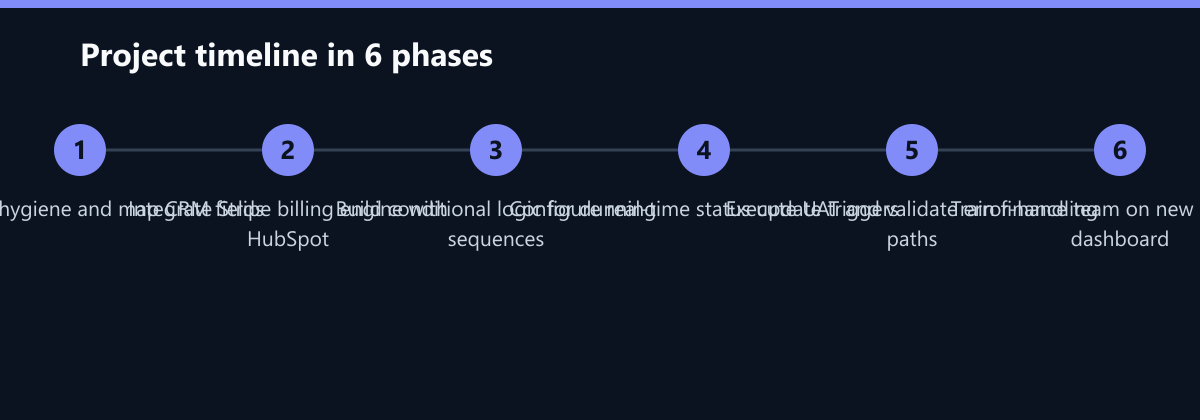
In weeks three and four, we developed the conditional logic for the payout workflow. This included defining the dunning sequences for failed payments, setting up automated email notifications for both customers and internal finance staff, and creating rules for when manual intervention was required. The system was designed to handle standard transactions automatically, while flagging complex cases for human review. We also built a dedicated view in HubSpot for failed transactions, allowing the finance team to quickly identify and resolve issues.
The final two weeks focused on User Acceptance Testing (UAT) and team training. We ran the new workflow in parallel with the manual process for a week to ensure that the automated results matched the manual ones. During this phase, we identified and fixed several edge cases, such as currency conversion errors and timezone discrepancies in payment timestamps. Once the UAT was successful, we trained the finance team on the new dashboard and the exception-handling procedures. The team was encouraged to provide feedback, which led to minor adjustments in the email templates and the dashboard layout to better suit their workflow.
The Outcomes
The automation delivered immediate efficiency gains within the first month of go-live. The most significant impact was on processing time. By eliminating manual cross-referencing, the average payout processing time was reduced by 60%. This meant that payments were verified and recorded in the system much faster, improving cash flow visibility.
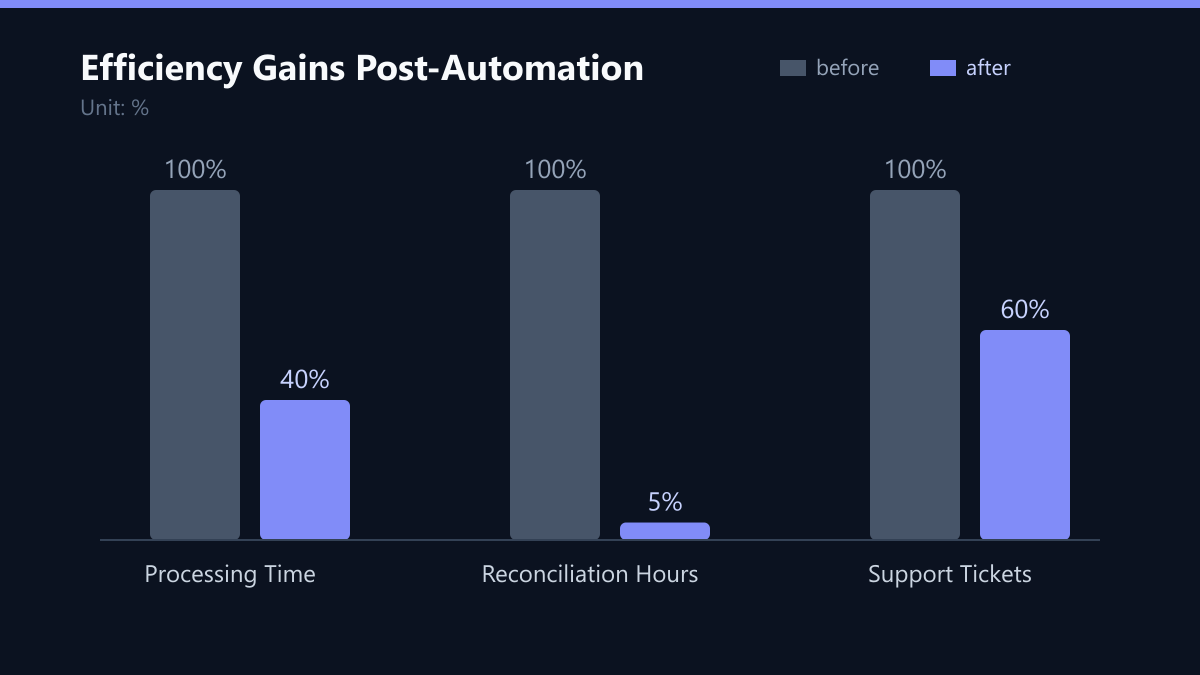
The reduction in manual effort was even more pronounced. The 18 hours per week previously spent on reconciliation dropped by 95%, freeing up the finance team to focus on strategic tasks such as financial planning and client analysis. This efficiency gain allowed the team to handle 20% more clients without additional headcount, effectively scaling their capacity without increasing costs.
Customer satisfaction also improved significantly. The 40% drop in payment-related support tickets was a direct result of the proactive dunning sequences and real-time status updates. Customers were informed of payment failures immediately, reducing confusion and the need for support interventions. The error rates in billing dropped to near zero due to automated validation checks, ensuring that invoices were always accurate and up-to-date.
What We Would Do Differently Today
While the project was a success, there are areas where we would refine our approach in future implementations. First, we would invest more time in the initial data audit. Although we spent two weeks on data hygiene, some inconsistencies were discovered during UAT that could have been caught earlier. A more rigorous data profiling phase at the start would have reduced the risk of workflow failures.
Second, we would involve the finance team more deeply in the design of the dunning sequences. While we created effective automated emails, the finance team had specific insights into customer communication preferences that could have been leveraged to improve the recovery rate further. Collaborative design sessions would have ensured that the automated messages resonated better with the clients.
Finally, we would implement a more robust monitoring system from day one. While we did set up alerts for critical failures, a more granular monitoring setup that tracked minor anomalies would have allowed for even quicker issue resolution. Continuous monitoring is essential for maintaining the reliability of automated workflows over time.
Lessons Learned
The success of this project underscores the importance of data quality in automation. Integration is only as good as the data it processes. We learned that investing time in data hygiene before building workflows is not an optional step but a critical prerequisite. Clean CRM records prevent workflow failures and ensure that the automation delivers consistent results.
Another key takeaway is the value of proactive communication. By automating dunning emails, we not only recovered 30% of failed payments but also improved the customer experience. Proactive communication builds trust and reduces the administrative burden on both the customer and the support team.
Lastly, monitoring exceptions is crucial for maintaining trust in automated systems. A dedicated view for failed transactions allows for quick manual intervention when needed, ensuring that the automation does not become a black box. This hybrid approach, where automation handles the standard cases and humans handle the exceptions, provides the best of both worlds: efficiency and control.
Passend dazu
- Performance Marketing
- SEO & AI Search (GEO)
- Automated Affiliate Workflows in HubSpot: From Click to Payout
- Automated Affiliate Payouts: Integrating Platforms with CRM Systems
- Affiliate Marketing
- Content & CRO
- CRM Marketing
- Reducing Reporting Effort by 40 Hours Monthly in the Scandinavian IT Services Sector Through Automated KPI Reports
- Automated Provisioning Workflows in HubSpot for Southern European B2B Service Providers: Reducing Process Costs by 30%
- DACH: Reducing Lead Response Time from 24 to 4 Hours Through Automated HubSpot Workflows in the Machinery Industry
- Optimizing ROAS in the Scandinavian Fintech Sector: Automated Bid Strategies and Landmark Tracking
- Reducing Time-to-Close by 40 Percent in UK Financial Services
- Reducing Product Through Time in the Benelux via Automated Video Onboarding