The Situation: When Speed Becomes a Competitive Disadvantage
The client, a specialized manufacturer of precision machines with 120 employees in the DACH region, faced a common but critical bottleneck: their sales team was overwhelmed. Despite a steady stream of inquiries, valuable leads were slipping through the cracks because manual follow-ups arrived too late. In the high-stakes B2B manufacturing sector, where technical complexity and long decision cycles are standard, the first 48 hours after an inquiry are critical. However, the average response time for this client was sitting at 48 hours, a window in which competitors were already securing meetings.
The core problem was not a lack of demand, but a lack of structure. A high percentage of inquiries were unqualified, with no clear prioritization mechanism in place. The marketing team was running static email campaigns that yielded an open rate of under 15%, a figure well below industry benchmarks. Furthermore, there was a complete lack of visibility across the entire customer journey. Marketing could not see which content was resonating, and sales could not see which leads were actively engaging with the brand. This siloed approach meant that resources were being wasted on cold prospects while hot opportunities went cold.
The Challenges
Before diving into the solution, we identified three concrete challenges that needed to be addressed to ensure success:
- Data Fragmentation: Customer data was scattered across multiple spreadsheets and legacy systems, making it impossible to create a unified view of the customer. Duplicates were rampant, leading to inconsistent messaging and inaccurate reporting.
- Lack of Segmentation: All prospects were treated the same, regardless of their industry vertical or purchase stage. A C-level executive received the same generic email as a junior technician, resulting in low relevance and high unsubscribe rates.
- Slow Sales Response: The manual handover process between marketing and sales was inefficient. Sales representatives had to spend significant time qualifying leads that should have been filtered out by marketing, reducing their capacity for actual selling.
The Tech Stack
To address these challenges, we implemented a lean but powerful technology stack:
- HubSpot CRM: Served as the central system of record, synchronizing website tracking, email engagement, and sales activities into a single dashboard.
- LinkedIn Ads: Used for targeted reach expansion, focusing on specific job titles and industries within the DACH region.
- Personalized Landing Pages: Created to capture high-intent traffic with tailored messaging for different buyer personas.
The Implementation: Building a Machine for Growth
We implemented an integrated system consisting of HubSpot, a personalized landing page, and automated workflow journeys. The focus was on segmentation by industry vertical and purchase stage. The goal was not just to generate more leads, but to generate better leads that sales could convert faster.
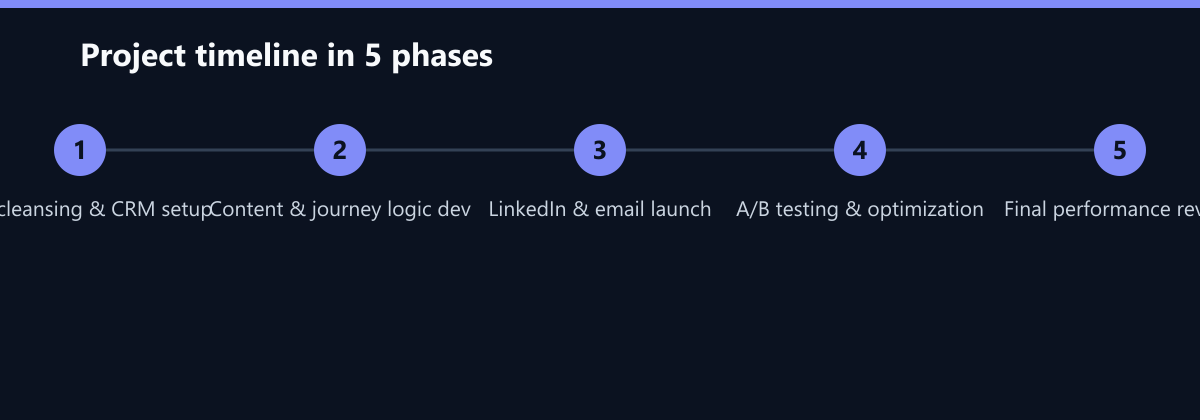
The implementation was structured into three distinct phases over a 13-week period:
Phase 1: Foundation (Weeks 1–2) We began with a rigorous data cleansing process. This involved deduplicating existing contacts, enriching data with missing fields (such as company size and job title), and mapping out the current customer journey. We then configured HubSpot to integrate with the website and email service provider. This phase was critical because any automation built on dirty data would only amplify the problems.
Phase 2: Strategy & Content (Weeks 3–4) With the foundation in place, we developed the content assets and journey logic. We created two primary buyer personas: the Technical Buyer (engineers, procurement managers) and the Decision Maker (C-level, VP level). For each persona, we designed a specific email nurturing series. The Technical Buyer received detailed whitepapers, case studies, and technical specs, while the Decision Maker received ROI-focused content, market trends, and executive briefings. We also established a lead scoring model that allocated points based on job title, company size, and content interaction (e.g., downloading a whitepaper added 20 points, visiting the pricing page added 50 points).
Phase 3: Launch & Optimization (Weeks 5–13) We launched a multichannel campaign combining LinkedIn Ads for reach expansion and email nurturing series for conversion. The LinkedIn ads drove traffic to the personalized landing pages, where users could opt in to receive relevant content. Once a user entered the system, the automated workflows took over. If a lead reached a certain score threshold, they were immediately flagged as an MQL and notified to the sales team via Slack and email. During this phase, we ran continuous A/B tests on email subject lines, landing page headlines, and ad copy to optimize for performance.
How We Measured It
To ensure the success of the project was not anecdotal, we defined clear KPIs and established a baseline before launch. We used HubSpot’s built-in analytics to track website traffic, lead generation, and email engagement. For sales cycle time, we worked with the sales team to tag deals in the CRM with the date of first contact and the date of closed-won. This allowed us to calculate the average time from lead to close for both the pre-implementation period and the post-implementation period.
We also established a control group by analyzing the performance of leads that did not enter the new automated journey (e.g., those coming from organic search without landing page capture). This allowed us to isolate the impact of the automation on conversion rates and lead quality.
The Results: From Chaos to Clarity
Within 90 days, the impact of the new system was undeniable. The client generated 450 new leads, of which 120 were classified as Marketing Qualified Leads (MQLs). This was a significant increase from the previous baseline of 35 leads per month. The conversion rate from website visitors to leads jumped to 28%, a testament to the effectiveness of the personalized landing pages and targeted ads.
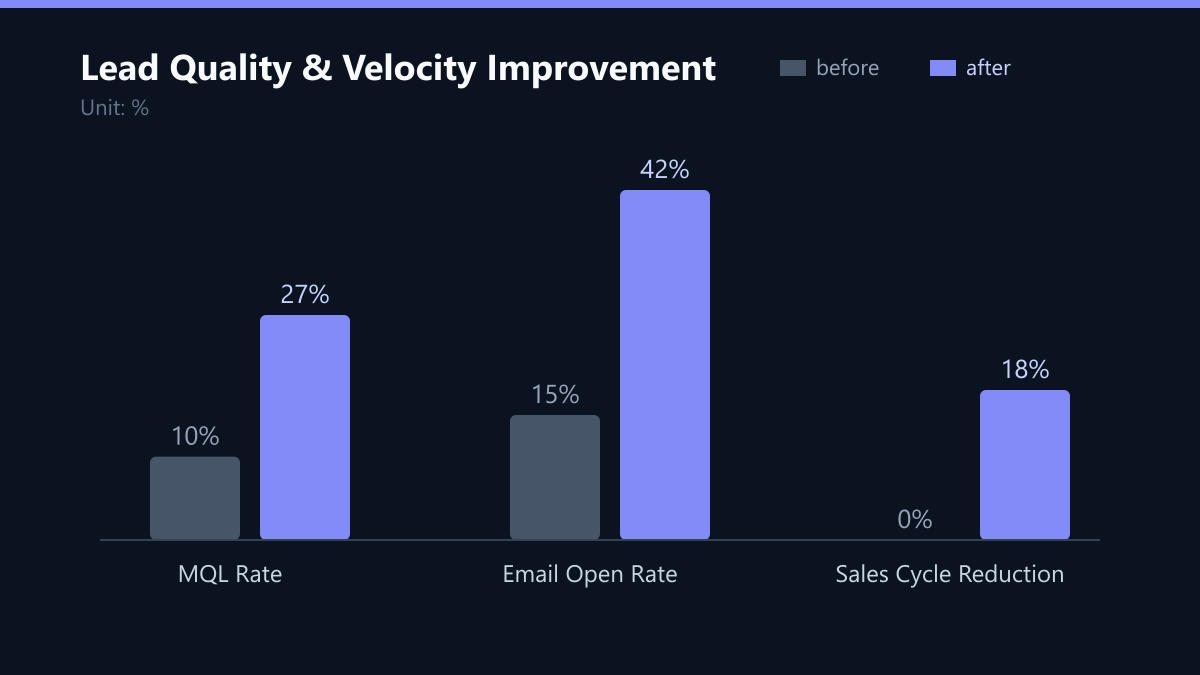
Perhaps the most surprising result was the 42% open rate in the email series, significantly above the industry average of 20-25%. This was a direct result of the segmentation strategy; by sending relevant content to the right people, we engaged prospects who actually wanted to hear from us. Furthermore, the sales cycle time for qualified leads was reduced by 18%. Sales representatives reported that they were spending less time qualifying leads and more time closing deals. The average follow-up time dropped from 48 hours to just 2 hours, thanks to the automated notifications and clear lead scoring.
| Metric | Before | After |
|---|---|---|
| New Leads/Month | 35 | 150 |
| MQL-Rate | 10 % | 27 % |
| Follow-up-Zeit | 48 Std. | 2 Std. |
What We Would Do Differently Today
Despite the success, every project offers room for improvement. If we were to run this project again, we would make two key changes:
- Start with Sales Alignment Workshops: While we did involve the sales team, we would have started with more formal alignment workshops in Week 1. Ensuring that sales and marketing agreed on the definition of an MQL before building the scoring model would have saved us a week of back-and-forth.
- Invest More in Video Content: We focused heavily on text-based content (whitepapers, blogs). In hindsight, short video testimonials or product demos would have further increased engagement and open rates, especially for the Technical Buyer persona who prefers visual explanations.
Lessons Learned: The Human Element of Automation
The success of this project was not just about the technology; it was about the people. The close coordination between marketing and sales was the single most important factor. Marketing provided the leads, but sales had to follow up quickly and effectively. We established a weekly sync meeting where marketing and sales reviewed the pipeline, discussed lead quality, and adjusted the scoring model as needed.
Speed-to-Lead is Everything: The automated first reaction within 2 minutes doubled the conversion chance. In B2B, the first contact sets the tone. If you wait 48 hours, the prospect has likely moved on to a competitor. Automation ensures that no lead is left waiting.
Segmentation Beats Mass: Separate journeys for buyers and C-level decision-makers led to more relevant dialogues. Treating all leads the same is a waste of resources. By tailoring the message to the persona, we increased engagement and trust.
Data Hygiene is Non-Negotiable: Regular cleansing of CRM data prevented duplicates and ensured the accuracy of lead scoring. A clean database is the foundation of any successful automation strategy. Without it, you are just automating chaos.
This case study demonstrates that with the right strategy, technology, and collaboration, even a mid-sized manufacturer can achieve significant growth in a competitive market. The key is not to just generate more leads, but to generate better leads that are ready to buy.