The Bottleneck: Why High-Value Leads Were Stalling
For a mid-sized B2B industrial manufacturer with 450 employees operating across the DACH region, the sales process had become a primary constraint on growth. The company generated a steady stream of high-value leads through trade shows and inbound web forms, yet these prospects often languished in the CRM for weeks without meaningful engagement. The core issue was a lack of clarity: sales teams lacked clear, real-time signals on which prospects were genuinely ready to buy and which required further nurturing. This ambiguity resulted in a sluggish pipeline, where high-potential opportunities were missed in a highly competitive market, and sales representatives were bogged down by manual administrative tasks rather than closing deals.
The Challenges
Before implementing any technical solution, we identified four specific structural and behavioral challenges that needed to be addressed:
- Data Fragmentation: Contact records were often incomplete, with missing job titles, company sizes, or interest categories, making it impossible to segment leads effectively.
- Slow Handover Friction: The transition from marketing-qualified lead (MQL) to sales-qualified lead (SQL) was manual and slow, causing an average delay of 48 hours before a rep made first contact.
- Ambiguous Qualification Criteria: Sales and marketing had different definitions of a “ready-to-buy” lead, leading to misaligned expectations and wasted effort on unprepared prospects.
- Lack of Automated Nurturing: Low-intent leads were not automatically engaged, resulting in a drop-off in the middle of the funnel while sales focused only on immediate opportunities.
How We Measured It
To ensure the success of the initiative could be objectively validated, we established a baseline before any changes were made. We used HubSpot’s native reporting tools to track the following metrics over a three-month pre-implementation period:
- Sales Cycle Duration: Calculated as the average time from lead creation to opportunity closed-won.
- First Response Time: Measured from the timestamp of lead creation to the first recorded sales activity (call, email, or meeting).
- Conversion Rate: The percentage of total leads that progressed to the “Opportunity” stage.
- Admin Time: Tracked via time-tracking surveys sent to sales representatives to quantify hours spent on manual data entry and follow-up.
This baseline allowed us to isolate the impact of the automation from other market factors and provide a clear before-and-after comparison.
The Tech Stack
- HubSpot Sales Hub & Marketing Hub: The central platform for CRM management, lead scoring, and workflow automation.
- Slack Integration: Used for real-time notifications to alert sales reps about high-score leads.
- Clearbit (Data Enrichment): Automated tool to fill missing contact fields such as company size, industry, and job title.
- HubSpot Reporting: Native dashboards for tracking KPIs and monitoring workflow performance.
Implementation: Building the Automation Engine
Our strategy focused on eliminating manual data entry and accelerating lead qualification by creating a seamless bridge between marketing engagement and sales action. This required close coordination between the marketing and sales teams to ensure that the automated triggers aligned with actual sales behaviors.
Lead Scoring Model We developed a granular lead scoring model based on over 150 behavioral and demographic criteria. Points were assigned not just for static attributes like job title, but for dynamic actions such as visiting the pricing page, downloading whitepapers, or attending webinars. This allowed the system to prioritize leads based on demonstrated intent rather than just potential.
Automated Journey Triggers We created three distinct workflow tiers to handle leads based on their score:
- High-Score Leads: Triggered an immediate Slack alert to the assigned sales rep, prompting a call within two hours.
- Medium-Score Leads: Entered a nurturing sequence with educational content to build trust and readiness.
- Low-Score Leads: Received general brand awareness content and were monitored for future intent spikes.
CRM Hygiene and Enrichment We automated data enrichment to fill missing fields in real-time. Before a sales rep attempted to call, the system ensured that the contact record included up-to-date company information and relevant context. This reduced the time reps spent researching prospects and improved the quality of conversations.
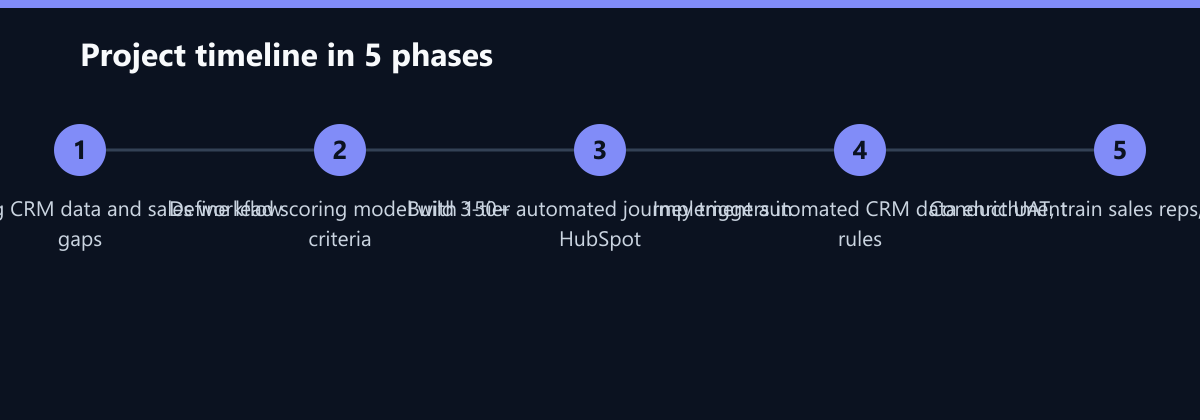
Project Timeline The implementation was executed over a six-week period to minimize disruption to ongoing sales activities:
- Weeks 1-2: Comprehensive audit of existing CRM data and sales workflow gaps; definition of the lead scoring strategy.
- Weeks 3-4: Building the automated workflows and integrating data enrichment tools.
- Week 5: User acceptance testing (UAT) with key sales stakeholders and training sessions for the wider team.
- Week 6: Go-live, monitoring, and initial adjustments based on real-time data.
Results: Measurable Impact on Sales Velocity
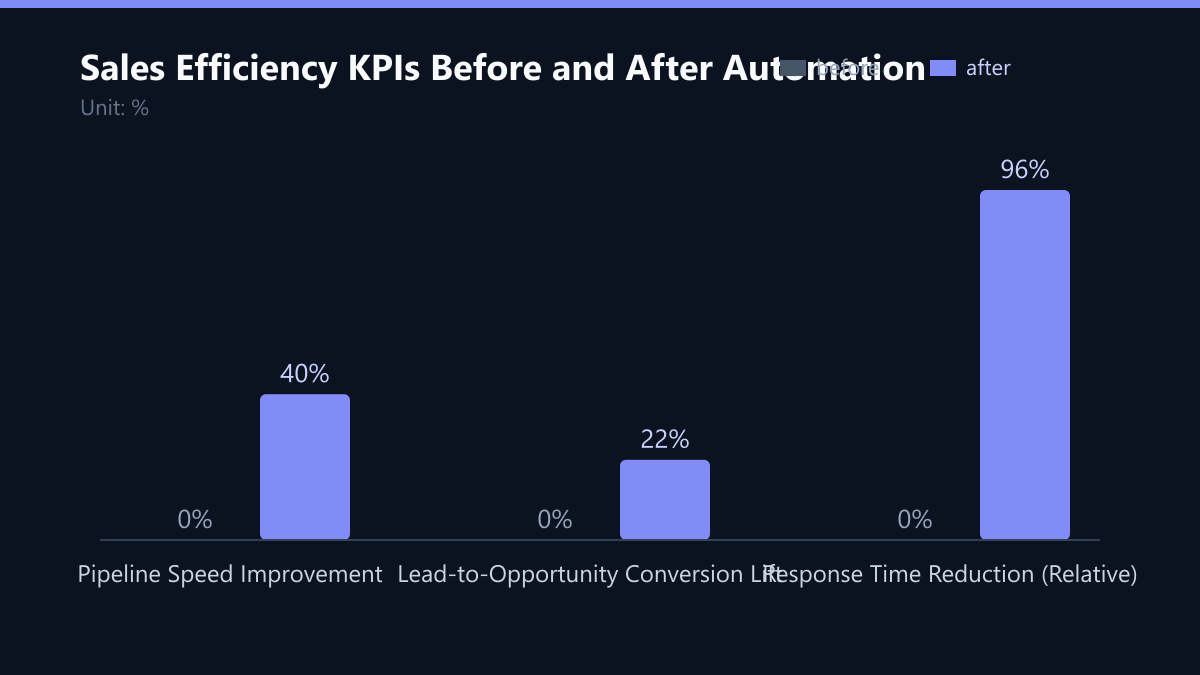
The impact on sales velocity was immediate and measurable. The automation removed the friction from the handover process, allowing sales teams to focus on closing rather than chasing data. Over a six-month period following the go-live, the following KPIs were tracked:
- Pipeline Speed: The average time from lead creation to opportunity closed-won decreased by 40%. This significant reduction meant that deals were closing faster, improving cash flow and allowing for more predictable revenue planning.
- Response Time: The average first response time to high-intent leads dropped from 48 hours to under 2 hours. This rapid response was critical in capturing leads while their interest was at its peak.
- Conversion Rate: The lead-to-opportunity conversion rate increased by 22%. By ensuring that sales reps only contacted leads that were truly ready to buy, the quality of opportunities improved significantly.
- Sales Efficiency: Sales representatives reported saving 15 hours per month on manual data entry and follow-up. This time was reinvested into strategic selling activities, further boosting productivity.
Lessons Learned: What Made It Work
Success depended heavily on the precise definition of lead stages. Initially, ambiguous scoring rules led to misclassification, where some leads were marked as “hot” when they were merely curious. We refined the model twice based on direct feedback from the sales team, adjusting point values for specific actions to better reflect buying intent.
Another key factor was stakeholder buy-in. Sales managers were initially skeptical of automated alerts, fearing they would be overwhelmed by noise. Regular check-ins during the first month of operation helped build trust. As the team saw the accuracy and relevance of the alerts, adoption became seamless. The system now runs autonomously, providing a consistent pipeline flow without requiring manual intervention.
What We Would Do Differently Today
While the project was a success, there are areas where we would refine our approach if we were to repeat this engagement:
- Earlier Stakeholder Involvement: We would involve senior sales leadership in the scoring model definition phase, rather than just the operational reps. Their input on strategic account priorities would have refined the model even further.
- Phased Rollout: Instead of launching all three workflow tiers simultaneously, we would have piloted the high-score workflow first to validate the Slack integration and alert accuracy before expanding to medium and low scores.
- More Robust A/B Testing: We would have implemented more rigorous A/B testing on the nurture sequences for medium-score leads to optimize content and timing before full deployment.
Passend dazu
- Affiliate Marketing
- Content & CRO
- Conversational Marketing
- Automated Campaign Management: 40% ROAS Increase for a DACH Industrial Supplier through Dynamic Budget Allocation in Amazon DSP
- From Content Cluster to Customer Journey: Social Content Strategy for a B2B Industrial Conglomerate in the UK
- B2B Software Provider in the DACH Region: Double Pipeline Volume with LinkedIn Ad Automation in HubSpot
- Building a High-Intent Pipeline in US Healthcare with LinkedIn and Intent Data