The Hidden Cost Driver: Why Quality Score Matters More Than Bids
In the high-stakes environment of B2B SaaS marketing, margins are razor-thin. Every euro spent on inefficient clicks directly erodes your return on investment. Many marketers focus obsessively on lowering their base bids, but this is a short-sighted strategy. The true lever for cost efficiency is not your bid, but your Quality Score.
Quality Score is not a vanity metric; it is the primary mechanism Google uses to determine your effective cost per click (CPC). It acts as a multiplier on your bid. A high score lowers the actual amount you pay, while a low score forces you to bid higher to maintain the same position. For B2B SaaS companies, this distinction is critical. By improving your Quality Score, you achieve a dual advantage: lower acquisition costs and better ad positions without needing to increase your budget.
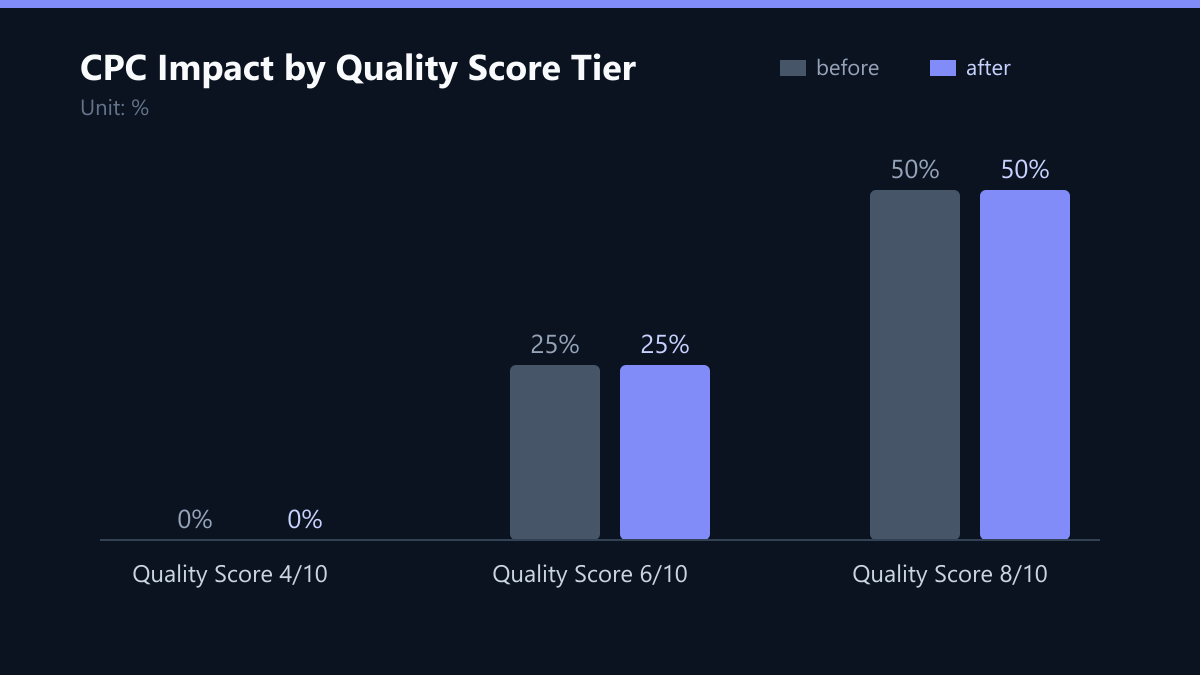
The impact is quantifiable and significant. A Quality Score of 8/10 can cost up to 50% less per click than a score of 4/10. This 50% variance is not a minor fluctuation; it is the difference between a sustainable growth engine and a cash drain. Furthermore, higher scores correlate with better data quality. More relevant traffic leads to higher conversion rates, creating a positive feedback loop that further improves your account’s efficiency.
Step 1: Tighten Keyword-to-Ad Group Relevance
The most common reason for a stagnant or low Quality Score is poor thematic alignment. If an ad group contains broad keywords that do not match the specific ad copy, Google penalizes the relevance. The solution is to create tighter, more focused clusters.
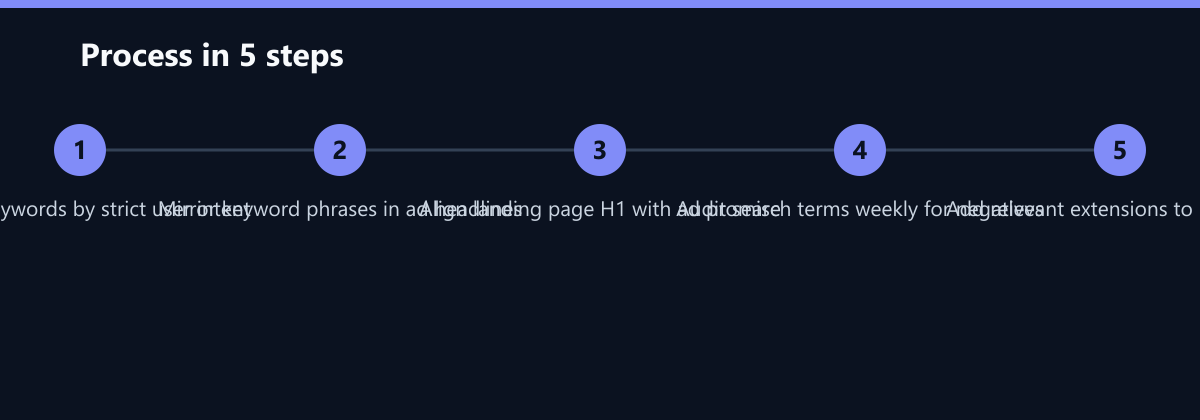
You must segment your keywords by specific user intent. Instead of lumping all “CRM software” terms together, create separate ad groups for “CRM for startups,” “CRM pricing,” and “CRM implementation services.” This ensures that when a user searches for “CRM for startups,” the ad headline directly addresses that specific need.
To execute this effectively, limit your keywords per group to 5–10 highly related terms. Use the exact keyword phrase in the headline of your ad. This mirroring technique signals to Google that the ad is highly relevant to the search query, which is the first component of Quality Score.
Step 2: Boost Click-Through Rate with Strong Hooks
Expected Click-Through Rate (CTR) is a major component of Quality Score. It measures how likely your ad is to be clicked when shown. Low CTR signals to Google that your ad is not relevant to the searcher’s query. You need to test and iterate on your ad copy to prove relevance.
Optimization tactics for B2B SaaS should focus on specificity and pain points. Using numbers and specifics, such as “Reduce Churn by 20%,” outperforms generic phrases like “Improve Retention.” Leverage extensions like sitelinks, callouts, and structured snippets to increase ad real estate and visibility. A/B test at least three different headline variations, focusing on pain points (e.g., “Stop Losing Leads”) rather than generic benefits.
A pro tip for B2B marketers: If your CTR is below the industry average (typically 3–5% for B2B), your ad copy is likely too generic. Rewrite it to speak directly to the specific problem solved by the keyword. The more specific the promise, the higher the CTR, and the stronger the signal to Google.
Step 3: Align Landing Page Experience with Ad Promises
Google evaluates the landing page experience based on relevance, load speed, and clarity. If your ad promises a “Free Trial” but the landing page asks for a demo booking, the user experience suffers, and so does your Quality Score. Consistency is key.
Your landing page must mirror the ad. The H1 of the landing page should contain the main keyword from the ad. Ensure fast load times, aiming for under 3 seconds on mobile. Slow pages increase bounce rates and lower scores. There should be one primary call-to-action above the fold, and the page must be fully mobile-optimized with easily clickable forms and buttons.
The data here is compelling. Improving page load speed by 1 second can increase conversions by up to 7%. For PPC, this directly improves the perceived value of the click, signaling to Google that your ad leads to a high-quality destination. This alignment between ad promise and page delivery is crucial for maintaining a high score.
Step 4: Refine Negative Keywords and Search Terms
Irrelevant clicks drag down your CTR and Quality Score. If users click on your ad but do not convert because the intent was mismatched, you waste budget and hurt your metrics. Regularly auditing search term reports is non-negotiable for B2B SaaS.
Implement a weekly process for negative keyword management. Download the search terms report and identify mismatches. Look for queries that are related but not relevant, such as “free,” “jobs,” or “DIY” for a B2B SaaS product. Add these terms as negative keywords at the campaign or ad group level. If a phrase match is bringing in too much noise, switch to exact match for high-value terms.
By filtering out low-intent traffic, you increase the proportion of qualified clicks. This naturally boosts your CTR and conversion rate, which are positive signals for Quality Score. It is a defensive strategy that protects your metrics from dilution.
Step 5: Leverage Ad Extensions to Increase Relevance
Ad extensions provide additional information that makes your ad more useful to the searcher. Google rewards ads with rich, relevant extensions because they improve the user experience. These extensions can increase your CTR by 10–15% without changing the core ad copy.
For B2B SaaS, the must-have extensions include sitelinks to key pages like “Pricing,” “Integrations,” or “Case Studies.” Use callouts to highlight unique selling points, such as “24/7 Support” or “GDPR Compliant.” Structured snippets can list types of services or products, e.g., “Features: Automation, Analytics, Reporting.” Image assets can also increase ad visibility in the search results.
The strategy is contextual relevance. Ensure each extension is relevant to the specific ad group. For a “Pricing” ad group, use sitelinks to the pricing page and callouts about “No Hidden Fees.” This contextual relevance boosts the expected CTR and overall Quality Score.
Typical Mistakes to Avoid
Even with the right strategy, marketers often make specific errors that hinder progress. First, many ignore the mobile experience. Mobile CTR is often lower, and if your landing page is not optimized for mobile, you are penalized twice: once for low CTR and once for poor landing page experience. Second, marketers often fail to update negative keywords. A search term that was irrelevant in January may become relevant in June, or vice versa. Stale negative lists waste budget. Third, there is a tendency to optimize for clicks rather than conversions. A high CTR is useless if the traffic does not convert. Always analyze conversion data to identify which keywords drive the most value, not just clicks.
How You Measure Success
To ensure your optimizations are working, you need concrete KPIs and a clear measurement method. The primary KPI is the Cost Per Click (CPC). Track the average CPC for your top 10% of keywords before and after implementation. A secondary KPI is the Quality Score itself, monitored per keyword. A tertiary KPI is the Click-Through Rate (CTR) by device.
The method involves a controlled A/B testing approach. Document your changes and track their impact over a 2–4 week period. Use Google Ads conversion tracking to isolate the impact on revenue. If your CPC drops by 10% while maintaining the same conversion rate, you have a clear success. If CTR increases but CPC does not drop, investigate the landing page experience. The goal is a compound effect: lower CPCs, higher CTRs, and improved ROAS.
Checklist for Implementation
- Audit Current Scores: Identify the top 20 keywords by spend with Quality Scores below 7.
- Restructure Ad Groups: Split broad ad groups into intent-specific clusters (max 10 keywords per group).
- Rewrite Ad Copy: Mirror keywords in headlines and add specific pain-point hooks.
- Fix Landing Pages: Ensure H1 match, mobile optimization, and load times under 3 seconds.
- Add Negatives: Review search terms report and add at least 5 new negative keywords per campaign.
- Enable Extensions: Add sitelinks, callouts, and structured snippets to all high-value ad groups.
- Monitor Weekly: Check Quality Score trends and CTR by device every Monday.
Monitoring and Iteration: A Continuous Process
Quality Score is not a one-time fix; it is a dynamic metric. Search trends, competitor bids, and user behavior change constantly. You need a systematic approach to monitoring and optimization.
Your weekly routine should include checking Quality Score trends for top-performing keywords, looking specifically for drops. Review CTR by device, as mobile CTR is often lower and requires specific attention. Test new ad copy regularly to rotate in new headlines and descriptions, preventing ad fatigue. Analyze conversion data to identify which keywords drive the most value.
For the long term, focus on high-value keywords first. Improving the Quality Score for your top 10% of keywords will yield the largest impact on your overall CPC and ROAS. Document your changes and track their impact over 2–4 weeks to understand what works best for your specific audience. This continuous cycle of testing, learning, and optimizing is what separates top performers from the rest.