The Hidden Cost of Fragmented Customer Data
Most mid-market B2B SaaS companies treat a Customer Data Platform (CDP) as a mere storage bucket. This approach ignores the complexity of data governance and integration. A CDP is only as valuable as the quality of the data it processes. When data remains siloed, teams operate on incomplete truths, leading to misaligned marketing efforts and lost revenue opportunities.
Key Risks of Poor Implementation:
- Data Silos: Fragmented profiles prevent accurate lead scoring, causing sales teams to prioritize low-intent prospects.
- High Maintenance Costs: Manual data cleansing consumes engineering hours that could be spent on product development.
- Low Adoption: Teams ignore the platform if the data feels unreliable or outdated.
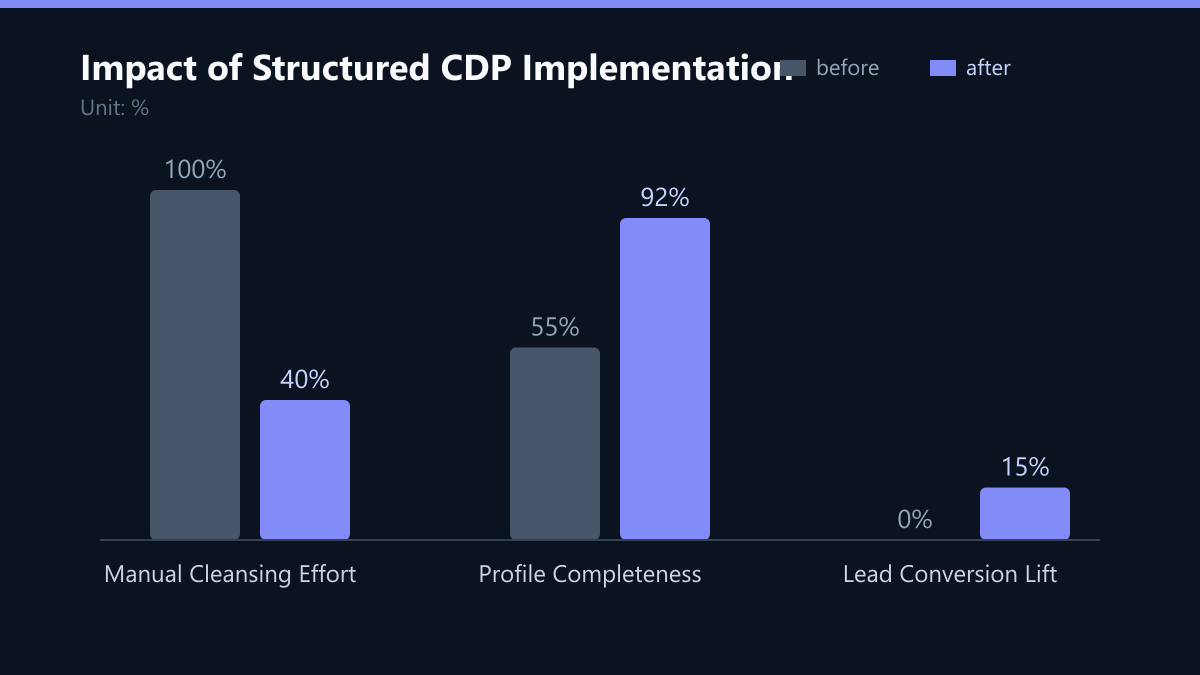
The goal is a single source of truth. This allows marketing, sales, and success teams to act on consistent, real-time insights. Without a structured approach, you risk investing in infrastructure that delivers no ROI. A well-executed CDP implementation can reduce manual data cleansing efforts by up to 60% and improve profile completeness from a typical 55% baseline to over 90%.
Phase 1: Diagnostic and Foundation
Audit Your Current Data Landscape
Before selecting a tool, map every data source currently feeding your stack. Identify where customer interactions are recorded and where they are lost. This audit reveals gaps in your current infrastructure. You must document the volume of data per source to size your CDP correctly.
Audit Checklist:
- First-Party Data: Website visits, email opens, CRM records, and support tickets.
- Third-Party Data: Ad platform conversions, social media interactions, and webinar registrations.
- Data Quality: Check for duplicate emails, missing company domains, or stale records.
A typical B2B SaaS company generates between 50,000 and 200,000 events monthly. Knowing this baseline helps you avoid overpaying for unused capacity or underprovisioning for peak loads. Use this data to estimate your required storage and processing power.
Define Identity Resolution Strategy
Identity resolution is the core function of a CDP. It stitches together disparate data points into a single customer profile. You must define how to match users across devices and channels. For B2B SaaS, prioritize deterministic matching. It offers higher accuracy for lead scoring compared to probabilistic methods.
Matching Strategies:
- Deterministic Matching: Uses unique identifiers like email addresses, user IDs, or company domains.
- Probabilistic Matching: Uses heuristics like IP addresses or device fingerprints.
Define your primary key early. Usually, the company domain or a unique CRM ID works best for B2B contexts. This ensures that all interactions from different team members at the same company are correctly attributed to a single account profile.
Phase 2: Architecture and Integration
Select the Right CDP Architecture
CDPs come in different forms: cloud-native, on-premise, or open-source. The right choice depends on your IT capabilities and data privacy requirements. Cloud-native options offer faster deployment but less control over the underlying infrastructure.
Comparison of CDP Types:
| Feature | Cloud-Native | Open-Source | On-Premise |
|---|---|---|---|
| Setup Time | 2-4 Weeks | 3-6 Months | 6-12 Months |
| Cost Structure | Subscription | License + Dev | High CapEx |
| Flexibility | Moderate | High | High |
| Support | Vendor Provided | Community | Internal Team |
Mid-market B2B SaaS companies often choose cloud-native CDPs. They balance speed and functionality without requiring a large data engineering team. This approach allows you to launch initial use cases within the first month, providing quick wins that build internal momentum.
Integrate Data Sources and Pipelines
Integration is where most implementation time is spent. You need to connect your CDP to your CRM, website, and ad platforms. Use pre-built connectors when available to reduce development time. However, custom API integrations are often necessary for unique data sources.
Integration Best Practices:
- Use APIs: Prefer API-based integrations over file drops for real-time data.
- Map Fields Early: Ensure field names match between source and destination to prevent data loss.
- Test Data Flow: Run small batches to verify accuracy before full migration.
Focus on high-value sources first. Start with your CRM and website analytics. These provide the most immediate value for lead nurturing and retention campaigns. Delaying the integration of lower-priority sources like legacy databases can accelerate your time-to-value.
Phase 3: Governance and Activation
Establish Data Governance Rules
Garbage in, garbage out. You must enforce data quality rules to maintain trust in the platform. Define how to handle missing data, duplicates, and outdated records. Governance is not a one-time task but an ongoing process.
Governance Actions:
- Deduplication: Set rules to merge duplicate profiles automatically based on email or domain.
- Data Retention: Define how long to keep inactive user data to comply with privacy laws.
- Access Control: Restrict who can view or modify sensitive customer data based on role.
Assign a data steward. This person is responsible for monitoring data quality and resolving issues. Without clear ownership, data quality degrades over time, leading to the same problems that existed before the CDP implementation.
Build and Activate Unified Profiles
Once data flows into the CDP, you can create unified profiles. These profiles contain all known attributes and behaviors for each customer. Use these profiles to power your marketing and sales tools. Start with one use case to prove value before scaling.
Activation Use Cases:
- Personalized Email: Segment lists based on product usage and engagement levels.
- Sales Enablement: Provide sales reps with full customer history and recent interactions.
- Ad Retargeting: Sync audiences to ad platforms for lookalike modeling.
For example, build a segment of high-intent leads who have visited pricing pages and pushed it to your CRM. Measure the impact on conversion rates before scaling to other channels. This iterative approach minimizes risk and ensures that the CDP delivers tangible business results.
Typical Mistakes to Avoid
- Skipping the Data Audit: Many teams jump straight to tool selection. This leads to discovering critical data gaps during integration, causing delays and increased costs.
- Ignoring Identity Resolution Complexity: Assuming that email addresses alone are sufficient for B2B matching. This results in fragmented profiles when multiple users at the same company interact with your brand.
- Over-Engineering the Data Model: Trying to include every possible data point from day one. Start with a lean model that supports your immediate use cases, then expand as needed.
- Lack of Stakeholder Buy-In: Failing to involve sales and success teams in the design phase. This leads to a platform that does not meet their actual needs, resulting in low adoption.
How You Measure Success
To ensure your CDP implementation delivers value, track these concrete KPIs:
- Profile Completeness: Percentage of profiles with all required fields (e.g., company size, industry, job title). Aim for a 90%+ completion rate within three months.
- Data Freshness: Time between event occurrence and profile update. Target a latency of less than 5 minutes for real-time use cases.
- Campaign Performance Lift: Increase in conversion rates from CDP-driven segments compared to non-CDP segments. A 15-20% lift is a common benchmark for well-executed implementations.
- Manual Effort Reduction: Hours saved per week on manual data cleansing and reconciliation. Track this to quantify ROI.
Review these metrics monthly. Adjust your data model or integration rules as needed. A well-maintained CDP becomes a strategic asset for your organization, enabling data-driven decision-making across all departments.
Implementation Checklist
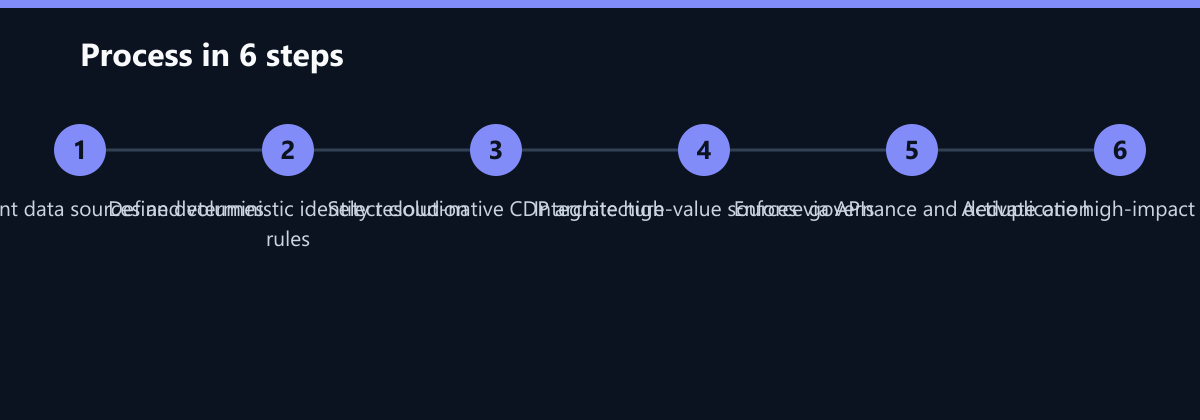
- Data Inventory: Document all data sources, volumes, and quality issues.
- Identity Strategy: Define primary keys and matching rules for B2B context.
- Tool Selection: Choose a cloud-native CDP based on integration capabilities and cost.
- Integration Plan: Prioritize high-value sources (CRM, Web) and map fields.
- Governance Framework: Assign a data steward and define deduplication/retention rules.
- Pilot Use Case: Launch one high-impact campaign (e.g., high-intent lead nurturing).
- Monitoring Setup: Configure dashboards for data quality and campaign performance.
- Team Training: Train marketing and sales teams on using the new unified profiles.
- Iterate and Scale: Expand to additional use cases based on pilot results.
- Continuous Improvement: Review KPIs monthly and optimize data flows.