The Starting Point: Rising Costs in a Saturated Market
In the competitive B2B SaaS landscape of the UK, customer acquisition costs have become a primary driver of financial pressure. Our client, a mid-sized B2B SaaS provider based in London with approximately 150 employees, found themselves in a difficult position. Despite robust product-market fit, their marketing efficiency was deteriorating. The core issue was not a lack of traffic, but a lack of relevance. Their generic landing pages failed to resonate with high-intent leads, resulting in a stagnant Customer Acquisition Cost (CAC) of £450 per customer. This figure was unsustainable for their growth targets, particularly as paid channel costs continued to climb.
The problem was structural. The marketing team was using a one-size-fits-all approach for all visitors, regardless of their job role, industry, or stage in the buyer’s journey. A Chief Technology Officer (CTO) landing on the same page as a junior developer saw identical messaging, which failed to address their distinct pain points. This mismatch led to a low average landing page conversion rate of just 2.1%. Furthermore, the marketing team was bogged down by manual workflows, spending hours each week manually segmenting lists and updating copy for new campaigns. This not only slowed down time-to-market for new offers but also increased the risk of human error in data handling.
The Challenges
Before implementing a new solution, we identified three specific hurdles that needed to be overcome to ensure the success of the project:
- Data Fragmentation: Firmographic data was stored in the CRM, while behavioral data (such as page views and content downloads) was siloed in the marketing automation platform. There was no real-time sync between these two systems, making dynamic personalization impossible.
- Lack of Granular Segmentation: Existing segments were too broad (e.g., “All Leads”). The team lacked the infrastructure to create micro-segments based on specific job titles or engagement scores, which are critical for B2B personalization.
- Manual Dependency: The current process relied heavily on manual intervention for list management and copy updates. This created a bottleneck that prevented the marketing team from scaling their efforts or reacting quickly to market changes.
The Tech Stack
To address these challenges, we selected a lightweight, integration-friendly stack that leveraged existing tools rather than introducing heavy new infrastructure.
- Klaviyo: Used as the central hub for email and web personalization, leveraging its advanced segmentation and dynamic content capabilities.
- Existing CRM: The source of truth for firmographic data (company size, industry, revenue).
- API Integration Layer: A custom API connection to sync CRM data with Klaviyo in near real-time.
- A/B Testing Tool: Built-in Klaviyo testing features to validate headline and CTA variants across segments.
Implementation: From Static to Dynamic
The project was designed to be executed in a tight four-week window to minimize disruption to ongoing marketing activities. The strategy focused on integrating Klaviyo with the client’s existing CRM to automate dynamic content delivery. The goal was to build role-specific landing pages triggered by user behavior and firmographic data.
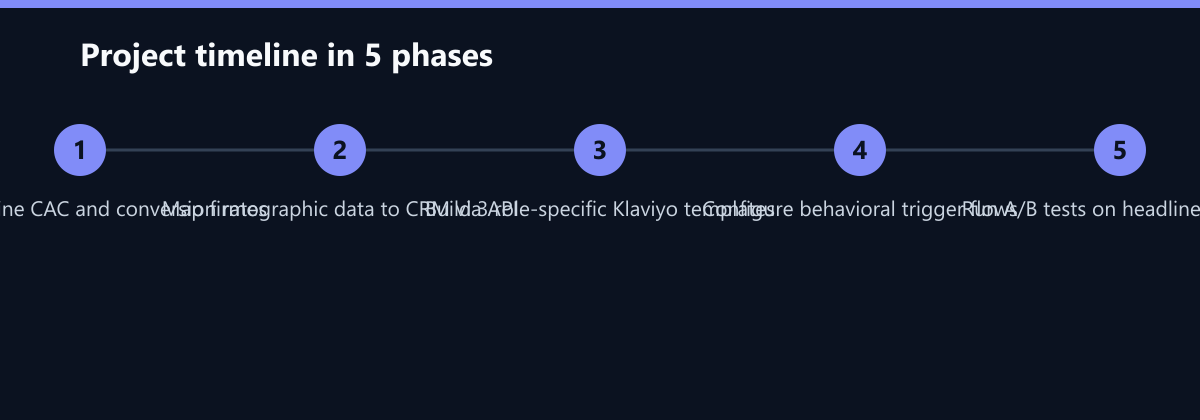
Phase 1: Data Integration and Mapping (Week 1)
The first step was establishing a reliable data pipeline. We connected Klaviyo to the CRM via API to sync firmographic data. This included fields such as company size, industry, and job title. Simultaneously, we mapped behavioral data points, such as content downloads and webinar attendance, to ensure that the system could understand not just who the lead was, but how they were engaging with the brand. This foundation was critical; without accurate data sync, any personalization would be based on guesswork.
Phase 2: Segmentation Logic and Template Design (Weeks 2-3)
With the data flowing, we created dynamic segments in Klaviyo. Instead of broad categories, we built granular segments based on job title (e.g., CTO vs. Developer) and engagement score. We then designed three distinct landing page templates using Klaviyo’s email builder, extended to web forms and embedded snippets. Each template utilized dynamic merge tags to insert the lead’s company name and specific industry challenges directly into the copy. For example, a CTO from a fintech company would see messaging focused on security and scalability, while a developer from a retail firm would see messaging focused on integration ease and developer experience.
Phase 3: Automated Journeys and A/B Testing (Week 4)
The final phase involved setting up triggered flows. We configured the system to redirect high-intent leads to their personalized page immediately after a key action, such as downloading a whitepaper or attending a webinar. This ensured that the user was served the right message at the exact moment of highest intent. During this week, we also ran A/B tests on headline variants for the top three segments to fine-tune the messaging before full rollout.
How We Measured It
To ensure the success of the implementation, we defined clear KPIs and measurement methods before the project began.
- CAC Calculation: We tracked the total marketing spend (paid ads, tools, labor) divided by the number of new customers acquired. This was measured monthly to account for seasonal variations.
- Conversion Rate: We monitored the percentage of visitors to personalized landing pages who completed the desired action (e.g., booking a demo). This was measured using UTM parameters to distinguish between personalized and generic traffic.
- Lead Quality (SQLs): We worked with the sales team to define what constituted a Sales-Qualified Lead (SQL). We tracked the volume of SQLs generated from personalized campaigns compared to the baseline. This required close collaboration with the sales team to ensure consistent qualification criteria.
- Time to Close: We measured the average number of days from lead creation to closed-won deal. This was tracked in the CRM to isolate the impact of the personalization on the sales cycle.
The Outcomes
After six months of live operation, the personalized approach significantly improved funnel efficiency. The system automatically served the right message to the right person, reducing friction in the sales cycle. The results were not just incremental; they were transformative for the client’s marketing efficiency.
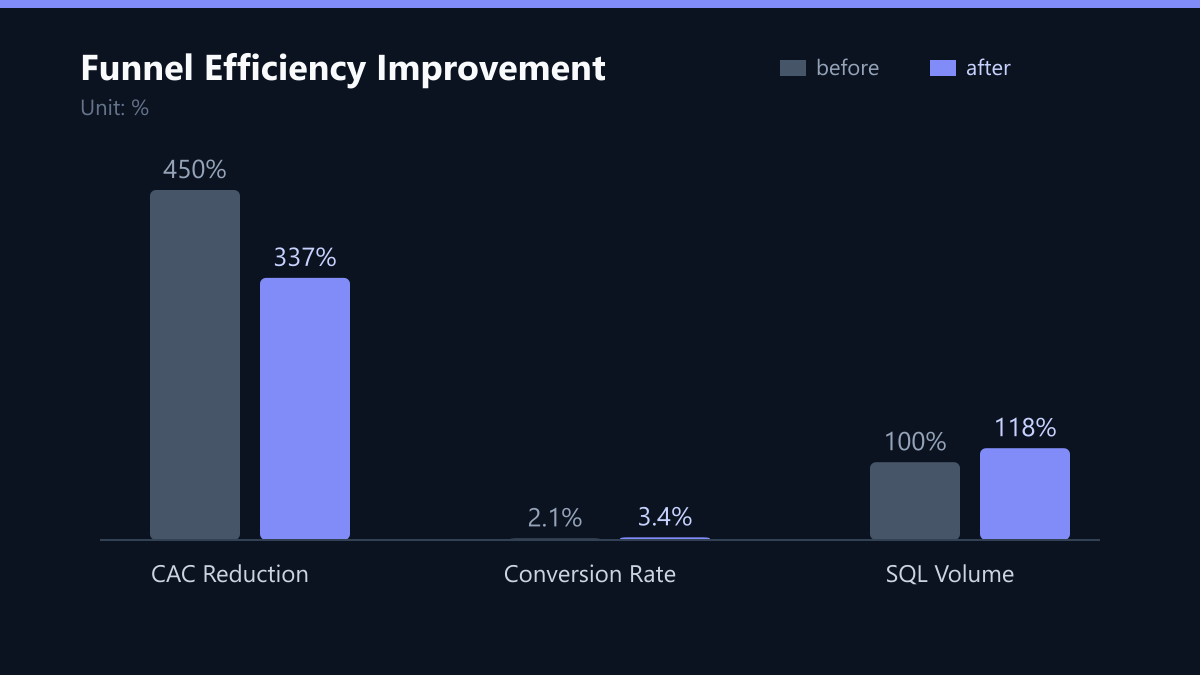
- CAC Reduction: The Customer Acquisition Cost dropped from £450 to £337, representing a 25% decrease. This allowed the client to scale their paid channels without blowing their budget.
- Conversion Rate Increase: The landing page conversion rate increased from 2.1% to 3.4% on targeted pages. This +62% improvement meant that the same traffic volume generated significantly more leads.
- Lead Quality Improvement: Sales-qualified leads (SQLs) rose by 18%. The personalized content acted as a filter, attracting high-intent buyers and repelling low-intent traffic earlier in the funnel. This meant the sales team spent less time on unqualified leads and more time on deals with high potential.
- Faster Sales Cycle: The average time to close was shortened by 12 days. Because the initial interaction was highly relevant, prospects felt understood and moved through the sales process more quickly.
| Metric | Before | After | Change |
|---|---|---|---|
| CAC | £450 | £337 | -25% |
| Conv. Rate | 2.1% | 3.4% | +62% |
| SQL Volume | Baseline | +18% | Growth |
| Time to Close | Baseline | -12 days | Faster |
Lessons Learned and What We Would Do Differently
The success of this project hinged on the granularity of the segments created in Klaviyo. It is not enough to have dynamic content; the segments must be precise enough to match the specific pain points of the buyer.
- Role-Specific Copy Matters: We found that technical decision-makers responded to data-heavy, feature-focused copy, while executives preferred ROI-focused, outcome-driven messaging. Generic copy failed to resonate with either group.
- Speed is Critical: The automated redirect to the personalized page within seconds of the trigger action was crucial for maintaining user intent. Any delay in serving the personalized content would have reduced its impact.
- Continuous Testing: We initially underestimated the need for continuous testing. The first set of headlines was good, but not perfect. Monthly A/B tests on dynamic elements kept the conversion rate climbing, preventing optimization plateaus.
If we were to do this project again, we would focus more on data hygiene in the early stages. Some of the firmographic data in the CRM was incomplete or outdated, which required manual cleanup before the segments could be fully effective. We would also invest more time in sales alignment from the start, ensuring that the sales team was on board with the new lead qualification criteria before the project went live. This would have reduced the friction in measuring lead quality and ensured a smoother transition for the sales team.
This case study demonstrates that CRO in B2B SaaS is not just about UI tweaks or button colors. It is about aligning infrastructure and content with the specific needs of your buyer personas. By leveraging data and automation, you can create a personalized experience at scale, driving down costs and increasing revenue.